
Key Takeaways
- Short tail keywords are search phrases with one to three words and high monthly search volume, typically 10,000 or more.
- They have broad intent, high competition, and low conversion rates.
- They are best used for brand awareness and topical authority, not as your first ranking target.
- New sites should build authority through long tail first, then move toward short tail as domain strength grows.
Most beginners hear “go after high-volume keywords” and immediately start targeting terms like “shoes,” “marketing,” or “SEO.” Then they wonder why, six months later, nothing has moved. Short tail keywords get more search volume than almost anything else in your niche. They also have the highest competition, the lowest conversion rates, and the least clear intent of any keyword type. That is not a reason to ignore them. It is a reason to understand them properly before you touch them.
Short tail keywords sit at the top of every keyword research spreadsheet. They look attractive because the numbers are big. But volume without context is just noise. “Shoes” gets searched millions of times per month. Some of those searches are from buyers. Some are from students writing a history report on footwear. Some are from kids who just like the word. Knowing what short tail keywords are, how they behave in Google, and when they actually belong in your strategy is the difference between chasing traffic and building it.
In this guide, I will walk you through what short tail keywords are, how they compare to long tail, where they fit in a real SEO strategy, and how to actually use them without burning six months on pages that will never rank.
What Are Short Tail Keywords and Why Do They Matter?
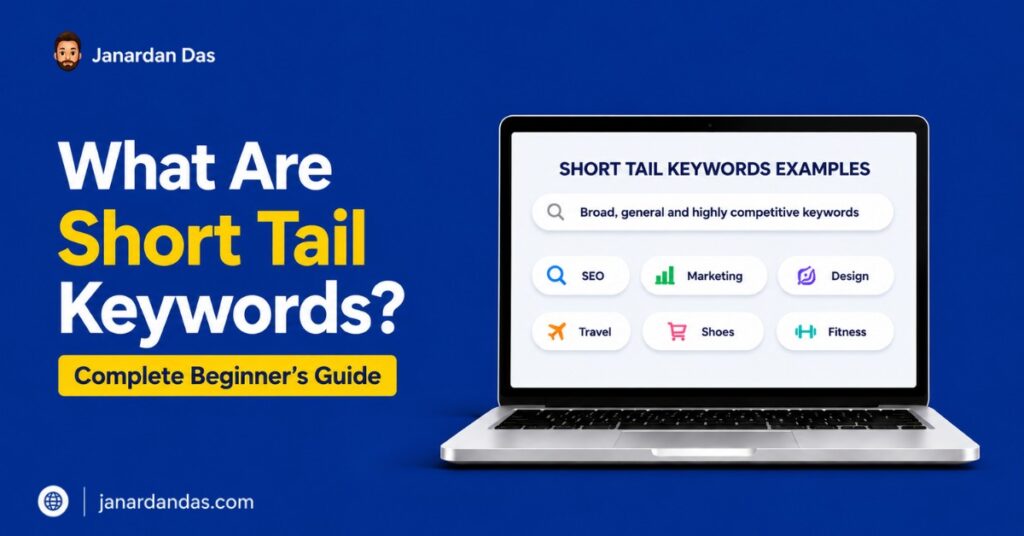
Short tail keywords are search queries made up of one to three words that typically generate high search volume, usually above 10,000 monthly searches. They are broad by nature and cover entire topics rather than specific questions. Examples include “coffee,” “SEO tools,” “running shoes,” and “email marketing.” They represent the widest lens a user can point at a topic before narrowing it down.
The reason short tail keywords matter is the same reason they are dangerous: they sit at the beginning of the search funnel. When someone types “coffee” into Google, they might want to buy beans, find a nearby cafe, read about caffeine, or learn how espresso is made. Google has to make educated guesses about what to show. The pages that win these keywords are usually brands with massive authority, Wikipedia, or publications with hundreds of topically relevant articles backing them up.
Despite the difficulty, short tail keywords matter for three reasons. First, they define topical territory. If your website is about SEO, ranking for “SEO” or “SEO tools” signals to Google that you own this space. Second, they drive the highest raw traffic volumes when you do rank. A move from position four to position one on a 50,000-monthly-search keyword can mean tens of thousands of additional visitors. Third, they anchor your content cluster strategy. Every piece of long tail content you write should support a short tail target at the cluster’s center.
The mistake is treating them as first targets rather than earned destinations.
Short Tail Keywords vs Long Tail Keywords: What’s the Difference?
Short tail keywords and long tail keywords differ in length, specificity, volume, competition, and intent. Understanding how they compare helps you deploy each one correctly.
Length and Specificity
Short tail keywords are one to three words: “protein powder,” “link building,” “CRM software.” Long tail keywords are three to seven words, often phrased as questions or specific scenarios: “best protein powder for women over 40,” “link building strategies for new websites,” “CRM software for small e-commerce businesses.”
The longer the query, the more specific the intent. Specificity is what makes long tail keywords convert better, despite having lower search volume.
Search Volume
Short tail keywords dominate in raw volume. A term like “SEO” generates millions of monthly searches globally. A term like “how to do SEO for a local bakery” might get 50 searches per month. That gap sounds like an obvious win for short tail, but the conversion math tells a different story.
Competition and Keyword Difficulty
In Ahrefs Keywords Explorer, keyword difficulty (KD) scores for most short tail terms sit between 60 and 90 out of 100. These are terms dominated by sites with Domain Ratings above 70. If your site is new or has a DR below 40, ranking for these terms is not a 6-month project. It is a multi-year project, if achievable at all, without a serious link building effort behind it.
Long tail keywords routinely score KD below 20. A new site can rank on page one in 60 to 90 days with a single well-written article and a handful of solid backlinks.
User Intent
Short tail keywords carry mixed or ambiguous intent. Long tail keywords almost always carry clear intent. “Running shoes” could mean anything. “Best running shoes for flat feet under $100” tells you exactly who you are writing for and what they want to find.
I have seen pages targeting precise long tail terms outperform general short tail pages in conversions by 3 to 5 times, even with a fraction of the traffic. The reason is simple: the reader who found the long tail page already knows what they want.
When to Use Each
Use long tail keywords when your site is new, when you need to demonstrate topical authority, or when you are targeting buyers at the decision stage. Use short tail keywords when you have built enough domain authority to compete, when you are writing pillar content meant to anchor a content cluster, or when brand awareness is the goal.
How Short Tail Keywords Work in SEO Strategy
Short tail keywords are not standalone targets. They work as anchors for content clusters, which is how Google now evaluates topical authority.
The Content Cluster Model
A content cluster is a group of related articles all interconnected through internal links. The pillar page sits at the center and targets the short tail keyword. Cluster pages surround it, each targeting a specific long tail variant of the core topic.
If you are building a site about email marketing, your pillar page targets “email marketing.” Cluster pages target “email marketing for small businesses,” “how to build an email list,” “email open rate benchmarks,” and so on. Every cluster page links back to the pillar. The pillar links out to each cluster page.
Google crawls this structure and interprets it as: this site has covered email marketing from multiple angles. It knows the topic. As the cluster pages begin ranking, they pass authority back to the pillar, lifting its chances of ranking for the short tail term over time.
This is how you earn short tail rankings rather than simply chasing them.
Domain Authority and Timing
Targeting a short tail keyword before you have the domain authority to compete for it is not just ineffective, it is a distraction. You are creating content that will sit on page seven or eight, collect zero clicks, and contribute nothing to your traffic, while you could have been ranking for long tail terms and actually growing.
I use a rule of thumb based on Ahrefs Domain Rating: below DR 30, stay under KD 20. Between DR 30 and 50, you can push into KD 20 to 40. Above DR 50, short tail keywords in the KD 40 to 60 range become realistic targets with solid content and a few good links behind the page.
If you are unsure where your site stands on this curve, an SEO audit is the clearest way to find out where your authority gaps are before you build your keyword targets.
Optimizing a Page for a Short Tail Keyword
When you write a pillar page targeting a short tail keyword, the structure has to do more work than a typical blog post.
Cover the full topic. If your page targets “email marketing,” it cannot just explain what email marketing is. It needs sections on strategy, platforms, metrics, list building, automation, and segmentation. Not exhaustively, but enough to show Google the breadth of your understanding. The cluster pages fill in the depth.
Use the short tail keyword naturally in: the H1, the first paragraph, at least two H2 subheadings, the meta title, the meta description, and the URL slug. Beyond that, let it appear naturally. Keyword stuffing a short tail term does not work, and it hurts readability.
Target featured snippets deliberately. Short tail keywords frequently trigger featured snippets, especially when phrased as questions nearby (“what is email marketing,” “how does email marketing work”). Write a clean two to three-sentence answer directly below the question heading. Google pulls these answers directly into the snippet box.
How to Find the Right Short Tail Keywords for Your Site
Finding short tail keywords is not the challenge. Finding the ones worth targeting at your current stage of growth is the skill.
Start With Your Core Topic
Your site has a theme. If you sell accounting software, your top-level short tail keyword is probably “accounting software.” If you run a digital marketing blog, it might be “digital marketing” or a more specific derivative like “content marketing.” List the three to five terms that, if you ranked for them, would define your site’s authority in your space.
These are your eventual short tail targets. They are not your starting point. They are your destination.
Use Ahrefs or Semrush for Volume and Difficulty Data
In Ahrefs Keywords Explorer, type your broad topic and filter for search volume above 5,000 and keyword difficulty below your site’s current ceiling. Look at what comes up. These are the short tail terms adjacent to your core topic that might be reachable sooner.
In Semrush, the same exercise is available under the Keyword Magic Tool. Set a broad match filter, sort by volume, and apply a KD ceiling. Export the list and sort by the volume-to-difficulty ratio. High volume, lower difficulty terms rise to the top.
Pay attention to the SERP analysis. If the first page is dominated by Wikipedia, Reddit, Forbes, and HubSpot, that is a signal the term is out of reach for now. If you see smaller niche sites ranking alongside major brands, that is an opening.
Look at What Your Competitors Already Rank For
In Ahrefs, run a competitor’s domain through Site Explorer. Go to Organic Keywords. Filter for positions one to five and volume above 1,000. The short tail terms they rank for tell you two things: what is possible in your niche, and what you need to build toward.
If a competitor with a DR of 55 ranks for a short tail keyword, you know that same keyword is achievable once your site reaches a similar authority level. Reverse-engineer their content cluster and build a better version.
Map Short Tail Keywords to Your Cluster Architecture
Every short tail keyword you identify should have a cluster plan before you write a word. Map out five to ten long tail variants that you can build cluster articles around. If you cannot find enough long tail support topics, the short tail term may be too narrow to justify a cluster, or it is a term better owned through a product page than a blog post.
This mapping exercise also tells you how much content production the short tail target actually requires. Some short tail keywords need eight to twelve cluster articles before the pillar has enough internal support to compete. Others need three or four. Knowing this upfront prevents you from writing a pillar page in isolation and wondering why it never moves.
Common Mistakes to Avoid With Short Tail Keywords
Knowing what short tail keywords are is half the battle. The other half is knowing where beginners go wrong when they start using them.
Targeting Short Tail Keywords Too Early
The most common mistake. A new site with forty pages and a DR of 18 creates a pillar page targeting “project management software.” It gets zero traffic for eight months, the founder gets frustrated, and the whole project stalls. The problem was not the content. The problem was the sequence.
Build your long tail base first. Get the cluster pages ranking. Let the internal link structure do its job. Then the pillar page has something to stand on.
Writing Pillar Pages That Are Too Thin
A short tail keyword pillar page needs depth. A 700-word page targeting “digital marketing” will not compete with Hubspot’s 5,000-word resource. I am not saying every pillar needs to be 5,000 words. I am saying it needs to be comprehensive enough to genuinely cover the topic. Let the question “would a reader who only read this page have a complete picture of the topic?” guide the length.
If you are running a content strategy for a client and their pillar pages are thin, this is usually the first thing I flag in an SEO consulting review. A weak pillar page breaks the entire cluster.
Ignoring Search Intent
Short tail keywords have mixed intent, but you still need to make a call. If the SERP for your short tail term is dominated by listicles, you need a listicle. If it is dominated by tool comparison pages, you need a comparison page. If it is dominated by definitions and guides, write a guide.
Matching search intent is not optional. A long-form guide targeting a term where Google is serving product pages will not rank, no matter how good the writing is.
Treating All Short Tail Keywords the Same
“Coffee” and “Ahrefs” are both short tail keywords. One has completely mixed intent and is dominated by brands with billion-dollar valuations. The other has branded intent and is completely owned by one company. Neither is realistic for a new site to target. But the error in strategy for each is completely different.
Always SERP-check every keyword before you build a content plan around it. Volume and KD scores tell part of the story. What is actually ranking on page one tells the rest.
Conclusion
Short tail keywords are not the enemy of a new site. They are just the wrong first move. Every serious SEO strategy is eventually built around owning short tail terms in its niche, because that is what topical authority actually looks like at scale. The path to getting there runs through long tail content, content clusters, and earned domain authority, not through publishing one pillar page and hoping Google notices.
Start by identifying the three to five short tail keywords that define your site’s territory. Build your cluster content around them. Let the long tail pages rank first, pass authority upward, and give the pillar something to stand on. Then, when your DR and internal link structure are ready, push the pillar hard. That sequence works. Skipping steps does not.
Pick one short tail target today. Map out the cluster. Start with the long tail content. That is the move.
Frequently Asked Questions
What are short tail keywords?
Short tail keywords are search queries containing one to three words with high monthly search volume, typically above 10,000 searches per month. They are broad in nature and cover entire topics rather than specific questions. Examples include “SEO,” “running shoes,” and “email marketing.” They have high competition because many sites target the same terms, and they carry mixed search intent because the same query can mean different things to different users.
What is the difference between short tail and long tail keywords?
Short tail keywords are one to three words, high volume, high competition, and broad in intent. Long tail keywords are three to seven words, lower volume, lower competition, and highly specific in intent. Long tail keywords convert better because the user has a clearer goal. Short tail keywords drive more total traffic when you rank, but ranking for them requires significant domain authority and a well-developed content cluster behind the page.
Are short tail keywords harder to rank for?
Yes. Short tail keywords consistently have high keyword difficulty scores in tools like Ahrefs and Semrush, often in the 60 to 90 range out of 100. Pages on page one for these terms are usually from high-authority domains that have been earning backlinks for years. New or mid-authority sites should build topical authority through long tail content first before competing for short tail rankings.
Should beginners target short tail keywords?
Not as first targets. Beginners should start with long tail keywords that have low competition, demonstrate expertise through cluster content, and build domain authority over time. Short tail keywords become realistic targets after a site has a content base of 30 to 50 relevant pages, a Domain Rating above 30 to 40 (depending on the niche), and consistent backlink growth.
How many short tail keywords should I target?
There is no magic number, but a focused approach works better than a broad one. Most sites should have three to seven core short tail targets that anchor their main content clusters. These are the terms that define what your site is about. Everything else in your keyword strategy serves those core targets by building topical authority around them through long tail content.
What is an example of a short tail keyword?
Examples of short tail keywords include: “SEO,” “coffee maker,” “weight loss,” “email marketing,” “CRM software,” and “running shoes.” Each is one to three words, covers a broad topic, and generates substantial monthly search volume. They are general enough that many different types of pages could theoretically satisfy the query.
Can short tail keywords drive conversions?
Rarely at high rates. Short tail keywords attract users at the top of the funnel who are still in awareness mode, not decision mode. Conversion rates for short tail traffic are typically much lower than for long tail. A page targeting “email marketing” might convert at 0.5%. A page targeting “best email marketing tools for Shopify stores” might convert at 3 to 5%. Use short tail pages for awareness, then guide users deeper into the funnel through internal links to product, service, or comparison pages.
How do I find good short tail keywords for my site?
Use Ahrefs Keywords Explorer or Semrush Keyword Magic Tool. Start with your core topic and filter for search volume above 5,000. Check keyword difficulty and compare it against your site’s current Domain Rating. Then SERP-check every candidate keyword to see what types of content rank on page one. The goal is to find short tail terms you can realistically compete for within 12 to 18 months, then build a content cluster strategy to support the pillar page.
Do short tail keywords belong in meta titles and descriptions?
Yes, when they fit naturally. The primary keyword for a page should appear in the meta title and meta description. For a short tail pillar page, this means the core term is in the title (preferably near the front) and in the meta description where it reads naturally to a human user. Forcing it unnaturally hurts click-through rate and sends a low-quality signal.
What happens if I only target short tail keywords and ignore long tail?
You miss the majority of your traffic opportunity and make your site’s growth much slower than it needs to be. Around 70% of all search traffic comes from long tail queries. Sites that only target short tail keywords either rank for almost nothing (if they are too new) or leave enormous traffic on the table (if they have authority but no long tail content). A healthy keyword strategy layers both: long tail for fast wins and cluster depth, short tail for topical authority signals and long-term traffic ceilings.
Is it worth targeting short tail keywords in paid search (PPC)?
It depends on your budget and goals. In paid search, short tail keywords cost more per click because of high competition for the ad slot. Unless you have a broad brand awareness goal and a budget to match, long tail keywords in PPC convert better at lower cost-per-click. Most performance-focused campaigns target longer, higher-intent queries. Short tail PPC spend is usually reserved for large brands building category presence, not performance-first campaigns.