
Key Takeaways
- Keyword research starts with understanding search intent, not search volume. A keyword with 500 monthly searches and the right intent beats a 10,000-volume keyword you cannot rank for.
- Use seed keywords to build out a full list, then filter by Keyword Difficulty (KD) and Traffic Potential, not volume alone.
- New and low-authority sites should target keywords with KD below 20 and clear informational or commercial intent.
- Long-tail keywords convert better and are easier to rank for, which makes them the smartest starting point for any site under two years old.
- Competitor gap analysis inside Ahrefs or Semrush is the fastest way to find keywords your site should rank for but does not yet.
- Organize keywords into topic clusters, not isolated pages, to build topical authority that compounds over time.
Most people start keyword research the wrong way. They type a broad term into a tool, grab the ones with the highest search volume, and wonder why they never rank. I’ve seen this pattern across dozens of projects, and it is one of the most predictable ways to waste months of content effort.
Here is the truth: keyword research is not about finding popular search terms. It is about understanding what your target audience is actually trying to accomplish, and then matching your content to that intent better than anyone else currently ranking. When I helped grow a single website to 200K+ monthly organic visitors, keyword research was the foundation every piece of content was built. Not guesswork. Not volume chasing. Structured, intent-driven research that told us exactly what to write, why, and in what order.
This guide walks you through how to do keyword research for SEO from scratch. You will learn how to find the right keywords, evaluate whether you can realistically rank for them, and build a list that actually moves organic traffic rather than just filling a spreadsheet.
What Keyword Research for SEO Actually Means (And Why Most People Get It Wrong)
Keyword research for SEO is the process of finding and evaluating search queries that your target audience types into Google, then deciding which ones to build content around based on their ranking potential and relevance to your site.
The mistake most beginners make is treating keyword research as a one-time volume check. They find a big number, feel confident, publish something, and wait. When nothing ranks, they assume SEO does not work. What actually happened is they skipped the evaluation step entirely.
Volume Is a Vanity Metric Without Context
A keyword with 40,000 monthly searches sounds attractive until you see that every page ranking for it is a domain with an 80+ Domain Rating and five years of backlinks. If your site is new, you are not ranking there. Not because your content is bad, but because the competitive landscape makes it mathematically improbable without significant authority.
The metric that actually matters is Traffic Potential in Ahrefs, not search volume. Traffic Potential shows how much total organic traffic the top-ranking page earns across all the keyword variants it ranks for, not just the primary keyword. A keyword with 2,000 monthly searches and a top-ranking page pulling 15,000 monthly visits tells you the real opportunity. That gap exists because the topic covers many long-tail variants the primary volume number does not capture.
Search Intent Is the Real Ranking Signal
Google’s algorithm has gotten exceptionally good at matching page content to what a searcher actually wants. When someone types “how to do keyword research for SEO,” they want a step-by-step guide, not a product page selling keyword tools. When someone types “best keyword research tool,” they want a comparison, not a definition of what keyword research is.
If your content format does not match the dominant intent behind a keyword, you will not rank, regardless of how well-optimized your page is technically. Intent signals everything: the content type (guide, list, comparison, landing page), the content format (step-by-step, FAQ, definition), and the depth of information required. Search intent analysis is not optional. It is the first thing I check before committing to any keyword.
How to Build Your Initial Keyword List for SEO Research
Every keyword research process starts with seed keywords. A seed keyword is a broad, short-tail term that represents a core topic your site covers. From seeds, you expand outward into hundreds or thousands of keyword variants that form the full content map.
Start With Seed Keywords That Match Your Site’s Core Topics
If you run a project management software company, your seed keywords might be “project management,” “task management,” “team collaboration,” and “productivity software.” You are not trying to rank for these seeds directly. You are using them as inputs to surface the long-tail variants around them that have lower competition and more specific intent.
To find seeds, write down the 5 to 10 topics your site covers. Think about what problems your audience is trying to solve, what products or services you offer, and what questions come up repeatedly in sales calls or support tickets. These are your seeds.
Expand Seeds Using Keyword Research Tools
Once you have your seed list, run it through a keyword research tool. The three I use most often are Ahrefs Keywords Explorer, Semrush Keyword Magic Tool, and Google Keyword Planner.
Ahrefs Keywords Explorer is my default. Type in a seed keyword and look at the “Matching terms,” “Related terms,” and “Questions” tabs. Each one surfaces a different category of variants. Matching terms shows keywords that include your seed phrase. Related terms show semantically connected terms that do not necessarily include the seed word. Questions show search queries phrased as questions, which are strong candidates for featured snippets and People Also Ask placements.
For each seed, export 100 to 200 variants into a spreadsheet. At this stage, do not filter aggressively. Capture everything, then evaluate.
Use Google’s Free Tools to Validate Real Search Behavior
Google Autocomplete is underrated. Type your seed keyword into the search bar and note every suggestion. These are real queries people are searching for, ranked by frequency. They are also search terms Google considers closely related to your seed, which means targeting them helps build topical authority around the parent term.
Google’s People Also Ask boxes work the same way. Click one question and more expand. These are real user intent signals, and they often surface long-tail variations that tool-based research misses. I keep a running list of PAA questions for any topic I am researching. They frequently become H2 or H3 headings inside my content.
How to Evaluate Keyword Difficulty and Ranking Potential
Finding keywords is the easy part. Knowing which ones you can actually rank for is where most beginners stall. This is where keyword evaluation comes in.
Understanding Keyword Difficulty Scores
Keyword Difficulty (KD) in Ahrefs is scored from 0 to 100. It estimates how hard it would be to rank in the top 10 for a keyword, based primarily on the number of referring domains pointing to the pages currently ranking. A KD of 80 means the pages ranking in the top 10 have, on average, a large number of high-quality backlinks pointing to them. A KD of 10 means you could potentially rank with a well-written article and a handful of links.
General guidelines that I work from: sites with low Domain Authority (under 30) should target KD 0 to 20. Sites in the 30 to 50 DA range can compete for KD 20 to 40. Established, high-authority sites can go after 40 to 70 with the right content and link strategy.
These are not absolute rules. I have ranked pages on new sites for KD 30 keywords when the content was significantly better than what was ranking, and the intent match was perfect. But as a filter for building an initial list, KD under 20 is where I start for any site still building authority.
SERP Analysis: The Step Every Beginner Skips
A KD score is an average. The actual competitive landscape for a keyword is revealed in the SERP (Search Engine Results Page) itself. Before committing to any keyword, look at who is currently ranking.
Open the top 5 results and assess: What is the Domain Rating of these sites? Are they large publications, Reddit threads, YouTube videos, or niche sites similar to yours? Are the ranking pages extremely comprehensive or relatively thin? Does the current top result fully satisfy the search intent, or does it leave obvious gaps?
If position 1 is held by Forbes or HubSpot with 1,000 referring domains and a page that covers every angle, you are not displacing them on a new site. If position 1 is a 1,200-word blog post on a domain with DR 25 and the content misses several key subtopics, that is a real opportunity.
SERP analysis is how I identify where the current top results are genuinely weak. Weak content on a lower-authority page is one of the clearest signals that a keyword is winnable. This manual step takes time, but it is the difference between a keyword list that looks good in a spreadsheet and one that actually produces rankings.
Traffic Potential vs. Search Volume: Use the Right Number
I mentioned this briefly above, but it deserves its own section because I see beginners get this wrong constantly. Search volume shows how often a specific phrase is searched. Traffic Potential shows how much traffic you would actually earn if you ranked number one for that keyword, because the top-ranking page typically ranks for dozens or hundreds of related variants simultaneously.
In Ahrefs Keywords Explorer, there is a TP column next to the Volume column. Always look at both. When TP is significantly higher than Volume, the keyword is part of a large topic cluster where a single well-written page can capture a lot of traffic across related searches. When TP is roughly equal to Volume, the keyword is fairly isolated. Both can be valuable, but knowing which type you are targeting shapes how you write the content.
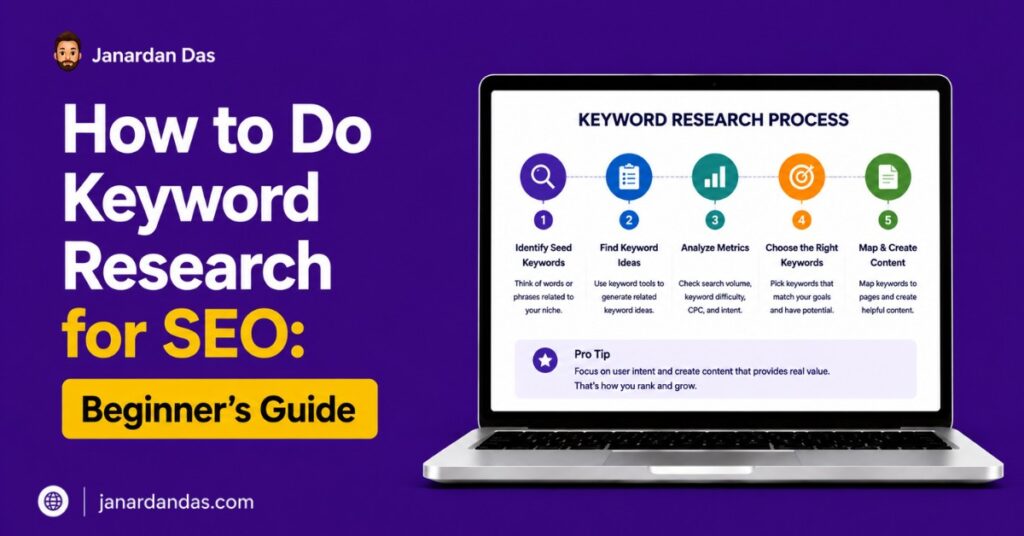
The Keyword Research Process: Step-by-Step Framework
Here is the exact process I follow when doing keyword research for any new site or content expansion project.
Step 1: Define the Site’s Core Topic Pillars
Before opening any tool, identify 4 to 6 topic pillars. These are the broad subject areas your site will build authority around. For an eCommerce SEO consultant, those might be: eCommerce SEO strategy, product page optimization, technical SEO for Shopify, link building for online stores, and category page SEO.
Every keyword you target should fall under one of these pillars. This is how you build topical authority, which is Google’s way of determining whether a site is a credible, comprehensive source on a subject. A site that covers five topics deeply ranks better than a site that touches thirty topics superficially.
Step 2: Generate 200 to 500 Keyword Variants Per Pillar
Use Ahrefs Keywords Explorer or Semrush for this. For each pillar topic, run the seed through the Matching Terms, Related Terms, and Questions tabs. Export everything into a master spreadsheet with columns for: keyword, search volume, Traffic Potential, KD, and intent (informational, commercial, navigational, transactional).
Do not worry about filtering yet. Capture broadly at this stage.
Step 3: Filter by KD and Intent Match
Apply your KD filter based on your site’s current authority. For sites under 30 DR, filter to KD 0 to 20 first. You can have a secondary tab for KD 20 to 40 keywords to revisit as your authority grows.
Then filter by intent. For a content-driven SEO strategy, focus on informational and commercial investigation keywords first. Informational keywords (how to, what is, guide, tutorial) build organic traffic and topical authority. Commercial investigation keywords (best, top, vs, review, alternatives) capture readers closer to a purchase decision.
Step 4: Run Competitor Gap Analysis
Go to Ahrefs Site Explorer and enter your top 3 to 5 competitors. Use the Content Gap tool to find keywords they rank for that your site does not. This is one of the fastest ways to discover proven keyword opportunities because if a competitor is ranking, you know the keyword drives traffic and your audience finds it relevant.
Filter the gap results by KD and volume using the same criteria as above. The keywords that appear across multiple competitors are especially valuable, because they signal high topic relevance regardless of which angle each competitor took.
If you want a more structured approach to this, it is something I work through directly in SEO consulting engagements, where competitor gap analysis informs the entire first-year content roadmap.
Step 5: Group Keywords Into Topic Clusters
Do not treat each keyword as an individual page. Group related keywords around a central pillar page. The pillar page targets the broad, higher-volume parent keyword. Supporting cluster pages target the more specific, long-tail variants.
For example, the pillar page might target “keyword research for SEO.” The cluster pages target “how to find long-tail keywords,” “keyword difficulty explained,” “how to use Ahrefs for keyword research,” “keyword research for eCommerce,” and “how to check keyword search volume.” All cluster pages link back to the pillar page and vice versa. This structure signals to Google that your site is a comprehensive resource on the topic, which is exactly how topical authority compounds.
Step 6: Prioritize the List and Build a Publishing Calendar
Not everything on your keyword list should go live at once. Prioritize based on three criteria: business relevance (does this keyword attract your target buyer?), ranking speed (low KD keywords with clear intent gaps can rank faster), and content effort (some keywords require 3,000 words and a custom tool, others need 1,200 well-structured words).
Sequence low-competition keywords first to build momentum and initial organic traffic. As your domain authority grows from links and traffic signals, gradually attack higher-KD keywords. This is not impatience management. It is how compound growth in organic search actually works.
Common Keyword Research Mistakes That Kill SEO Results
Understanding how to do keyword research for SEO is not just about following the right steps. It is equally about avoiding the wrong ones. These are the keyword research mistakes I see most often, and they show up even on sites that have been doing SEO for years.
Targeting Keywords That Are Too Broad Too Early
“Digital marketing,” “SEO,” “email marketing.” Every new site wants to rank for terms like these. None of them will, at least not for years without an enormous link building investment. Broad keywords are dominated by media companies, platforms, and sites that have spent a decade building authority. Targeting them early is how sites burn through publishing budgets without a single ranking to show for it.
Start narrow and specific. “How to do keyword research for a new blog” is a real keyword, has addressable competition, and drives traffic from a specific audience at a specific point in their journey. Own the specific first. The broad terms follow from building topical authority through the specifics, not the other way around.
Ignoring Search Intent and Just Matching Keywords
I have seen pages that are technically well-optimized, include the keyword in all the right places, have good backlinks, and still do not rank. The reason, almost every time, is an intent mismatch. The page is a product landing page targeting a keyword where every top result is an informational guide. Google will not rank a sales page when the SERP tells you searchers want an educational resource.
Before writing a single word, look at the top 5 results for your target keyword. What is the content type? What is the format? What level of detail do they go into? Your page needs to match and exceed what is there on all three dimensions.
Building a Keyword List Without Considering the Full Funnel
Keyword research for SEO covers the entire buyer journey, not just one stage of it. Informational keywords (what is, how to, guide) attract readers at the awareness stage. Commercial investigation keywords (best, top, vs, alternatives) attract readers evaluating options. Transactional keywords (buy, hire, get started, pricing) attract readers ready to act.
A site that only targets informational keywords builds traffic but misses conversion opportunities. A site that only targets transactional keywords struggles to rank because it has no topical authority from broader coverage. The goal is a balanced mix across all three funnel stages, weighted toward where your audience spends the most time before making a decision.
Conclusion
Keyword research for SEO comes down to finding the intersection of three things: what your audience is searching for, what your site can realistically rank for given its current authority, and what content format will satisfy the intent behind each search. Get all three right, and you have a keyword strategy that produces compound organic growth. Get one wrong, and you are publishing content that might be excellent but will not rank.
Start with seeds, expand into variants, filter ruthlessly by KD and intent, analyze the actual SERPs, and build topic clusters rather than isolated pages. That process is repeatable, scalable, and works for sites at every stage of growth. The first clear action from this guide: open Ahrefs or Semrush today, run your top seed keyword through the tool, and find three low-KD, high-intent keywords you can rank for within the next 90 days. Start there.
Frequently Asked Questions
What is keyword research in SEO?
Keyword research in SEO is the process of identifying the search terms your target audience uses in search engines, then evaluating those terms for their ranking potential, search intent, and relevance to your site. It forms the foundation of any SEO content strategy because it determines which topics to cover, in what depth, and in what format. Without structured keyword research, you are producing content without knowing whether there is an audience searching for it.
How do I start keyword research as a beginner?
Start by writing down the 5 to 10 core topics your site or business covers. These become your seed keywords. Run each seed through a tool like Ahrefs Keywords Explorer or Google Keyword Planner to surface hundreds of related keyword variants. Filter those variants by Keyword Difficulty (stay below 20 if your site is new), check the search intent by looking at what currently ranks, and prioritize keywords with lower competition and clear topic gaps you can fill with better content.
Which keyword research tool is best for beginners?
Ahrefs Keywords Explorer is the most complete tool for keyword research, with accurate Keyword Difficulty scores, Traffic Potential data, and SERP analysis all in one place. Semrush Keyword Magic Tool is a strong alternative with a similar feature set. For budget-conscious beginners, Google Keyword Planner is free and gives volume ranges, and Google Search Console (once your site has data) shows you what keywords you are already receiving impressions for. I use Ahrefs as my primary tool for all client work because the data quality is consistently better for competitive analysis.
What is search intent, and why does it matter for keyword research?
Search intent is the underlying goal behind a search query. It determines what type of content Google will rank for a given keyword. There are four main types: informational (the user wants to learn something), navigational (the user wants to find a specific site), commercial investigation (the user is researching before a purchase), and transactional (the user is ready to buy or take action). If your content type does not match the dominant intent for a keyword, you will not rank, regardless of how optimized your page is technically. Checking the top 5 results for any keyword before writing reveals exactly what Google considers the right format and depth.
What is a good keyword difficulty score to target?
For new sites with low domain authority (under 30 DR), target keywords with a Keyword Difficulty of 0 to 20 in Ahrefs. For mid-authority sites (DR 30 to 50), KD 20 to 40 is realistic with solid content and some link building. Established sites with strong authority can target KD 40 to 70. High-KD keywords (70 and above) are generally dominated by large media brands and require significant link investment to rank for. The KD score is an average, so always supplement it with a manual SERP analysis to see who is actually ranking and how strong their individual pages are.
How many keywords should I target per page?
One primary keyword per page, plus 5 to 10 related secondary keywords naturally woven throughout the content. Google ranks pages, not keywords in isolation, but your content should be primarily structured around one main topic. Secondary keywords help the page appear in related searches without creating a diluted, unfocused article. The goal is to write a page that thoroughly answers the primary search query and, in doing so, naturally uses the language and subtopics a searcher would expect to see covered.
What is the difference between short-tail and long-tail keywords?
Short-tail keywords are broad, typically 1 to 2 words, with high search volume and high competition. Examples: “SEO,” “keyword research,” “link building.” Long-tail keywords are more specific, usually 3 or more words, with lower volume and significantly less competition. Examples: “how to do keyword research for a new blog,” “best free keyword research tools for beginners.” Long-tail keywords convert better because they capture users with more specific intent, and they are easier to rank for because fewer sites have targeted them with dedicated content. For sites still building authority, long-tail keywords are where most of the ranking wins will come from.
How often should I do keyword research?
Keyword research is not a one-time task. Run a full keyword research session when you launch a new site or content initiative, every quarter to find new opportunities and track which keywords you have already covered, and whenever you create a new content cluster or expand into a new topic pillar. Additionally, Google Search Console shows which queries your existing pages are receiving impressions for, which often surfaces new keyword opportunities you did not target initially. Reviewing that data monthly helps you find quick wins, such as pages ranking on page 2 that could move to page 1 with additional content or link building.
Is keyword research different for eCommerce sites?
The principles are the same, but the keyword types and funnel weighting shift. eCommerce sites focus heavily on product-level keywords (branded and unbranded), category page keywords, and commercial investigation keywords like “best,” “top,” and “vs.” Informational content still matters for topical authority and top-of-funnel traffic, but the primary conversion-driving keywords are category and product terms. eCommerce keyword research also requires understanding high-purchase-intent modifiers like “buy online,” “free shipping,” “discount,” and specific product attributes (size, color, model). This is an area I specialize in across Shopify and WooCommerce projects, where the gap between a well-structured keyword map and a poorly organized one is measured in hundreds of thousands of dollars in organic revenue.
Can I do keyword research without paid tools?
Yes, though it is slower and less precise. Google Keyword Planner gives volume ranges for free. Google Autocomplete and People Also Ask reveal real search behavior without any tool. Google Search Console shows the queries your existing pages already rank for. Keyword Surfer (a free Chrome extension) shows volume data directly in search results. Ubersuggest offers a limited free version. The limitation of free tools is that they do not give accurate Keyword Difficulty scores, SERP-level analysis, or Traffic Potential data, which are the three metrics that make keyword evaluation reliable. If you are serious about SEO, a paid tool subscription is one of the highest-ROI investments you can make. For sites at an early stage with a tight budget, starting with free tools and upgrading once the first revenue comes in is a reasonable approach.
How do I know if a keyword is too competitive for my site?
Look at the Keyword Difficulty score in Ahrefs or Semrush, then do a manual SERP check. If the top 5 results are from sites with DR 70 and above, each with hundreds of referring domains pointing to the specific ranking page, and the content is thorough and recently updated, that keyword is out of reach for a new or low-authority site right now. The clearest signal a keyword is winnable: at least 2 to 3 results in the top 10 from sites with DR below 50, where the ranking pages have fewer than 50 referring domains and the content leaves obvious gaps in depth or format. Those are the keywords worth prioritizing.