
Key Summary:
- Long-tail keywords are specific search phrases (usually 3+ words) with lower search volume but higher conversion intent and lower keyword difficulty.
- They make up an estimated 70% of all search queries, which means most of your rankable traffic opportunity lives there, not in head terms.
- Tools like Ahrefs, Semrush, and Google Search Console are the most reliable ways to find long-tail keyword opportunities at scale.
- One long-tail keyword can anchor an entire page, but you can also cluster multiple long-tail variants around a single topic to cover it completely.
- The biggest mistake is targeting long-tail keywords with zero buyer or action intent; match keyword intent before you write a single word.
Most SEO beginners chase the same high-volume keywords that every authority site already dominates. The result is predictable: months of work, zero rankings, and a traffic graph that looks flat.
Long-tail keywords are the smarter play. They are the specific, longer search phrases that individually get fewer searches but collectively make up the majority of all search queries on Google. In my experience growing sites from zero to 150K+ monthly visitors, long-tail keywords have been responsible for a larger share of that traffic than any single “big” keyword ever was.
This post covers exactly what long-tail keywords are, why they work, how to find them with real tools, and how to turn them into content that actually ranks and converts.
What Long-Tail Keywords Actually Are (Beyond the Definition)
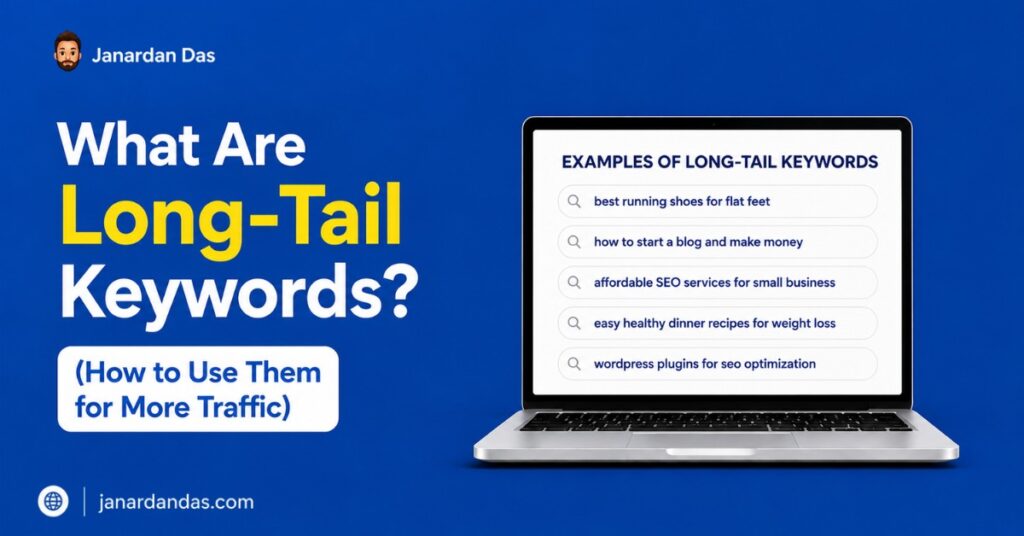
Long-tail keywords are search phrases that are highly specific, typically three or more words long, and target a narrow slice of search intent. A head keyword like “running shoes” gets hundreds of thousands of searches per month. A long-tail version like “best running shoes for flat feet under $100” gets far fewer, but the person typing that phrase knows exactly what they want.
The term comes from the “long tail” of a demand curve. In any market, a small number of products (or keywords) account for a large share of demand, and a massive number of niche items account for the rest. That “rest” is the long tail, and in SEO, it is huge.
What Makes a Keyword “Long-Tail”
There is no fixed word count that automatically makes something long-tail. The defining characteristics are:
Specificity: Long-tail keywords narrow down a topic with qualifiers such as location, price range, use case, product type, comparison, or problem. “Email marketing software” is a head term. “Email marketing software for Shopify stores with abandoned cart automation” is long-tail.
Lower search volume: Most long-tail keywords get between 10 and 1,000 searches per month. This sounds discouraging until you realize the same site can rank for thousands of these simultaneously.
Higher purchase or action intent: When someone types seven words into a search bar, they are not casually browsing. They are usually close to a decision. A Backlinko study found that long-tail keywords convert at 2.5x the rate of head terms. I have seen this play out across multiple client sites where long-tail traffic drove most of the form fills and sales.
Lower keyword difficulty: High-volume head terms have KD (Keyword Difficulty) scores in the 60 to 90 range on Ahrefs. Most long-tail keywords sit below 20, which means a site with even modest domain authority can rank with well-written, properly structured content.
Long-Tail Keywords vs. Short-Tail Keywords: The Real Difference
Short-tail (or “head”) keywords are broad, high-volume, highly competitive terms: “SEO,” “laptops,” “content marketing.” Long-tail keywords are specific, lower-volume, and easier to rank for.
The trade-off is not traffic volume vs. competition. It is reach vs. relevance. Head terms attract large, undefined audiences. Long-tail terms attract smaller, highly specific audiences who are much more likely to take action on what you are offering.
For a new site or one with a low Domain Rating (under 40 on Ahrefs), head terms are essentially unreachable for the first year or two. Long-tail keywords are where you build your traffic foundation, establish topical authority, and eventually earn the links and authority that let you compete for harder terms later.
Why Long-Tail Keywords Drive More Traffic Than Most People Expect
This is the part most SEO guides skip over, and it is worth understanding properly because it changes how you think about your entire content strategy.
The 70% Rule of Search Demand
Ahrefs and Semrush internal data both consistently show that roughly 70% of all search queries are long-tail. Some estimates place this higher. That means if you are only targeting head terms, you are competing for access to 30% of total search volume while ignoring the other 70%.
More importantly, those 70% of queries are often underserved. A head term like “SEO tips” has thousands of pages competing for it. A query like “SEO tips for B2B SaaS with long sales cycles” might have three decent pages written about it. If your site serves B2B SaaS companies, which keyword do you think drives better leads?
Topical Authority Compounds Long-Tail Rankings
When you consistently publish high-quality content targeting related long-tail keywords in a niche, Google starts recognizing your site as a topical authority on that subject. That authority then makes it easier to rank for new long-tail keywords in the same cluster, and eventually for the harder head terms at the center of your topic.
I have seen this play out on client sites: after publishing 20 to 30 well-researched long-tail articles on a specific topic, rankings for mid-tail and head terms in the same cluster started improving without any additional effort on those pages. The site had earned its authority through depth.
Long-Tail Keywords and Featured Snippets
Google frequently pulls featured snippets from pages targeting long-tail question-based keywords. When someone types “how do I set up SPF records for Gmail in 2026,” a page that answers that specific question thoroughly will often win the snippet. Featured snippets drive significantly higher click-through rates than regular organic positions.
Question-format long-tail keywords (how, why, what, when, which) are particularly good snippet targets because they invite the kind of structured, direct-answer writing that Google’s systems reward.
How to Find Long-Tail Keywords: 6 Methods That Work
Finding the right long-tail keywords is not guesswork. Each method below returns different types of long-tail data, so using more than one gives you a broader, better picture.
Method 1: Ahrefs Keywords Explorer
Ahrefs is my preferred tool for long-tail keyword research because of its filters. Here is the specific workflow I use:
Open Keywords Explorer, type in a seed keyword (broad topic you want to cover), then apply these filters:
- KD (Keyword Difficulty): 0 to 20
- Volume: 50 to 1,000
- Word count: 4 or more words
This returns a list of specific, low-competition, realistic-volume long-tail keywords. Sort by Traffic Potential rather than volume, because Traffic Potential accounts for all the keywords a page ranking for that term would also rank for.
The “Questions” tab inside Keywords Explorer is also worth checking. It surfaces long-tail queries formatted as questions, which are ideal for FAQ sections and featured snippet targeting.
Method 2: Google Search Console (Free and Underrated)
If your site already has some traffic, Google Search Console is one of the best long-tail keyword sources you have, and most people do not mine it properly.
Go to Performance, then the Queries tab, and sort by Impressions. Look for queries where you have impressions but a low average position (12 to 30). Those are long-tail keywords Google is already showing your site for, but you are not ranking well enough to get clicks.
These represent existing content that needs optimization, not new content you need to write. Updating those pages with better on-page structure, more depth on the specific subtopic, and proper use of the long-tail phrase can move you from page 2 to page 1 in a matter of weeks.
Method 3: Semrush Keyword Magic Tool
Semrush’s Keyword Magic Tool lets you start with a seed keyword and filter for long-tail variations by word count, KD, and intent (informational, navigational, commercial, transactional). The intent filter is useful because it lets you separate research-stage queries from purchase-ready ones, so you can match your content type to the right stage of the funnel.
Set the KD filter to “Easy” (0 to 29) and filter for 4+ word phrases. Export the list, sort by search volume, and work through the top 50 to 100 keywords to identify topical clusters you can build content around.
Method 4: Google Autocomplete and People Also Ask
Free, fast, and often overlooked. Type your seed keyword into Google and observe the autocomplete suggestions. Each suggestion is a real query real people typed. Long-tail variations appear naturally in autocomplete because Google is surfacing the most common completions.
People Also Ask (PAA) boxes are another source. Click through PAA questions and observe how new ones load dynamically. Spend 5 minutes clicking through PAA on 3 or 4 seed keywords and you can generate 20+ long-tail ideas with clear question-format intent.
Tools like AlsoAsked.com automate this process and visualize the PAA structure in a map you can export.
Method 5: Reddit and Quora
The problem with keyword tools is they only show you what people type into search engines. Reddit and Quora show you what people actually want to know, in their own language, with the context and nuance included.
Search Reddit for your topic and look for threads with high engagement. The specific question in a thread title is often a direct long-tail keyword. The replies reveal related sub-questions you can answer in the same article.
Quora works similarly. Search for your topic and sort by most recent or most viewed. Questions phrased in natural language often map directly to long-tail keywords with real search demand.
Method 6: Competitor Content Gaps via Ahrefs
Go into Ahrefs Site Explorer, enter a competing site’s domain, click on “Top Pages,” and look at which long-tail keywords drive traffic to their top-performing articles. You can also use the Content Gap tool: enter your domain and 2 to 3 competitor domains, and Ahrefs returns keywords competitors rank for that you do not.
This is one of the fastest ways to find validated long-tail opportunities because someone has already done the work of ranking for them. Your job is to build a better, more thorough page.
How to Use Long-Tail Keywords in Your Content (The Right Way)
Finding keywords is only half the job. How you use them determines whether you actually rank.
One Page, One Primary Long-Tail Keyword
Every page on your site should have a single primary long-tail keyword that defines its topic and intent. This is the keyword your title, H1, URL slug, meta description, and intro paragraph should all align with.
You can and should use related long-tail variants throughout the body, but the primary keyword sets the focus. A page trying to rank for six different long-tail keywords simultaneously usually ranks for none of them well.
Match the Intent Before You Write a Word
Search intent is the most important thing to verify before writing any content targeting a long-tail keyword.
Type the keyword into Google. Look at the top 5 results. Are they blog posts? Product pages? Comparison articles? Tool listicles? That is what Google considers the right format for that intent. If you write a 3,000-word informational guide for a keyword where Google is serving product pages, you are not going to rank, regardless of how good the content is.
Long-tail keywords split across four intent types:
- Informational: “how to fix keyword cannibalization” (wants a tutorial or guide)
- Commercial: “best keyword research tools for small blogs” (wants a comparison or listicle)
- Transactional: “buy Ahrefs subscription annual plan” (wants a pricing or sign-up page)
- Navigational: “Ahrefs login page” (wants to go directly somewhere)
Know which type you are targeting and build the right page for it.
Use Long-Tail Keywords in H2 and H3 Headings
Google parses heading structure to understand what a page covers. When a long-tail keyword or a close variant appears in an H2, it signals that the page specifically addresses that topic.
For example, if your article is about keyword research and one of your long-tail targets is “how to do keyword research without a paid tool,” that phrase or a close rewrite of it should appear in one of your H2 or H3 headings, not just in the body text.
Build Keyword Clusters, Not Isolated Pages
A single page targeting one long-tail keyword is fine. A cluster of 5 to 10 pages all targeting related long-tail keywords in the same topic area, all interlinked with clear hierarchical structure, is what builds topical authority.
For example, if your main topic is “email marketing for eCommerce,” your cluster might include:
- Main pillar page: “Email Marketing for eCommerce: The Complete Guide”
- Supporting cluster pages: “how to set up abandoned cart emails in Klaviyo,” “best email marketing segmentation strategies for Shopify,” “email open rate benchmarks for eCommerce brands,” “how to A/B test email subject lines”
Each of those cluster pages targets a specific long-tail keyword. Together, they tell Google your site has depth and authority on the whole subject.
Include Long-Tail Keywords in Meta Descriptions and Title Tags
While meta descriptions are not a direct ranking factor, they influence click-through rates, which are a ranking signal. When a user’s exact search query appears in your meta description, Google bolds it in the SERP result, which makes your listing stand out.
Use the long-tail keyword naturally in your title tag (ideally near the front) and in the meta description. Keep title tags under 60 characters and meta descriptions between 150 and 160 characters.
Common Long-Tail Keyword Mistakes That Kill Your Rankings
Knowing what to avoid saves you months of wasted effort.
Targeting long-tail keywords with no search volume. A keyword with 0 searches per month is not a long-tail keyword, it is just a phrase you made up. Use Ahrefs or Semrush to confirm monthly search volume before building content around a term.
Ignoring keyword difficulty on long-tail terms. Most long-tail keywords are easy to rank for, but not all. Check KD before targeting. A long-tail keyword with KD 45 is not the opportunity it looks like on the surface.
Writing thin content for long-tail keywords. A 400-word page will not rank for a long-tail keyword with genuine search intent behind it. Google’s quality thresholds still apply. A page targeting “how to fix duplicate meta descriptions in WordPress” needs to actually solve that problem in full, including the common edge cases.
Keyword stuffing long-tail phrases. Long-tail keywords, by nature, are specific phrases. Repeating them verbatim throughout a page reads unnaturally and can trigger over-optimization signals. Use the phrase naturally 2 to 3 times and rely on semantic variations for the rest.
Not updating pages after ranking. A page that ranks on page 2 for a long-tail keyword is not a failure; it is unfinished work. Add more depth, improve the structure, target a featured snippet, and build a few internal links to that page from related content. Position 2 to 3 is often reachable with on-page improvements alone.
Frequently Asked Questions
What is a long-tail keyword example?
A long-tail keyword is a specific, multi-word search phrase with lower volume and higher intent. For example, “running shoes” is a head term. “Best lightweight running shoes for marathon training on roads” is a long-tail keyword. It is specific, targets a defined audience, and signals that the searcher has a clear goal in mind.
How many words make a keyword long-tail?
There is no strict rule, but long-tail keywords are typically 3 or more words. What defines them is specificity and intent, not word count alone. A 4-word phrase that is still broad (“best SEO tools 2026”) behaves more like a head term than a long-tail keyword because of its volume and competition level.
Are long-tail keywords easier to rank for?
Generally yes. Long-tail keywords have lower keyword difficulty scores because fewer sites target them specifically. Ahrefs data shows that most long-tail keywords have KD scores below 20, meaning even newer sites can rank with well-written, properly structured content, without needing hundreds of backlinks.
How do I find long-tail keywords for free?
Google Autocomplete, People Also Ask boxes, and Google Search Console are all free sources. Type a seed keyword into Google and observe the autocomplete suggestions and PAA questions. If your site already has traffic, check Search Console for queries with impressions but low average positions, since those are long-tail keywords you are nearly ranking for already.
How many long-tail keywords should I target per page?
Target one primary long-tail keyword per page. Use 5 to 10 related long-tail variants naturally throughout the content to build relevance and cover the topic thoroughly. Trying to rank one page for too many distinct long-tail terms with different intents usually results in ranking for none of them well.
What is the difference between long-tail keywords and LSI keywords?
Long-tail keywords are specific search phrases with defined intent and search volume. LSI (Latent Semantic Indexing) keywords are semantically related terms that signal topic relevance to search engines. For example, if your page is about “email marketing,” LSI keywords might include “subscriber list,” “open rate,” “click-through rate,” and “autoresponder.” They are not the same thing, though both belong in a well-optimized page.
Can long-tail keywords help with voice search?
Yes. Voice search queries tend to be longer and more conversational than typed queries, which means they closely resemble long-tail keyword patterns. A page targeting “what is the best time to send marketing emails” is naturally well-positioned for voice search because the phrasing matches how people speak into a phone or smart speaker.