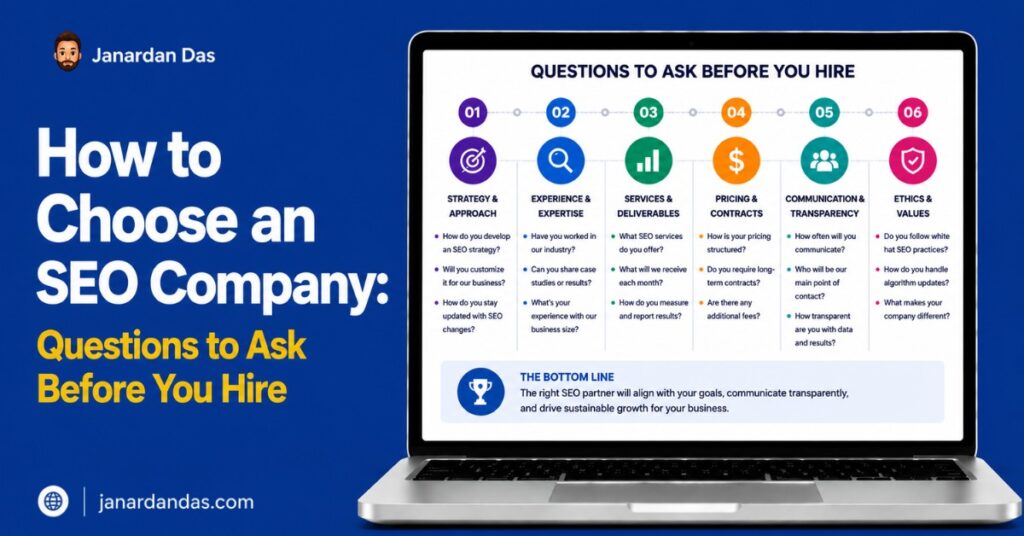

Key Takeaways
- Most SEO agencies sound credible before you hire them — the questions you ask before signing separate real expertise from rehearsed sales pitches.
- Ask for specific examples of results in your industry, not general case studies with impressive-looking graphs.
- Any agency that cannot explain their link building approach in concrete terms is a risk to your domain.
- Guaranteed rankings, overnight timelines, and vague “proprietary methods” are signals to exit the conversation.
- A good agency sets realistic expectations, asks about your business model, and tells you what they will not do, not just what they will.
- The right SEO partner should feel like a strategic hire, not a vendor transaction.
Most businesses choose their SEO company the same way they choose a contractor on a marketplace: look at the reviews, get three quotes, go with whoever sounds most confident. Then, six months later, they have a handful of keyword rankings nobody is searching, a backlink profile full of links from unrelated blogs, and a monthly report full of vanity metrics that do not connect to anything that makes the business money.
The problem is not that SEO is hard to buy. The problem is that almost everyone selling SEO sounds good before the contract is signed. Agencies know what you want to hear: “we’ll get you to page one,” “guaranteed results,” “our proprietary system.” None of that tells you whether they have actually done this for a business like yours.
Knowing how to choose an SEO company comes down to asking the right questions and knowing what a good answer sounds like versus a rehearsed one. After seven years running SEO campaigns across ecommerce, B2B SaaS, and service businesses, I have been on both sides of this conversation. I know what separates agencies worth hiring from the ones that will burn six months of your budget before you figure out they had no idea what they were doing. This article gives you nine specific questions to ask, what to listen for in each answer, and the signals to watch before you sign anything.
Why Choosing the Wrong SEO Company Costs More Than Just Money
When an SEO campaign goes wrong, the damage is rarely just financial. The more expensive problem is domain damage that takes years to undo.
Bad link building is the most common culprit. An agency that builds links from low-quality directories, irrelevant blog networks, or spun guest posts can trigger a manual action from Google or suppress your rankings through accumulated algorithmic signals. Recovering from a link penalty is not a matter of disavowing the bad links and waiting a month. I have seen recoveries take 18 months of sustained effort, including a full SEO audit, disavow files, and a rebuild of the entire link profile from scratch. That is money and time on top of whatever you already paid the agency that caused the problem.
Beyond domain damage, there is the opportunity cost. A twelve-month contract with an agency producing no measurable results is not a neutral outcome. That is twelve months your competitors spent earning rankings you could have had. In competitive industries, ranking gaps close slowly but the compounding nature of organic search means early movers build authority that is increasingly expensive to displace.
There is also the internal trust damage. When leadership invests in SEO and sees nothing, they do not blame the agency. They blame the channel. Getting an organization to reinvest in SEO after one bad experience is harder than the SEO work itself.
None of this means you should avoid SEO agencies. It means the evaluation deserves real rigor, not a twenty-minute discovery call.
How to Choose an SEO Company: 9 Questions That Separate Good Agencies from Bad Ones
These are not generic interview questions. Each one is designed to expose how an agency actually thinks and works, not how well they pitch.
1. Can You Show Me Results in My Industry or Business Model?
This is the first question because it immediately filters out agencies that run the same playbook regardless of context. Ranking a local plumbing company is a different problem from growing organic traffic for a B2B SaaS platform with a two-month sales cycle. The keyword strategy is different, the content architecture is different, the link building targets are different, and the way you measure success is different.
When you ask this question, you are not just looking for a case study with traffic graphs. You are looking for evidence that the agency understands the specific mechanics of your business model. For a SaaS company, that means ranking for bottom-of-funnel commercial terms and building topical authority in a niche vertical. For an ecommerce brand, it means category page optimization, internal linking architecture, and managing crawl budget at scale. For a service business, it means local signals, Google Business Profile, and location-specific landing pages.
A good answer includes a specific client situation (without necessarily naming the client), a description of the initial challenge, what they actually did, and what changed in measurable terms. Traffic numbers, keyword rankings at a specific difficulty level, revenue attribution if they have it.
A bad answer is: “We have worked with a lot of companies in that space and they have all been really happy with us.”
2. What Does Your Link Building Process Look Like Specifically?
This is the question most businesses forget to ask, and it carries the highest downside risk if you skip it. Low-quality link building is the single fastest way to damage a domain. The problem is that every agency will tell you they do “white hat link building.” The term means nothing without specifics.
Push past the talking points. Ask them to describe what a typical link looks like: What domain rating range do they target? What tactics do they use (digital PR, HARO, guest posts, link insertions, niche edits)? How do they vet the sites they target? Do they prospect manually or use a database of pre-arranged placements? How many links do they build per month on average for a client at your budget level?
An agency doing legitimate outreach-based link building will answer these questions with detail and some acknowledgment of how time-consuming the process is. They will tell you their acceptance rate is low. They will know the names of the tools they use (Ahrefs, Pitchbox, Hunter.io, Respona). They will not sound smooth.
An agency running a private blog network or buying bulk placements will get vague. They will say things like “we have relationships with thousands of publishers” or “our network gives us access to high DA placements fast.” That smoothness is a red flag, not a selling point.
3. How Do You Define Success for a Client Like Me?
How an agency defines success tells you almost everything about whether their incentives are aligned with yours. An agency that talks primarily about keyword rankings is optimizing for a metric they control. An agency that talks about organic traffic growth is one level better. An agency that talks about qualified traffic, conversion rates from organic, revenue influenced by SEO, or pipeline generated from organic is operating at the level your business actually needs.
There is a common disconnect in SEO services: an agency can increase your organic traffic by 40% while simultaneously doing your business no favors. If the traffic growth comes from informational keywords that do not attract buyers, you have more sessions and no more revenue. This is not a hypothetical. I have audited sites with impressive traffic charts and almost no organic-attributed revenue.
Ask the agency directly: “If we are six months in and our traffic is up but our leads from organic are flat, how do you think about that?” The answer will tell you whether they are thinking about your business or their dashboard.
4. What Technical SEO Issues Do You Typically Find During an Audit?
You are not testing whether they can recite a list of technical issues. You are testing whether they have actually done this work and whether they think critically about it.
An agency with genuine technical SEO experience will talk about things like crawl budget waste on paginated archives, JavaScript rendering issues preventing Googlebot from indexing dynamic content, duplicate content generated by URL parameters, Core Web Vitals failures on mobile caused by render-blocking resources, or hreflang misconfigurations on international sites. They will talk about the difference between an issue that is a priority and one that can wait.
An agency reading from a checklist will say things like “we look at your site speed, your meta tags, your mobile friendliness, and your XML sitemap.” That is not wrong. It is just the surface of the surface. If that is the depth of their technical vocabulary, you are hiring someone who will run Screaming Frog, export the errors tab, and call it an audit.
5. How Long Before I See Results, and What Happens in the First 90 Days?
This question has two parts. The timeline answer tests their honesty. The 90-day answer tests whether they have a real process.
On timeline: anyone who tells you SEO results take two to three weeks is either lying or about to do something that will hurt you long-term. The honest answer is that meaningful organic traffic growth typically takes four to six months for sites with existing authority, and six to twelve months for newer domains or highly competitive verticals. Early wins on long-tail keywords can come faster, but those are signals of progress, not results.
On the first 90 days: a serious agency should describe exactly what they do and in what order. Typically this looks like a technical audit and fix prioritization in month one, keyword strategy and content gap analysis in month two, and initial content and link building execution beginning in month three. If they cannot tell you what they are doing in the first ninety days with some specificity, they do not have a process. They have a pitch.
6. Who Will Actually Be Working on My Account?
The agency you are evaluating is represented by its best people during the sales process. Those are often not the people who will be executing your campaign.
Ask directly: who is the account lead? What is their experience level? How many accounts does that person manage? Is there an SEO strategist involved or is your account handled entirely by a coordinator? What does the communication and reporting cadence look like?
Agencies with high client-to-strategist ratios (anything above fifteen to twenty active accounts per senior person) are structurally unable to do deep work on any single account. They are running templates and checking boxes, not thinking about your specific competitive landscape.
This is also where the question of whether to hire an agency versus a fractional SEO consultant becomes worth exploring. Fractional arrangements give you senior-level strategic thinking embedded closer to your team at a lower cost than a full agency retainer, with full visibility into who is doing the work.
7. What Happens to the Work If We Stop Working Together?
The answer determines whether the engagement builds lasting assets for your business or whether you are renting access to results that disappear when the contract ends.
Deliverables that should belong to you: content published on your site, technical fixes implemented on your site, links pointing to your domain, keyword strategy documentation, and any reporting dashboards built on your data.
Things that can walk out the door: proprietary tools the agency licenses on your behalf, private channels with strategic context, relationships with publishers the agency manages, and any content hosted on their infrastructure rather than yours.
The risk is highest with agencies that build campaigns entirely inside their own systems and never document the strategy in a transferable format. If you terminate, you get a traffic graph and nothing actionable. A good agency builds campaigns in a way where, if you left tomorrow, your in-house team could pick up the work and continue it.
8. How Do You Stay Current with Algorithm Changes?
You are not looking for them to recite the names of recent Google core updates. You are looking for a real answer about how SEO knowledge actually flows through their organization.
Good answers sound like: “Our senior strategists test hypotheses on our own properties and on a few willing client accounts. We run our own sites where we test changes before implementing them for clients. We read the primary research publications — Ahrefs, Search Engine Land — and we validate against what we see in our own data.”
Bad answers sound like: “We stay up to date on all the latest Google updates and adjust our strategies accordingly.”
The SEO industry has no central textbook. The practitioners who actually know what is happening are running experiments or studying data at scale. An agency that learns about algorithm changes by reading the same blog posts you could read yourself is not giving you any advantage.
9. What Would You NOT Do for a Client in My Industry?
This question is unusual enough that it catches most agencies off guard, which is exactly the point. A competent agency knows where their approach has limits.
Good answers include things like: “We would not pursue aggressive exact-match anchor text ratios in a heavily regulated industry like finance or legal — the downside risk is too high.” Or: “We would not prioritize high-volume informational content for a small ecommerce site with a limited crawl budget — we would focus on transactional pages first.” Or: “We would not attempt to compete on head terms in the first twelve months for a new domain — we would target long-tail clusters and build authority before going after the competitive terms.”
An agency that will not tell you what they will not do is either not thinking critically about your situation or they are telling you whatever you want to hear to close the deal. The ability to say “we would not do that, and here is why” is a sign of expertise, not weakness.
What Green Flags Actually Look Like When You’re Evaluating an SEO Company
Understanding how to choose an SEO company also means recognizing the signals that indicate a genuinely strong partner, not just the absence of red flags.
They ask more questions than they answer in the first call. A serious agency cannot scope a real engagement without understanding your business model, your current organic situation, your top competitors, your conversion funnel, and what internal resources you have available. If the first conversation is mostly them presenting their services, they are treating you as a revenue line, not a client problem to solve.
They have case studies with specific metrics, not just impressive-looking graphs. Traffic graphs stripped of context can mean anything. The best agencies show you before-and-after situations with specific keyword categories, named challenges they solved, and measurable outcomes that connect to business results, not just sessions. Cross-check their claims using Ahrefs or Semrush before the follow-up call.
They have a point of view on your current situation before the engagement starts. Give them your domain before the first call and ask them to take a brief look. An agency worth hiring will come to the meeting with at least two or three specific observations about what they see and what they would prioritize. This costs them fifteen minutes. If they are not willing to do it, you are not a priority.
They are honest about what SEO cannot do. If you need revenue in sixty days, SEO is not the channel. A good agency will tell you that and either refer you elsewhere for short-term tactics or suggest a combined approach. An agency that tells you SEO is the solution to every problem you have is selling, not advising.
The Red Flags Most Businesses Miss When Hiring an SEO Agency
Most people know the obvious ones: guaranteed rankings, overnight results, prices that are suspiciously low. Here are the signals that are easier to miss.
They spend the entire discovery call talking about their process rather than your problem. Process talk sounds organized and professional. But an agency describing their five-step proprietary framework without asking a single question about your business is telling you they have a template, not a strategy. Templates applied to unique problems produce generic results.
Their reporting centers on impressions and clicks without connecting to revenue. Impressions are awareness. Clicks are traffic. Neither means your business grew. If an agency’s sample report does not include keyword intent analysis, conversion rate from organic, or at minimum organic-attributed leads and revenue, their reporting is designed to look good, not to hold themselves accountable.
They use the phrase “we follow Google’s guidelines” as a selling point. Following guidelines is a baseline, not a differentiator. Every legitimate agency does it. When an agency leads with compliance rather than results, they either have no differentiated results to point to or they are managing expectations down in advance.
The account lead they assign you has fewer than two years of experience. Junior SEOs working without close senior oversight will execute tasks but will not make strategic calls specific to your situation. Technical fixes, content briefs, and link outreach done without a senior strategist reviewing the logic behind each decision add up to activity, not strategy.
They cannot tell you what a good month looks like versus a bad one. If you ask “how will we know this is working?” and the answer is vague or centered entirely on trailing metrics you will not see for months, the agency has no leading indicators they are willing to be held to. Good agencies can name early signals specific to your situation: crawl rate improvement, indexed page count growth, average position movement on target terms, domain rating increases from legitimate link acquisition.
How to Make the Final Call When Choosing Between SEO Companies
After running your candidates through the nine questions, you will likely have a clear front-runner and a few you can eliminate. Here is how to close the gap on the final decision.
Compare the strategy, not the proposal. Most agency proposals look similar: technical work, content, link building, reporting. The difference is in the specificity of the strategy. Ask each finalist to walk you through how they would approach your site for the first six months in fifteen minutes. The level of specificity in that conversation is your clearest signal of expertise.
Check references from clients they still work with, not just clients they closed a case study on. It is easy to find happy references from a finished engagement. It is harder to find clients who are still paying and still satisfied twelve to eighteen months in. Ask for both.
Run a small paid discovery engagement if you have the flexibility. Some agencies will do a paid strategy sprint — four to eight weeks of work on a scoped problem (a technical audit, a content gap analysis, a link building pilot) before a full retainer engagement. If their output in a discovery sprint is specific, actionable, and clearly informed by your situation rather than a template, you have answered every question the pitch process left open.
Match the scope of engagement to your stage. A startup with a new domain does not need a ten-person agency with an enterprise retainer. An enterprise brand managing a million-page site with international markets needs a team with the infrastructure to match. You can review the full range of SEO services to understand what structure fits your situation before you have the conversation with an agency.
The most important signal, once you have screened for competence, is whether the agency actually understands what winning looks like for your business — not what winning looks like in SEO terms, but what winning looks like for your revenue, your sales cycle, and your customers.
Conclusion
Choosing an SEO company is a business decision, not a marketing purchase. The agencies that drive real results treat it the same way. They push back on your assumptions, tell you what will not work, ask questions that make you think, and set expectations that do not sound as exciting as “page one rankings guaranteed.” That friction early is a signal. The companies that tell you everything you want to hear before the contract is signed are the ones you will regret hiring.
If you have gone through this process and want a direct assessment of your current SEO situation and what kind of engagement actually fits, get in touch and I will give you an honest read on where you stand.
Frequently Asked Questions
How do I know if an SEO company is legitimate?
A legitimate SEO company will be transparent about their methods, show you specific examples of results in comparable industries, explain their link building process in concrete terms, and give you realistic timelines. They will not guarantee specific rankings, claim to have special access to Google, or use vague language like “proprietary algorithm” to describe their approach. Request references from current clients and verify the results they show you using Ahrefs or Semrush to confirm traffic claims independently.
How much should I pay for SEO services?
SEO pricing varies significantly by scope and provider type. Freelancers typically charge $75 to $200 per hour. Small to mid-size agencies charge $2,000 to $8,000 per month for a standard retainer. Larger or specialist agencies charge $10,000 or more monthly for enterprise-level work. Anything below $500 per month as a retainer is structurally too low to produce meaningful results — at that price point, you are paying for reporting, not execution.
How long does it take to see SEO results?
Most sites begin to see measurable keyword movement within three to four months of a well-executed campaign. Traffic impact from those rankings typically builds over months four through eight. Significant organic revenue impact usually takes six to twelve months, depending on the starting authority of the domain and the competitiveness of the target keywords. For new domains with no existing authority, plan for twelve to eighteen months before organic becomes a primary traffic channel.
What is the difference between an SEO agency and an SEO consultant?
An SEO agency is a team-based service provider, typically offering a range of services (technical SEO, content, link building, reporting) executed by multiple people at different seniority levels. An SEO consultant, or fractional SEO, is typically a senior individual who embeds more directly into your business, provides strategic direction, and either executes directly or works closely with your internal team. Consultants offer more senior involvement at lower cost than a full agency retainer, but with less execution bandwidth.
Can an SEO company guarantee rankings?
No credible SEO company can guarantee specific keyword rankings, because Google’s algorithm is not within anyone’s control. Any agency that guarantees page one rankings or specific traffic numbers is either misrepresenting what is possible, or planning to use tactics (private blog networks, link schemes, doorway pages) that violate Google’s guidelines and create serious long-term risk for your domain.
How do I evaluate an SEO agency’s case studies?
Look for specificity over impressiveness. The best case studies include a description of the starting situation (domain age, authority, competitive landscape), specific tactics applied and why, and measurable outcomes that connect to business metrics, not just sessions. Use Ahrefs or Semrush to verify the traffic trends they show you — you can cross-reference any domain’s organic history independently to confirm the claims are accurate.
Should I hire a local SEO company or does location not matter?
For most SEO work, location does not matter. SEO is primarily remote work and the best practitioners are distributed globally. The exception is if your business needs local SEO specifically (Google Business Profile optimization, local citations, geo-targeted content) and you want someone who deeply understands your local market. For everything else, evaluate expertise and track record over geography.
How do I compare multiple SEO proposals?
Do not compare line items on a proposal document. Give each agency your domain and ask them to walk you through what they see and what they would prioritize in the first ninety days. The depth and accuracy of that conversation is a far better signal of expertise than what is written in a proposal. Also compare the seniority of the person who will actually work your account, not just the person who sold you.
What should be included in an SEO contract?
A sound SEO contract should include a clear description of deliverables (what exactly will be done and at what cadence), ownership terms (all content and links belong to you, not the agency), reporting schedule and what metrics will be reported, contract length and termination terms (avoid contracts longer than twelve months without a 60 to 90-day exit clause), and a clear statement that the agency will not use tactics that violate Google’s guidelines.
How do I know when to fire my SEO company?
If you are six months into an engagement with no measurable keyword movement, no visible technical improvements to your site, no content published, and no transparent reporting on what was done, you have a performance problem worth addressing directly. If their response to that conversation is more reassurance than a specific corrective plan, it is time to evaluate alternatives. Other clear signals: discovering the agency is building links from sites that clearly violate Google’s quality guidelines, receiving reports with inflated vanity metrics but no connection to business outcomes, or losing access to your own data or dashboards when you request it.
What is the average length of an SEO contract?
Most SEO agencies offer three, six, or twelve-month contracts. Six months is the most common starting point, as it gives enough time to see early results before committing to a longer engagement. Be cautious about signing a twelve-month contract before you have seen any deliverables. Twelve-month terms are reasonable for an agency you have already vetted through a shorter engagement. If an agency requires a twelve-month minimum before you have worked together, negotiate a 60 to 90-day exit clause as a baseline protection.