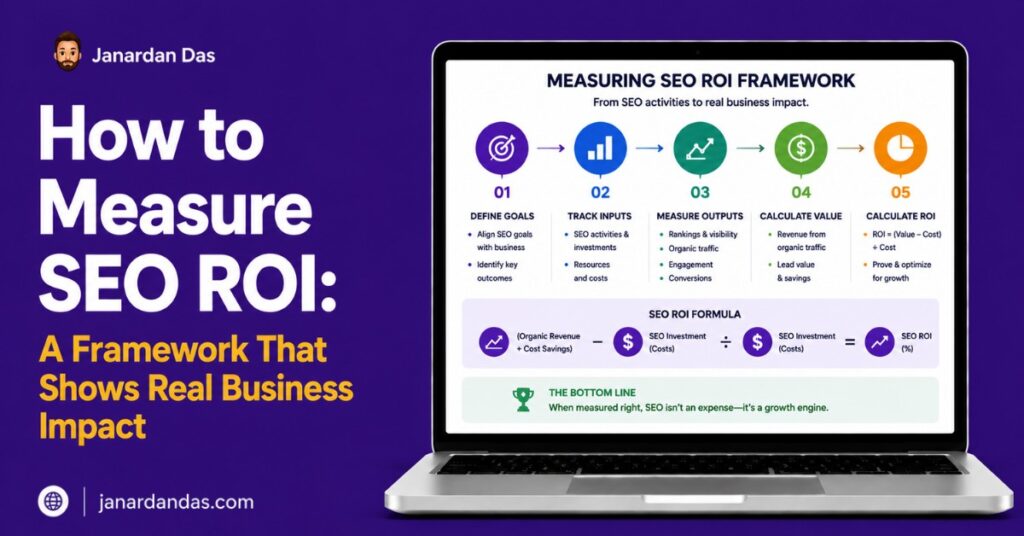

Most SEO reports are built to impress, not to inform. Rankings went up. Traffic increased. Impressions climbed. And somewhere in a boardroom, a decision-maker asks the same question every quarter: "But what did it actually do for the business?"
That question is not a sign of someone who does not get SEO. It is the only question that matters.
If you cannot connect your SEO activity to revenue, pipeline, or qualified demand, you do not have a measurement problem. You have a strategy accountability problem. And no amount of keyword rank tracking will fix it.
Learning how to measure SEO ROI is what separates SEO practitioners who keep their budgets from those who lose them. The framework I use with clients is not complicated. But it requires being honest about what your organic channel is actually producing versus what you are claiming it produces.
This guide walks through the full framework: how to calculate SEO ROI accurately, which metrics actually signal business value, how to attribute conversions correctly, and where most teams go wrong when they try to justify their SEO spend.
TL;DR
- SEO ROI is calculated as (SEO Revenue Gained minus SEO Cost) divided by SEO Cost, multiplied by 100. The hard part is the accurate input, not the formula.
- Traffic and rankings are diagnostic metrics, not ROI metrics. Business impact lives in conversions, pipeline, and revenue.
- Attribution is the biggest challenge in measuring SEO ROI accurately. Last-click models systematically undervalue organic search.
- Tracking SEO value requires setting up goal completions, assigning monetary values to non-ecommerce conversions, and separating branded from non-branded traffic.
- SEO ROI compounds over time. A paid channel stops the moment you stop paying. Organic does not. That time-value distinction belongs in every ROI conversation with stakeholders.
What SEO ROI Actually Measures (and What It Does Not)
SEO ROI measures the return your business gets from investing in organic search. The formula is straightforward:
SEO ROI = ((Revenue from SEO – SEO Investment) / SEO Investment) x 100
If you spent $5,000 per month on SEO and it generated $25,000 in revenue, your ROI is 400%. Clean on paper. Difficult in practice.
The difficulty is not the math. It is knowing what counts as “revenue from SEO” in the first place, and that requires getting honest about a few things.
What Counts as SEO Investment
Your SEO investment includes every dollar that goes into making organic search work. That means agency retainers or freelancer fees, internal team salaries (prorated for SEO-focused work), content production costs, tool subscriptions (Ahrefs, Semrush, Screaming Frog, SurferSEO, and similar tools), and developer time spent on technical SEO fixes.
Most teams count only the agency fee. They leave out the $3,000 per month in content production and the engineering sprint that fixed Core Web Vitals. That makes ROI look better than it is and eventually sets unrealistic expectations for what the channel can sustain.
What Counts as Revenue from SEO
This depends on your business model. For ecommerce, it is transaction revenue attributed to organic sessions. For SaaS and B2B, it is closed revenue from leads that first entered through organic search. For lead gen businesses, it is the pipeline value or conversion value assigned to organic form fills and calls.
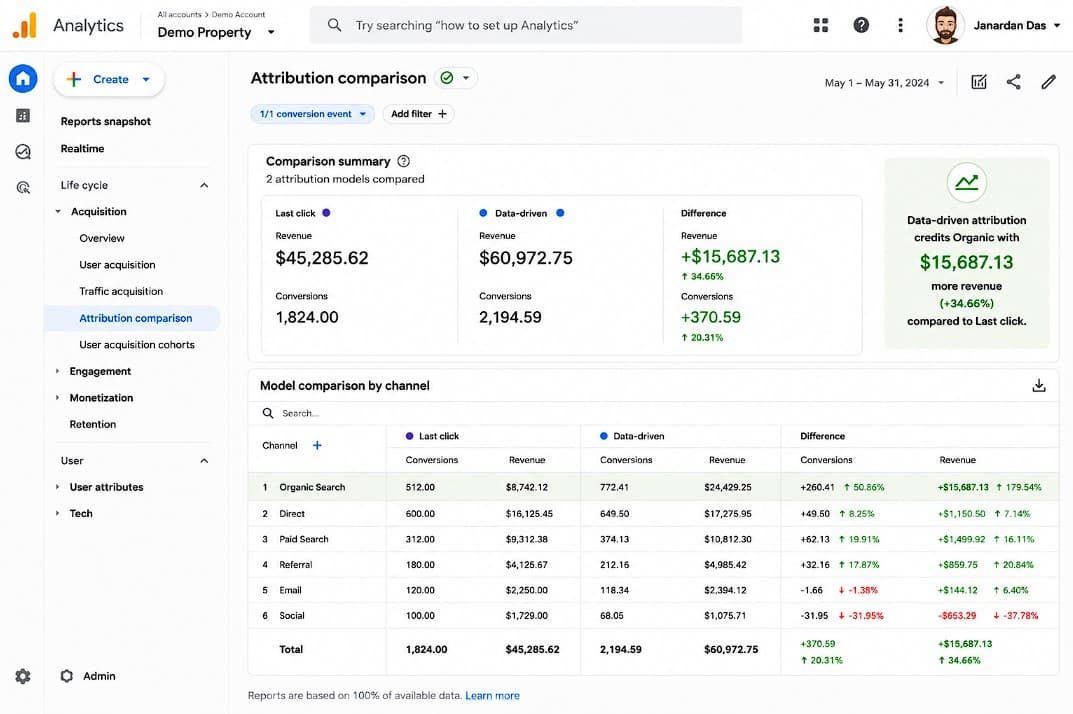
The common mistake is pulling a revenue number from Google Analytics’s organic channel without questioning the attribution model behind it. Default last-click attribution gives organic search zero credit every time a paid ad appeared later in the journey. For most B2B buyers who research for weeks before converting, that number is significantly understated.
How to Calculate SEO ROI With Accurate Attribution
Attribution is where measuring SEO ROI gets hard and where most reports become fiction.
Why Last-Click Attribution Breaks SEO Measurement
Google Analytics 4’s default attribution model is data-driven for conversions and last-click for most standard reports. In practice, a user who finds your site through organic search, leaves, gets retargeted by a paid ad three days later, and then converts gets logged as a paid conversion. SEO gets nothing.
For informational and top-of-funnel content, this happens constantly. A prospect reads your SEO-driven blog post, subscribes to your newsletter two weeks later, and buys after a sales call. Last-click attribution gives the credit to direct or email. The organic touchpoint that started the journey is invisible.
The fix is to stop using last-click as your primary attribution model for SEO value assessment. In GA4, go to Advertising > Attribution > Model Comparison. Compare last-click against data-driven or position-based. The difference in organic channel revenue attribution will often be significant, sometimes double or more.
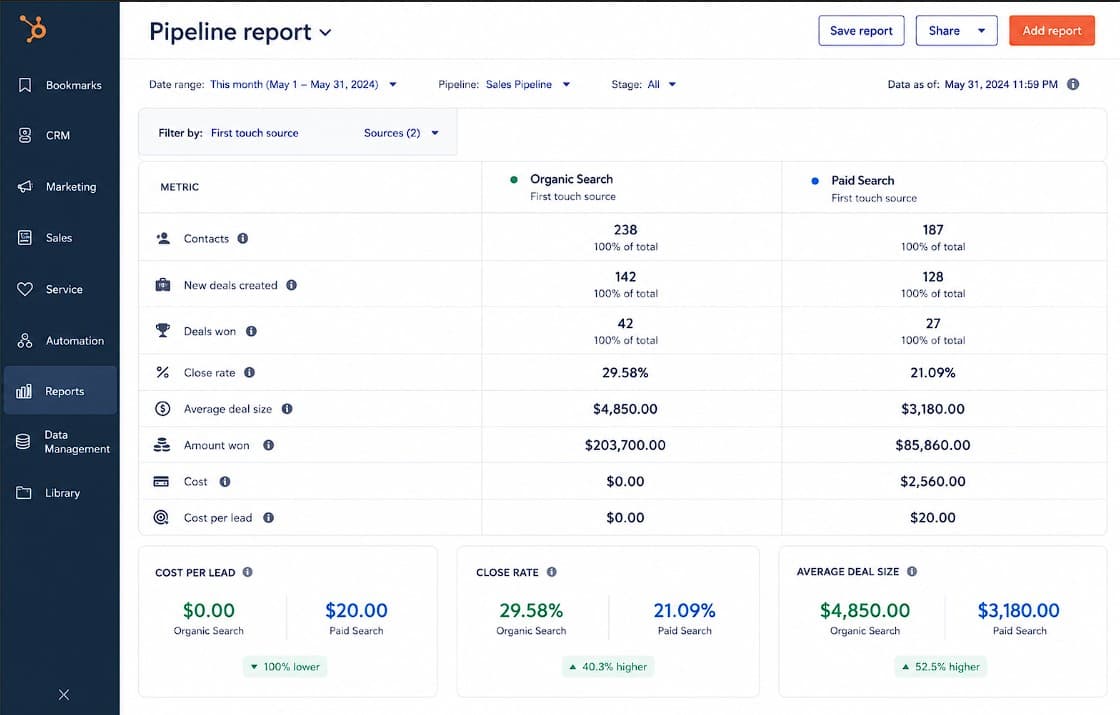
For B2B teams using a CRM, the more accurate approach is first-touch attribution in Salesforce or HubSpot. Pull every closed deal where the first-touch source was organic search. That number is your SEO revenue contribution. It is not perfect either, but it captures what last-click misses entirely.
Assigning Monetary Value to Non-Ecommerce Conversions
If you do not run an ecommerce store, you need to assign a revenue value to every SEO conversion goal. Here is how to do it in practice.
For lead generation: calculate your average lead-to-customer close rate and your average contract value. If you close 20% of leads at an average deal size of $8,000, each lead is worth $1,600. Enter that as the conversion value in GA4 goal settings.
For SaaS free trials: calculate your trial-to-paid conversion rate and multiply by average first-year contract value. If 15% of trials convert at $2,400 per year, each organic trial signup carries a $360 attributed value.
Once every conversion has an assigned monetary value, your SEO ROI calculation has real inputs instead of traffic assumptions.
Separating Branded and Non-Branded Organic Traffic
One more attribution trap: branded searches inflate organic traffic and make SEO look more impactful than it is.
When someone types your company name into Google and lands on your homepage, that session shows up as organic traffic. But that visit was not driven by SEO work. That person already knew you. It came from brand awareness built through other channels.
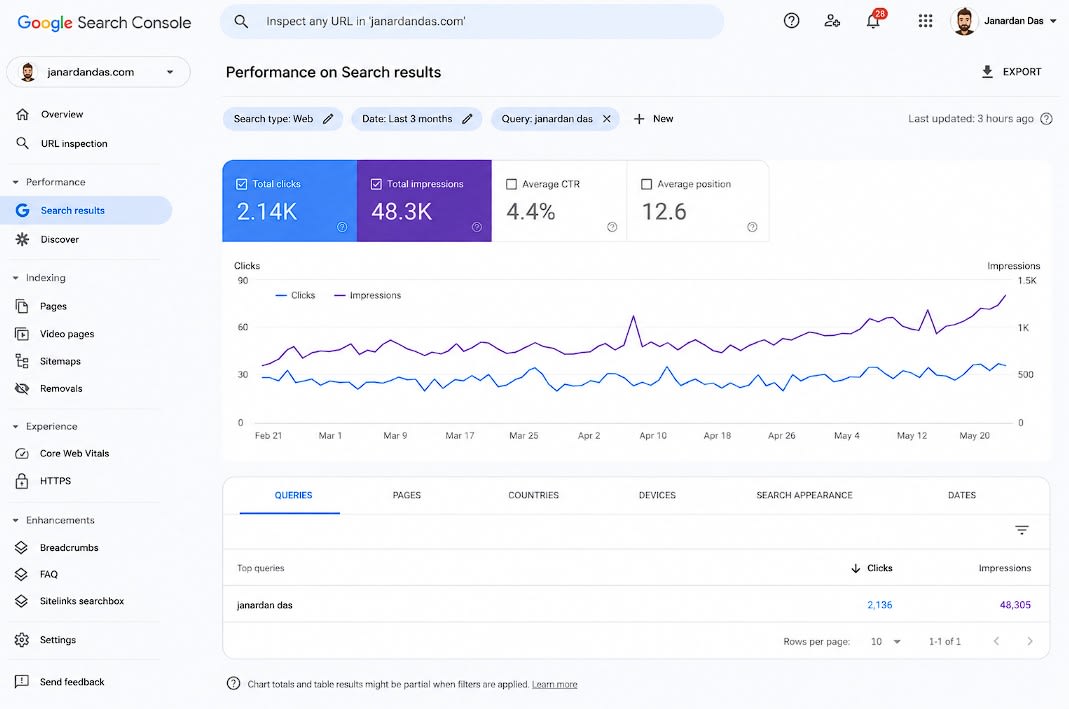
In Google Search Console, go to Performance, filter queries by your brand name and domain variants, and note the click volume. In GA4, create a segment that excludes sessions from branded keyword queries. Measure SEO ROI only against non-branded organic traffic and conversions. This gives you a defensible number that represents actual SEO-driven value.
The SEO Metrics That Actually Signal Business Value
Once attribution is set up correctly, you need to track the right metrics. Not all SEO metrics are ROI metrics. Most of them are diagnostic.
Revenue and Pipeline Metrics (The Ones Stakeholders Care About)
These are the metrics that belong in a boardroom report:
Organic revenue: For ecommerce, this is tracked directly in GA4 ecommerce reports filtered to the organic channel with non-branded sessions. For B2B, it is closed revenue from first-touch or multi-touch organic attribution in your CRM.
Organic pipeline value: In B2B contexts, pipeline matters as much as closed revenue because SEO deals have longer sales cycles. Track every deal currently in-progress where organic was the first or most influential touchpoint. That is SEO’s forward-looking contribution.
Organic conversion rate: Divide organic goal completions by organic sessions. If you are getting 50,000 organic sessions per month and 300 leads, your organic conversion rate is 0.6%. Improving that rate is often as valuable as growing traffic.
Cost per organic lead or acquisition: Divide total SEO investment by total organic conversions. If $6,000 per month in SEO produces 80 leads, your cost per organic lead is $75. Compare that to your paid search CPL. In most industries, organic CPL is a fraction of paid CPL within 12 to 18 months of consistent investment.
Traffic Quality Metrics (The Diagnostic Layer)
These metrics help you understand why revenue metrics are moving, but they are not ROI metrics on their own.
Non-branded organic sessions: This is the number to grow. Stripped of brand traffic, it reflects your actual reach into new demand.
Organic share of total conversions: What percentage of your total leads or revenue comes from organic? If that share is growing, SEO is becoming a more reliable channel for the business.
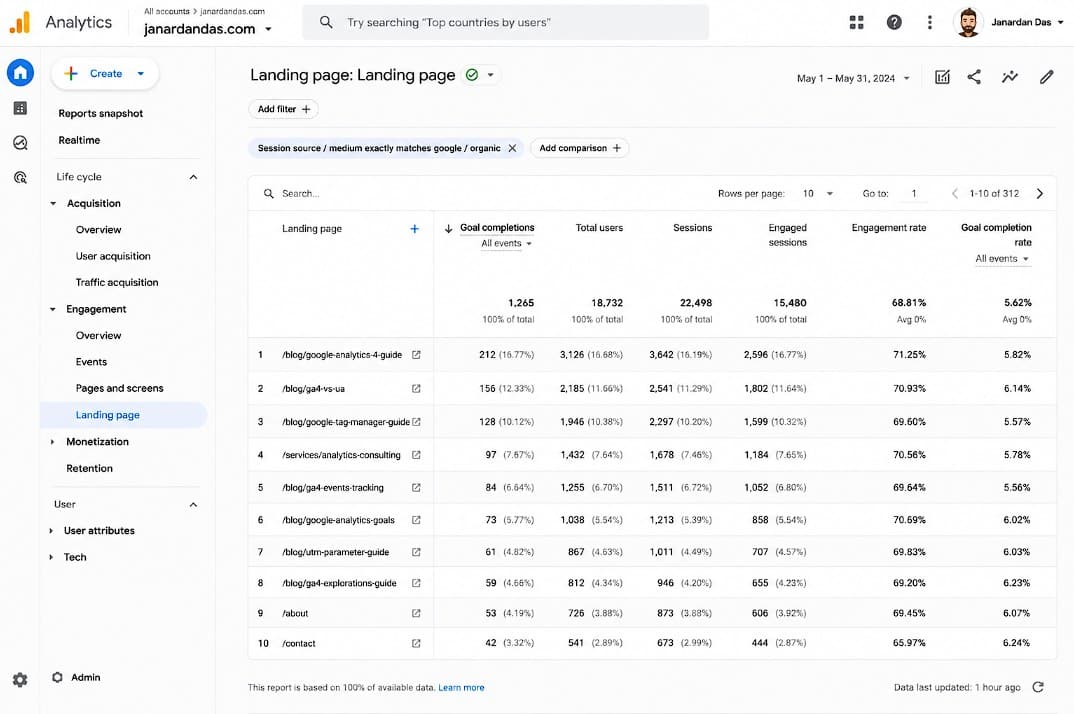
Pages generating organic leads: In GA4, use the Landing Page report filtered to organic/google source/medium, then cross-reference with goal completions. You will find that a small number of pages, often 10 to 20% of your organic content, drives 80 to 90% of organic conversions. That is your highest-ROI content and the model to replicate.
Average session duration and pages per session for organic: Traffic quality indicators. If organic sessions have a 20-second average duration, the traffic does not match the content, or the content is not delivering on what it promised in the SERP.
How to Build an SEO ROI Report That Earns Stakeholder Trust
A technically accurate calculation is not enough if the person reading it does not trust the methodology. Here is how I structure SEO ROI reporting in a way that holds up to scrutiny.
The Monthly SEO ROI Snapshot
Every month, report these six numbers together in a single table:
| Metric | This Month | Last Month | 3-Month Trend |
|---|---|---|---|
| Non-branded organic sessions | |||
| Organic goal completions | |||
| Attributed organic revenue / pipeline | |||
| Total SEO investment | |||
| SEO ROI (%) | |||
| Cost per organic conversion |
This format makes the ROI calculation transparent. Stakeholders can see the inputs, not just the output. That builds trust and removes the “how did you get that number” question from every review meeting.
The Cumulative ROI View
SEO is a compounding channel, and monthly snapshots miss that. A page you published seven months ago might be generating 400 organic visits per month today. The cost of creating that page was paid once. The return continues.
Build a cumulative ROI view that tracks total investment to date against total attributed revenue since campaign start. This view typically shows a ramp period (months 1 to 6, often negative ROI as investment precedes results) followed by a curve where ROI climbs rapidly as content and authority compound.
That ramp period is also where most SEO programs get cancelled. Showing stakeholders the cumulative curve upfront, before they see six months of negative ROI in isolation, is the difference between programs that get cut and programs that get funded.
If you are working with a B2B SEO consultant or managing SEO for an enterprise account, this cumulative framing is especially important because deal cycles are long and the revenue lag from organic content is often 6 to 12 months.
Comparing SEO ROI to Other Channels
The most persuasive ROI framing is comparative. If your paid search CPA is $320 and your organic CPA is $85, that is the argument for increasing SEO investment. If your paid social drives leads that close at 8% and your organic leads close at 22%, that is the argument for organic quality over paid volume.
Pull this data from your CRM, filtered by first-touch source. Compare organic against paid search, paid social, and email across three dimensions: cost per acquisition, lead-to-customer rate, and average deal size. In most B2B and SaaS businesses I have worked with, organic leads outperform paid on all three when measured on a 12-month basis.
Common Mistakes That Make SEO ROI Look Wrong
Even teams with the right intentions end up with ROI numbers that are either inflated or understated. Here are the specific errors that cause both.
Measuring the Wrong Conversion Events
Tracking “Contact Us” form submissions as your primary SEO conversion when 70% of your pipeline comes from demo requests is a data quality problem dressed as a measurement problem. Start from your CRM: which conversion events actually precede closed revenue? Build your GA4 goal tracking around those, not around every form or page scroll.
Ignoring Content Lifecycle When Calculating Costs
A common mistake is attributing the full cost of content production to the month it was published. A piece of content that ranks for two years should have its production cost amortized across its ranking lifespan. If you spent $600 producing a guide that drives 15 leads per month for 24 months, the true cost per lead is not $40. It is closer to $1.67. Amortized content cost shows the real long-tail economics of organic content.
Conflating DR and Traffic Growth With Business Impact
I have seen SEO reports where the headline metrics are Domain Rating growth (from 32 to 48) and monthly traffic growth (from 12,000 to 31,000 sessions), with a paragraph of interpretation claiming this represents strong ROI. Those are inputs. They tell you that authority and visibility are increasing. They say nothing about whether any of that traffic is turning into revenue.
Every SEO reporting structure needs a clear bridge from traffic and authority metrics to conversion and revenue metrics. Without that bridge, you are reporting on the mechanism, not the outcome.
Not Tracking Organic Search as an Assist
Even when organic does not get last-click credit, it often plays a role in the journey. In GA4, look at the Path Exploration report under Explore. Filter by conversions and trace back the sequence of channels. Identify what percentage of converting paths included an organic session at any point, regardless of where it sat in the sequence. This “organic assist” rate is often 40 to 60% of total conversions and is one of the strongest arguments for organic’s true contribution to the business.
If you want a structured approach to figuring out which SEO activities are actually moving revenue, a formal SEO consulting engagement can help build the measurement infrastructure alongside the strategy.
Conclusion
Knowing how to measure SEO ROI is not about finding a number that justifies your budget. It is about building a measurement system that gives you and your stakeholders an honest read on whether organic search is worth what you are putting into it.
That means setting up attribution correctly, separating branded from non-branded traffic, assigning real monetary values to conversions, amortizing content costs over their useful life, and presenting ROI as a cumulative curve rather than a monthly snapshot. When you do all of that, the ROI case for SEO almost always holds up because the compounding nature of organic search is genuinely one of the better returns in digital marketing.
The next step: audit your current GA4 setup and check whether your organic conversions have monetary values assigned to them. If they do not, that is where to start. Without those values, every ROI calculation you run is an estimate at best, and no one in finance is going to fund a strategy built on estimates.
If you want help setting up an SEO measurement system that actually reflects business impact, reach out here.
Frequently Asked Questions
What is a good SEO ROI?
A good SEO ROI varies by industry, business model, and how long the program has been running. For most businesses, a mature SEO program (12 months or more of consistent investment) should deliver an ROI of 200% to 500% or higher, meaning $3 to $6 returned for every $1 invested. Early-stage programs often show negative ROI in the first 3 to 6 months because content and authority take time to compound. The benchmark that matters most is whether your organic cost per acquisition is lower than your paid channels, which it typically is after the first year.
How long does it take to see a positive SEO ROI?
Most SEO programs take 6 to 12 months to turn a positive ROI. The timeline depends on your site’s existing authority, the competitiveness of your target keywords, the quality and volume of content production, and how well technical SEO issues are addressed early. Sites with higher Domain Ratings and established content libraries tend to see returns faster. New sites or sites targeting highly competitive keywords will have a longer ramp period before the cumulative return curve crosses the break-even point.
How do you calculate SEO ROI for a B2B company?
For B2B companies, SEO ROI is best calculated using CRM first-touch attribution. Pull all closed deals where the first-touch source was organic search, total the contract values, and divide by your total SEO investment for the same period. Because B2B sales cycles can span months, use a rolling 12-month window rather than a monthly snapshot. Pipeline value from organic (deals currently open where organic was the first touch) should also be included to show forward-looking ROI, not just closed revenue.
What is the difference between SEO ROI and SEO metrics?
SEO metrics are diagnostic signals: keyword rankings, organic traffic volume, Domain Rating, backlink count, Core Web Vitals scores. SEO ROI is a business outcome measurement: revenue or pipeline generated relative to investment. Metrics tell you whether your SEO program is working mechanically. ROI tells you whether it is worth the money. Most SEO reports lead with metrics. The best reports lead with ROI and use metrics as supporting evidence.
How do I measure SEO ROI without an ecommerce store?
Without a direct transaction to track, you measure SEO ROI by assigning monetary values to conversion events. Calculate your average close rate from a lead (or trial, or demo request) and multiply by your average contract value. That gives you a per-conversion value. Enter it as a conversion value in GA4. Then track total organic goal completions multiplied by that value as your SEO revenue contribution. This is an estimate, but it is a grounded one based on your actual sales data, which is more accurate than leaving the revenue field blank.
Should I include internal team salaries in my SEO cost calculation?
Yes, if you want an accurate ROI number. Leaving out internal labor costs inflates ROI and creates a misleading picture of the channel’s true economics. Estimate what percentage of an SEO manager’s or content writer’s time is dedicated to organic search, prorate their salary and benefits accordingly, and include that figure in your monthly SEO investment total. For companies where a significant portion of the SEO work is done in-house, leaving out labor can understate costs by 30 to 60%.
How does branded traffic affect SEO ROI calculations?
Branded traffic, meaning organic visits from searches that included your company name, inflates your organic conversion numbers because those visitors already know your brand and are more likely to convert. Including branded traffic overstates SEO’s contribution to demand generation. For a clean ROI calculation, filter out branded queries in Google Search Console and create a non-branded organic segment in GA4. Build your conversion and revenue reporting around non-branded sessions only. This gives you a view of what SEO is doing in the market, not just for people who already found you another way.
Can you measure SEO ROI for content marketing?
Yes, and this is one of the highest-value applications of SEO ROI measurement. For content-driven SEO, track which specific pages (or content categories) drive organic goal completions. Use GA4’s Landing Page report filtered to organic/Google, sorted by conversions. Calculate the cost of producing those pages (writer, editor, design, publishing time) and amortize that cost across the page’s ranking lifespan. A well-optimized guide that took $1,200 to produce and generates 20 leads per month over 18 months has a cost per lead of $3.33. That is the kind of number that makes a strong case for content investment.
What tools are best for measuring SEO ROI?
The core stack for measuring SEO ROI includes Google Analytics 4 for session and conversion tracking, Google Search Console for query-level data and click attribution, and your CRM (HubSpot, Salesforce, or Pipedrive) for revenue attribution by first-touch source. For more advanced attribution modeling, tools like Triple Whale (ecommerce), Northbeam, or HubSpot’s attribution reports can give a clearer multi-touch view. Ahrefs and Semrush are useful for estimating traffic value and benchmarking organic performance against competitors, but neither replaces your first-party conversion data.
How often should I calculate and report on SEO ROI?
Report SEO ROI monthly as a snapshot, but evaluate it quarterly as a trend. Monthly numbers are too volatile to draw conclusions from in isolation because of algorithm fluctuations, seasonality, and reporting lag from long sales cycles. A quarterly review smooths out the noise and gives you enough data to make strategic decisions, whether that is doubling down on a content category that is generating a strong organic pipeline or adjusting investment based on what the ROI curve actually looks like over a longer window. Present both the monthly snapshot and the cumulative trend in every stakeholder report.
Is SEO ROI better than paid search ROI?
Paid search delivers faster results but carries no compounding effect. Once you stop paying, the traffic stops. SEO builds an asset. A well-optimized page continues to rank and drive conversions without additional cost per click. In most industries, SEO’s cost per acquisition is significantly lower than paid search on a 12 to 24-month basis, even accounting for the ramp period. That said, paid and organic are not substitutes. Paid is better for capturing immediate demand. SEO is better for building sustainable, lower-cost organic demand over time. The strongest programs use link building services to accelerate the authority side of SEO while letting content compound.