
Key Takeaways
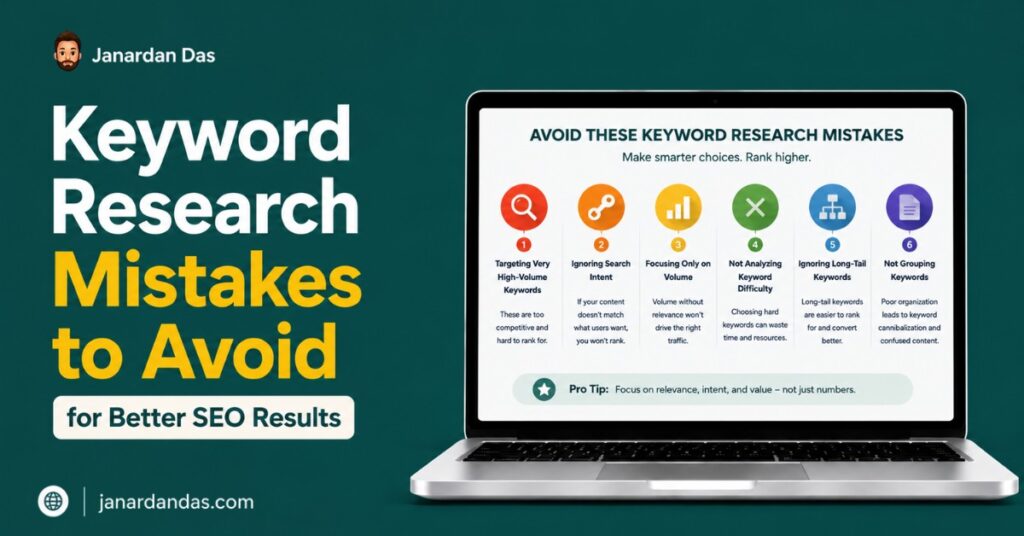
- Targeting high-volume keywords without checking competition or domain strength is one of the most expensive keyword research mistakes you can make.
- Search intent mismatches are more damaging than low keyword volume; Google rewards the page that best serves the intent, not the one with the most optimization signals.
- Ignoring long-tail keywords leaves the most conversion-ready traffic on the table.
- Keyword cannibalization quietly destroys your rankings by splitting your authority across multiple competing pages.
- Skipping SERP analysis before targeting a keyword means you are flying blind on what it actually takes to rank.
Most SEO campaigns do not fail because of bad backlinks or weak content. They fail because the keyword research underneath everything is broken. You can write exceptional articles, build authoritative links, and still watch your rankings flatline because you started with the wrong keywords.
I have audited hundreds of websites over the past seven years, and the pattern is consistent: the sites that struggle are not struggling because of technical issues or thin content. They built everything on top of keyword lists that were high-volume, low-intent, or completely disconnected from what the business actually needed to rank for. They chased numbers instead of targeting the right search queries that match their domain strength, their audience’s actual purchase journey, and their ability to compete.
The frustrating part is that keyword research mistakes are the hardest to spot until months of effort have already gone in the wrong direction. A technical SEO issue throws an error. A bad keyword strategy just quietly wastes your budget and your time. This article covers the mistakes I see repeatedly, the specific ones that produce zero results even when everything else looks fine, and what you should do instead.
Keyword Research Mistakes That Kill Rankings Before You Publish
The single most common keyword research mistake is targeting keywords you have no realistic path to ranking for. Not in six months, not in a year. Just not at all, given your current domain authority, topical depth, and link profile.
Here is how it plays out: someone pulls up Ahrefs Keywords Explorer or Semrush Keyword Magic Tool, filters by monthly search volume above 1,000, picks the keywords that look attractive, and builds a content calendar around them. The keyword difficulty score says 65. The domain rating is 22. The gap between those two numbers represents months of wasted effort.
Why Keyword Difficulty Scores Are Only Half the Picture
Keyword difficulty (KD) scores from Ahrefs, Semrush, and Moz give you a useful starting benchmark, but they measure linking domain requirements, not ranking feasibility in full. A keyword with a KD of 40 might actually be easier to rank for than a keyword with a KD of 25 if the higher-KD keyword has weaker on-page optimization across the SERP.
Before committing to a keyword, open an incognito browser and read the actual pages ranking in positions 1 through 5. Check three things: how thoroughly they cover the topic, whether their content matches what you are prepared to write, and how many referring domains they are carrying. Ahrefs’ SERP overview tab shows referring domains per page, which is the number you care about, not the site-level domain rating.
For a new site (DR under 30), I generally tell clients to target keywords where the top-ranking pages have fewer than 30 referring domains and the keyword difficulty sits below 20. That is not a conservative strategy; it is the only strategy that produces results when authority is still being built.
The Volume Trap: When Big Numbers Produce Zero Traffic
A keyword getting 18,000 searches per month sounds like an opportunity. What the number does not tell you is whether the intent behind it matches any page you can realistically create, whether the SERP is dominated by Reddit threads and YouTube videos (which signals Google is not favoring traditional articles), or whether the traffic converts.
I have seen clients rank for keywords pulling 500 monthly searches and generate more revenue than they were getting from 5,000-search keywords they had previously ranked for. Volume without intent alignment is noise. The fix is to filter keywords not just by volume and difficulty but by business value, conversion proximity, and SERP type. Ahrefs’ Traffic Potential column is a better proxy for actual traffic than raw search volume because it captures the broader cluster of keywords a ranking page tends to pull in.
How Ignoring Search Intent Is One of the Biggest Keyword Research Mistakes
Search intent is not a checkbox. It is the entire architecture decision behind a piece of content. Getting it wrong means the page will not rank even if every other SEO signal is correct, because Google’s ranking systems explicitly reward the result that best fulfills what the user was actually trying to do.
There are four intent types: informational (the user wants to learn something), navigational (they want to reach a specific destination), commercial (they are evaluating options), and transactional (they are ready to act). Most keyword research mistakes around intent happen in the grey zones between these categories.
When the Same Keyword Needs Two Different Page Types
Take “email marketing tools.” At a surface level, this looks like a commercial keyword, and most SEOs would target it with a comparison roundup. But when you look at the actual SERP, you find a mix of informational guides (“what is email marketing”), tool comparison listicles, and review pages. The right page type for this keyword depends on where the majority of high-ranking results land.
Checking SERP intent is not optional. Pull the top 10 results for every keyword you plan to target and identify the dominant content format. If eight out of ten are listicles, write a listicle. If they are long-form guides, write a guide. If they are product pages, you need a product page — not a blog post trying to rank for a transactional keyword.
I have watched sites publish excellent informational content for keywords where every competing result is a product page. They write perfectly, optimize carefully, and still cannot crack position 20 because Google’s understanding of the intent behind the query does not match what the content delivers.
The Informational vs. Transactional Mismatch
This is where I see the most damage in eCommerce and SaaS SEO. A site targets “buy project management software” with a blog post explaining what project management software is. The keyword is transactional. The page is informational. That mismatch is not something you can optimize your way out of because the intent signal is baked into how Google reads the query.
The reverse is equally damaging: targeting “what is CRM software” with a product or category page. The user wants to learn, and Google will consistently favor editorial content for that query, regardless of how well the commercial page is optimized. Matching page format to intent is not an SEO tactic; it is a prerequisite for any ranking possibility.
Long-Tail Keyword Research Mistakes That Leave Revenue on the Table
Long-tail keywords, typically three or more words, often question-based or highly specific, generate most of the actual conversions in any content program. They also represent the most overlooked category in most keyword strategies. Skipping them is one of the quietly expensive keyword research mistakes you can make, especially for newer sites that cannot compete on head terms.
The logic is straightforward: “shoes” has 250,000 monthly searches and zero realistic path to ranking for most sites. “Best running shoes for flat feet under $100” has 800 monthly searches and a buyer at the bottom of the funnel who has already made most of their decision. One of these drives revenue. The other drives traffic goals on paper.
How to Find Long-Tail Opportunities Your Competitors Are Missing
The best long-tail keyword sources are not keyword tools; they are the places where your actual audience describes their own problems. Start with:
Google’s “People Also Ask” and autocomplete: Type your seed keyword into Google and screenshot every autocomplete suggestion and PAA expansion. These are real queries from real users. They represent the exact language your audience uses when they are one click away from taking action.
Answer the Public and AlsoAsked: Both keyword research tools surface question-based variations of any seed keyword. AlsoAsked in particular shows how questions branch from each other, which is useful for mapping out content clusters where one parent article and several supporting pieces can own an entire topic.
Your own site’s search data: If your site has an internal search, pull the query report. It shows exactly what visitors are looking for but cannot find. Those are content gaps with a built-in audience that already trusts your domain.
Competitor content gap analysis in Ahrefs: Plug two or three competitor domains into the Ahrefs Content Gap tool. Filter results by keyword difficulty below 15 and search volume between 100 and 2,000. That range is where long-tail opportunities cluster.
The Difference Between Long-Tail and Low-Value
Not every long-tail keyword is worth targeting. The filter is buying intent and topical relevance, not just length or specificity. “What color is the sky” is long-form but low value. “SaaS link building service for B2B startups” is specific, high-intent, and directly connected to a buying decision.
The qualifying test I use: if someone searching this keyword has a credit card nearby or is one conversation away from hiring someone, the keyword is worth building content for, regardless of its volume.
Keyword Cannibalization: The Keyword Research Mistake That Compounds Over Time
Keyword cannibalization happens when two or more pages on your site target the same keyword or closely related keywords with the same intent. Rather than combining their authority to own a topic, they compete against each other for the same ranking position — and Google, forced to choose, often ranks neither well.
This is one of the keyword research mistakes that starts small and becomes a structural problem. You write a blog post about “email marketing tips” in January. In March, you published “email marketing best practices.” In July, a “guide to email marketing” goes live. By the end of the year, you have three pages with splitting signals and confusing Google about which one should rank, and none of them are in the top 10.
How to Identify Cannibalization in Your Current Content
The fastest diagnostic method: go to Google and search site:yourdomain.com "keyword". If more than one page appears in the results and they cover similar angles, you likely have a cannibalization problem. For a deeper analysis, export your Google Search Console performance report and filter by keyword. Any keyword where two or more pages are receiving impressions is worth investigating.
Ahrefs Site Explorer’s Organic Keywords report also lets you filter by keyword and see which pages are receiving traffic for overlapping terms. Group the URLs by keyword cluster, and wherever you see more than one URL competing for the same cluster, that is a consolidation candidate.
Fixing Cannibalization Without Losing Rankings
The standard fix is to consolidate: merge the weaker pages into the strongest one using 301 redirects, and update the surviving page to include the best content from the ones being absorbed. Before you redirect, pull the traffic and backlink data for every page being merged. Some of those weaker pages may have links you want to preserve. The redirect passes most of that link equity to the new page, but confirm the destination page can absorb the consolidated anchor text without creating a new signal conflict.
In cases where both pages serve different intents (one informational, one transactional) despite sharing keywords, keep them both but differentiate them clearly. Add canonical tags where needed and adjust the targeting so Google can understand which page serves which query type.
The SERP Analysis Mistakes Most Keyword Researchers Skip Entirely
Running a keyword through a tool, seeing a volume number and a difficulty score, and adding it to a spreadsheet is not keyword research. That is keyword collection. The actual research happens in the SERP, and skipping it is one of the most consequential keyword research mistakes in the industry.
SERP analysis tells you things no tool can: the actual content format Google rewards for this query, the average word count and depth of ranking pages, whether SERP features like featured snippets, video carousels, or knowledge panels are reducing click-through rates, and whether the intent is stable or shifting.
Reading SERP Features Before You Invest in a Keyword
Before assigning a keyword to a content brief, check what is taking up real estate on the results page. If a featured snippet is already answered by a well-structured definition, you need to consider whether you can write a more complete, better-formatted version and whether Google is likely to swap the existing one out.
If the SERP has a video carousel occupying positions 1 through 3, you are fighting for position 4 and below with a text article. That is not always a bad thing, but it changes the traffic math significantly. A keyword showing 5,000 monthly searches with a video carousel pulling 40% of clicks leaves far fewer visits for organic text results than the raw volume suggests.
Zero-click queries deserve special attention. Keywords like “what time is it in Tokyo” or “euros to dollars conversion” produce answers directly in the SERP with no reason for users to click. Targeting them drives impressions, not traffic. Filter these out by checking the estimated click-through rate in Ahrefs’ Keywords Explorer. Anything showing below 40% click potential warrants closer inspection before building content around it.
How Competitor Page Quality Should Change Your Targeting Decisions
When you analyze the top 5 results for a target keyword, you are not just confirming that you can compete; you are building a content brief. What headings do they use? What questions do they answer? What do they all skip? The gaps in competitor content are your differentiation opportunity.
I use this process for every significant keyword before approving it for production: read the top 3 articles completely, identify the sub-topics all three cover, identify the sub-topics none of them cover well, and build the brief around covering both groups with more depth and specificity than any single competitor achieves. That is the skyscraper method in practice, not in theory.
If you need help diagnosing whether your keyword strategy is the bottleneck in a stalled SEO program, an SEO audit is the fastest way to identify the exact breaks. I have seen keyword strategy issues surface immediately in audits that had been invisible for months because the site was technically clean and the content was well-written, just aimed at the wrong targets.
Conclusion
Keyword research mistakes are not obvious when you make them. They look like a solid content plan, a well-structured spreadsheet, and a reasonable publishing schedule. The failure shows up three, six, and twelve months later when the rankings that were supposed to come never arrive.
The fix is not more keywords — it is better filtering. Check domain-to-difficulty alignment before you build a single piece of content. Verify intent by reading the SERP, not inferring it from a keyword category label. Use long-tail keywords as the backbone of your strategy, not an afterthought. Audit for cannibalization before it compounds. And never skip the SERP analysis step, because no tool tells you what the results page itself will tell you in two minutes.
If your existing keyword strategy needs a reset, the place to start is a structured SEO consulting engagement where we map your current keyword coverage against realistic ranking opportunities. Most sites have more untapped potential than they realize — it just requires targeting it with precision instead of volume.
Frequently Asked Questions
What are the most common keyword research mistakes beginners make?
The most common beginner mistakes include targeting keywords with high difficulty scores that do not match the site’s domain authority, ignoring search intent, and publishing the wrong content format for a query, and overlooking long-tail keywords in favor of broad, high-volume terms. New sites in particular suffer from competing against established domains for keywords they have no realistic chance of ranking for in the short or medium term. Starting with low-difficulty, high-intent keywords and building topical authority from there produces results far faster than chasing competitive head terms.
How does keyword cannibalization affect SEO rankings?
Keyword cannibalization splits your page authority across multiple URLs competing for the same query, which confuses Google about which page should rank and typically results in both pages ranking poorly. Google is forced to pick one, and when the signal is divided, neither page accumulates the full strength it would if the content were consolidated. The impact compounds over time as you continue publishing content without a clear keyword mapping strategy, making the problem progressively harder to diagnose and fix.
Is targeting high-volume keywords always a keyword research mistake?
Not always, but targeting high-volume keywords without matching them to your domain’s competitive position is a mistake. High-volume keywords are appropriate targets when your domain rating is strong enough to compete, when the keyword difficulty is within reach, and when you have the topical authority to rank. For most new and mid-authority sites, high-volume keywords should be long-term aspirational targets, not the anchor of your current content strategy. Build from lower-difficulty, lower-volume keywords first and use the authority you accumulate to compete upward.
How do you fix search intent mismatches in existing content?
Start by identifying which pages are ranking below position 20 for their target keywords despite good technical SEO and content quality. Pull up the SERP for each keyword and compare the dominant content format against what your page delivers. If your article is informational but the SERP favors product pages, either update the page to match the transactional format or retarget it toward an informational keyword where the format aligns. In most cases, reformatting and restructuring the content to match intent will produce faster ranking improvements than adding more content or building more links.
What is the difference between keyword difficulty and ranking feasibility?
Keyword difficulty is a metric calculated primarily from the number of linking domains pointing to top-ranking pages. Ranking feasibility is the full picture: difficulty score, your domain authority relative to competing pages, the quality of your content compared to what currently ranks, SERP feature saturation reducing click-through, and whether your site has sufficient topical authority in the niche. A keyword can have a moderate difficulty score but be effectively impossible to rank for if the SERP is dominated by Wikipedia, Reddit, and major publication sites, because those domains carry authority signals that no standard SEO campaign can match in a reasonable timeframe.
How many keywords should one page target?
One page should target one primary keyword and 5 to 10 closely related secondary and LSI keywords that share the same search intent. Trying to make one page rank for multiple unrelated keywords or for keywords with different intents dilutes the page’s relevance signal and increases the risk of cannibalization. The practical test: if two keywords would produce different content structures, different page formats, or target users at different stages of the funnel, they belong on separate pages.
What tools are best for avoiding keyword research mistakes?
Ahrefs Keywords Explorer is the most comprehensive tool for keyword research because it combines search volume, keyword difficulty, Traffic Potential (a better proxy for real traffic than volume alone), and SERP analysis in one workflow. Semrush Keyword Magic Tool is strong for discovering keyword variations and long-tail clusters. Google Search Console is irreplaceable for identifying keywords your existing pages are already ranking for, but not fully optimized to capture. For question-based and conversational keywords, AlsoAsked and Answer the Public surface intent-driven variations that most volume-based tools miss. Using two or three of these tools in combination produces far more reliable keyword lists than relying on any single source.
How often should you revisit and update your keyword research?
Keyword data changes, search behavior shifts, and your domain authority evolve, so keyword research should be treated as an ongoing process rather than a one-time task. I recommend reviewing your keyword strategy quarterly: check whether your target keywords are gaining or losing search volume, look for new ranking opportunities that have opened up as your authority grows, and audit for new cannibalization issues that may have been introduced by recent content. High-priority keywords driving significant traffic should be monitored monthly through Google Search Console to catch intent shifts or new SERP features that could affect performance.
Can you recover lost rankings caused by keyword research mistakes?
Yes, and typically faster than most people expect once the root cause is correctly diagnosed. If cannibalization is the issue, consolidating content and setting up 301 redirects often produces ranking improvements within four to eight weeks. If intent mismatch is the problem, reformatting the content to align with the dominant SERP format can recover rankings in one to two Google crawl cycles. If the issue is targeting keywords that were simply too competitive, creating a new content plan around achievable targets produces results as soon as those pages age and accumulate links. The key is accurate diagnosis before taking action; making the wrong fix to the wrong problem slows recovery.
What is topical authority, and why does it matter for keyword research?
Topical authority refers to Google’s assessment of how thoroughly and credibly your site covers a given subject area. A site that has published 30 well-structured articles about email marketing from multiple angles, including tools comparisons, strategy guides, deliverability tutorials, list segmentation how-tos, will rank more easily for new email marketing keywords than a site that published one or two articles on the topic. When building your keyword strategy, clustering keywords by topic and ensuring you have deep coverage across a subject before moving to the next one is how topical authority gets built systematically. Scattered keyword targeting across unrelated subjects is a direct barrier to topical authority and one of the structural keyword research mistakes that holds sites back from competing in any category.
Is it a mistake to ignore branded keywords in your research?
Yes. Branded keywords queries that include your business name or product names often have very high conversion rates because users searching for you by name are already aware of your brand and closer to a decision. Failing to track and optimize for branded keywords means missing out on an easy ranking win and potentially losing clicks to competitor ads or review sites that appear above your own pages. Branded keyword research also reveals how users describe your product, which informs the non-branded keyword angles worth targeting.