
Key Takeaways
- Keyword clustering is the process of grouping keywords with shared search intent so one page can target multiple related terms without cannibalization.
- Free tools like Keyword Cupid’s free tier, Google Sheets with SERP overlap formulas, and ChatGPT with structured prompts can handle small-scale clustering at zero cost.
- Budget tools like Keyword Insights, Cluster AI, and SE Ranking’s Keyword Grouper offer SERP-based clustering at under $100 per month, which is the most accurate clustering method available at any price point.
- Premium platforms like Semrush, Ahrefs, and Screaming Frog, with custom extraction, deliver clustering integrated into broader SEO workflows, which is justified when you are managing content at scale.
- SERP-based clustering (grouping keywords by shared ranking URLs) is more accurate than NLP-based clustering because it reflects how Google categorizes intent, not how an algorithm infers intent from word similarity.
Most SEOs do keyword research wrong. They build a spreadsheet of 500 keywords, sort by volume, and start writing articles for each one. The result is a site full of content that cannibalizes itself, dilutes topical authority, and never ranks for anything well because no single page is built to be the definitive resource on any specific topic.
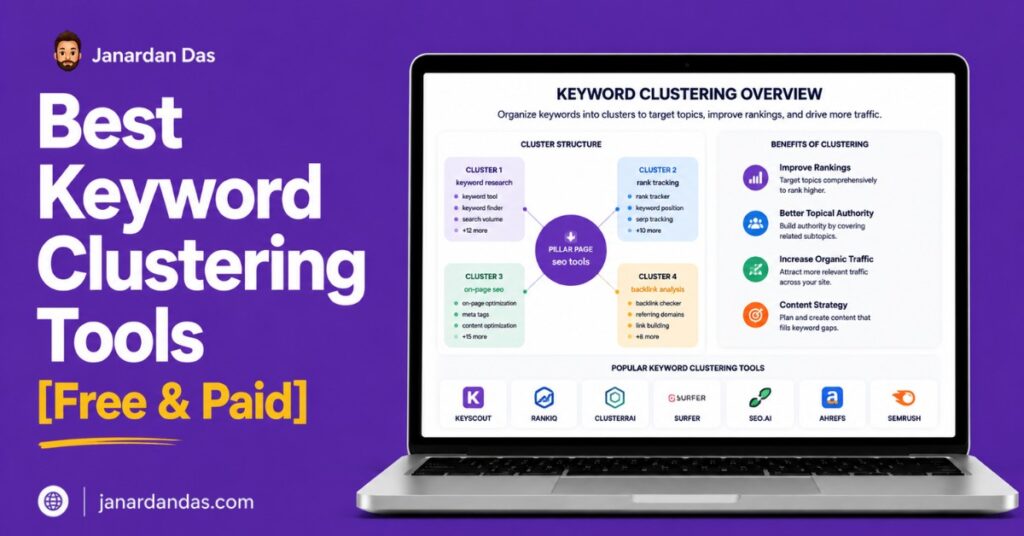
Keyword clustering fixes this. It is the process of grouping related keywords by shared search intent so you know which terms to target on a single page versus which ones need their own dedicated content. When you cluster correctly, you stop producing content that competes with itself and start building pages that cover a topic so thoroughly that Google has no reason to rank anything else above them.
I have been running keyword clustering workflows across e-commerce, SaaS, and B2B client sites for years. The difference in organic output between teams that cluster properly and teams that do not is not marginal. Sites that build content around tight semantic clusters tend to rank more keywords per page, accumulate topical authority faster, and hold rankings more durably through algorithm updates. The tools that support this process range from free spreadsheet methods to AI-driven platforms that cluster 10,000 keywords in under a minute.
This article covers 15 keyword clustering tools organized by price tier: free, budget under $100 per month, and premium above $100 per month. Each entry covers what the tool actually does, where it does it well, and what its real limitations are in a production SEO workflow.
Best Free Keyword Clustering Tools (Zero Cost, Real Use Cases)
Free keyword clustering tools have a hard ceiling. None of them match the accuracy or throughput of paid SERP-based clustering tools. But for small sites, freelancers doing initial research, or practitioners who want to test a clustering workflow before investing in a paid tool, several free options deliver genuine value. The key is knowing exactly what each one can and cannot do before building a process around it.
1. Keyword Cupid (Free Tier)
Keyword Cupid uses SERP-based clustering, meaning it groups keywords based on which URLs share rankings across those keywords, not based on word similarity alone. That distinction matters because two keywords can look semantically identical and have completely different search intents. “Best running shoes” and “running shoes review” sound like the same topic. If the SERPs show different pages ranking for each, Google treats them as different intents, and they need separate content.
The free tier on Keyword Cupid allows up to 200 keywords per cluster job. For a new site doing initial content planning on a focused niche, 200 keywords are often enough to map out the first three to six months of content. The output is a grouped list with cluster labels, and the interface is clean enough that you do not need a tutorial to use it.
The limitation is volume. Once your keyword list exceeds 200 terms, you are hitting the paid wall. And the free plan restricts how many jobs you can run per month, so batch-processing a large content calendar requires upgrading.
Best for: Freelancers and new site owners doing SERP-based clustering on focused keyword lists under 200 terms.
Limitation: 200-keyword cap per job. Monthly job limits on the free plan. Not suited for large-scale content operations.
Pricing: Free (limited). Paid plans from $29/month.
2. ChatGPT or Claude (With Structured Prompts)
AI language models are not keyword clustering tools in the traditional sense, but with the right prompt structure, they can cluster small keyword lists quickly and usefully. The approach: paste 50 to 150 keywords into the prompt and ask the model to group them by search intent, labeling each cluster with a suggested page type (blog post, product page, landing page, FAQ) and a primary keyword to target per cluster.
This is NLP-based clustering, not SERP-based, which means the groupings reflect linguistic similarity rather than actual Google search behavior. For highly ambiguous keywords or competitive niches where intent shifts significantly between similar-sounding terms, AI clustering alone will produce groupings that do not match real SERP reality. Always spot-check the output by manually searching a sample of clustered keywords and confirming the same pages are actually ranking for them.
Where this approach genuinely earns its place: rapid initial passes on new research dumps before investing in paid clustering tools, or validating clusters on evergreen topics where intent is stable and relatively unambiguous. I use this when onboarding a new client and need a rough cluster map within an hour before a strategy call, not as a replacement for SERP-based tooling.
Best for: Rapid initial clustering on small keyword lists, rough content architecture sketches before deeper analysis.
Limitation: NLP-based, not SERP-based. Does not reflect the actual Google intent categorization. Accuracy degrades on ambiguous or competitive terms.
Pricing: Free on ChatGPT’s base tier and Claude’s base tier. Paid plans available for higher limits.
3. Google Sheets + SERP Overlap Method (Manual)
The SERP overlap method is the most accurate free approach to keyword clustering because it is built on real Google data rather than algorithmic assumptions. The process: for each keyword in your list, record the top 5 to 10 ranking URLs. Then compare URL overlap across keywords. Keywords that share three or more of the same ranking URLs belong in the same cluster and can likely be targeted by a single page.
In Google Sheets, this can be structured as a lookup matrix: keywords in rows, top-ranking URLs in columns, with a binary indicator for each URL-keyword combination. A simple COUNTIF formula then identifies keyword groups with sufficient URL overlap to cluster together.
The honest limitation here is that this method does not scale. Running this manually for 50 keywords is feasible. For 500 keywords, it becomes a full-time project. Tools like Keyword Insights and Cluster AI automate exactly this process at scale, which is what makes them worth paying for once your keyword lists grow beyond manual handling.
Best for: SEOs who want the most accurate free clustering method and are working with lists of 50 to 100 keywords where manual SERP checking is feasible.
Limitation: Does not scale beyond 100 to 150 keywords without becoming prohibitively time-intensive. Requires manual SERP data collection or a separate scraping setup.
Pricing: Free (Google Sheets is free; SERP data collection requires time or a separate tool).
4. Screaming Frog SEO Spider (Free Tier, Custom Extraction)
Screaming Frog’s free tier crawls up to 500 URLs, which is not a clustering tool on its own but becomes one when combined with custom extraction and Google Search Console data. The workflow: export your GSC query data, use Screaming Frog to crawl your site and associate pages with their ranking queries, and then group queries by the page they are ranking on.
Pages already ranking for multiple related queries are validated clusters, because Google has already confirmed that one URL can satisfy the intent behind all those terms simultaneously. This approach is particularly useful for existing sites doing a content audit where you want to identify which pages could be expanded to capture additional related keywords versus which pages are being diluted by targeting too many disconnected terms.
The 500 URL limit on the free tier is meaningful. For larger sites, Screaming Frog’s paid license at $259 per year unlocks unlimited crawling, and the value-to-cost ratio at that price point is strong enough that most practitioners eventually upgrade.
Best for: Existing sites using GSC data to cluster ranking queries by page, and content audits where you are mapping current content to keyword intent.
Limitation: Free tier capped at 500 URLs. Not a direct clustering tool; requires combining with GSC data and manual analysis.
Pricing: Free up to 500 URLs. Paid license at $259/year for unlimited crawls.
5. Keyword Grouper Pro (Free Version)
Keyword Grouper Pro is a simple, browser-based tool that groups keywords by shared modifier words rather than by SERP overlap or NLP analysis. You paste a keyword list, select a grouping modifier (the word the tool uses to identify cluster membership), and it outputs groups based on that modifier pattern.
This is the most basic form of keyword clustering available, and it shows. Groups are based on word presence, not intent, which means a list containing “best running shoes,” “running shoes for flat feet,” and “running shoes Nike” would be grouped even though “running shoes Nike” is a navigational query targeting a specific brand and should never be on the same page as informational comparison content.
That said, for very large, very broad keyword lists where you need a rough first pass to reduce 10,000 terms down to manageable buckets before doing real SERP-based clustering, the modifier grouping approach gets you there quickly. Treat it as a pre-clustering step rather than a finished output.
Best for: Large initial keyword lists that need a rough first-pass sort before deeper SERP-based analysis. Not suited for final cluster decisions.
Limitation: Groups by word pattern, not search intent. Produces inaccurate clusters for any keyword set with mixed intent types.
Pricing: Free.
Best Budget Keyword Clustering Tools (Under $100/Month)
Budget clustering tools are where the real workflow gains start. The tools in this tier automate SERP-based clustering, which is the method that actually reflects Google’s intent categorization rather than relying on word similarity or language model assumptions. At under $100 per month, several of these tools handle thousands of keywords per run, integrate with your existing keyword exports, and output cluster maps you can hand directly to a content team.
6. Keyword Insights
Keyword Insights is the tool I reach for most often when onboarding a new client project that needs a full content cluster map built from a raw keyword export. It takes a keyword list, fetches live SERP data for each term, and groups keywords by URL overlap across the top 10 results. The threshold you set determines how many shared URLs are required to place two keywords in the same cluster; a threshold of three means keywords need at least three of the same ranking URLs to be grouped.
The output is a structured spreadsheet with cluster names, primary keyword suggestions for each cluster, average search volume, and keyword difficulty aggregated per cluster. That format hands directly to a content strategist or writer without requiring a separate reformatting step.
The “Content Brief” generation feature is worth mentioning specifically. After clustering, Keyword Insights can generate brief-level guidance for each cluster, including competitor page analysis, suggested headings, and questions to answer. For agencies running content at volume, that brief generation saves meaningful time between the research phase and the writing phase.
Where Keyword Insights sometimes struggles: very long-tail keyword sets where SERP overlap is naturally low because each query has a more specific intent. In those cases, the tool may produce clusters with only one or two keywords in them, which is technically accurate but not very actionable. Setting a lower overlap threshold helps, but the right fix is usually combining Keyword Insights with a manual review pass on the thin clusters.
Best for: Agencies and content teams that need SERP-based clustering at scale with built-in brief generation, without the cost of a full enterprise SEO platform.
Limitation: SERP data fetching makes processing time longer for large lists (1,000+ keywords). Thin clusters on very long-tail sets require manual review.
Pricing: Credit-based. Starts at around $58/month for 2,000 keywords per month. Pay-as-you-go option available.
7. Cluster AI
Cluster AI is a purpose-built keyword clustering tool that runs SERP-based grouping with a clean interface designed specifically for content teams who are not necessarily technical SEOs. You upload a keyword list (with or without volume data), it fetches SERP results, and clusters the keywords by URL overlap within minutes.
The cluster output includes a “hub and spoke” visualization showing the primary topic (hub) and supporting cluster keywords (spokes), which is directly useful for planning internal linking structure alongside content production. Most tools output a flat spreadsheet. The hub-spoke view helps content teams understand the relationships between pages before they start writing, not after.
One specific advantage Cluster AI has over some competitors is the ability to import keywords directly from Ahrefs, Semrush, or Google Keyword Planner exports without reformatting. That integration step sounds minor, but it eliminates a consistent point of friction in agency workflows where keyword exports from multiple tools need to be normalized before processing.
Best for: Content teams and SEO agencies that want fast SERP-based clustering with a visual output that communicates cluster relationships clearly.
Limitation: Less control over clustering parameters compared to tools like Keyword Insights. Not as feature-rich for teams that need deep customization of cluster logic.
Pricing: Starts at $27/month. Higher tiers for larger keyword volumes.
8. SE Ranking Keyword Grouper
SE Ranking’s Keyword Grouper is built into the broader SE Ranking SEO platform, which means it sits alongside rank tracking, site auditing, and competitive research rather than functioning as a standalone clustering tool. The grouper uses a combination of SERP-based and semantic clustering, and you can toggle the grouping method and strictness level depending on how tightly you want keywords grouped.
The integration with SE Ranking’s keyword research module is the main workflow advantage here. You can go from keyword discovery to cluster output to rank tracking setup without leaving the platform. For agencies already using SE Ranking as their primary SEO tool, adding the Keyword Grouper does not require adopting a new platform or exporting and importing between tools.
The strictness setting deserves attention. At high strictness, the grouper requires significant SERP overlap before clustering two keywords together, which produces cleaner clusters but leaves more keywords ungrouped. At low strictness, it groups more aggressively, which produces larger clusters but sometimes combines keywords with genuinely different intents. I typically run at medium strictness and do a manual review pass on any cluster containing more than 15 keywords.
Best for: Teams already using SE Ranking as their primary platform who want clustering integrated into an existing workflow without adding a new tool.
Limitation: Clustering feature quality is secondary to SE Ranking’s primary rank tracking and research functionality. Standalone clustering tools offer more control over the methodology.
Pricing: SE Ranking starts at $65/month. Keyword Grouper is included in all plans.
9. Surfer SEO (Keyword Surfer and Content Editor)
Surfer SEO is primarily known as a content optimization tool, but the keyword research and clustering functionality built into the Content Planner deserves specific attention. The Content Planner takes a seed keyword and returns a set of content cluster recommendations, each with a primary keyword, supporting terms, estimated traffic potential, and a difficulty score.
The cluster recommendations are derived from SERP analysis rather than pure semantic similarity, which means Surfer is grouping keywords based on actual ranking overlap rather than just word proximity. For teams that use Surfer’s Content Editor for on-page optimization, having the clustering and the content optimization workflow in the same platform reduces the number of tools in the process.
Where Surfer’s clustering has a limitation: the Content Planner generates cluster suggestions around a seed keyword rather than accepting a pre-existing keyword list as input. If you have already done keyword research in Ahrefs or Semrush and have a list of 500 terms you want to cluster, Surfer’s Content Planner is not built for that workflow. It is better suited for building a cluster plan from scratch around a new topic than for organizing an existing keyword dataset.
Best for: Teams already using Surfer for content optimization who want clustering built into the same workflow, and content planning from seed keywords rather than pre-existing keyword lists.
Limitation: Cluster planning starts from seed keywords, not imported keyword lists. Less suited for organizing large pre-existing keyword datasets.
Pricing: Starts at $99/month.
10. Mangools (KWFinder + Manual Clustering)
Mangools does not have a dedicated keyword clustering feature, but the combination of KWFinder’s SERP analysis and its related keyword suggestions creates a workable clustering workflow for practitioners at the budget tier. From any seed keyword, KWFinder shows you the related terms alongside SERP data for each, including which pages rank for multiple related queries simultaneously.
The practical workflow: export a keyword list from KWFinder, open the SERP analysis for your primary terms, and manually identify which keywords show the same pages ranking in the top three positions. Keywords consistently sharing the same top-ranking URLs get assigned to the same cluster. It is more manual than Keyword Insights or Cluster AI, but for a practitioner already using Mangools for keyword research, it avoids adding another tool to the stack.
The limitation is throughput. This workflow is manageable for lists under 150 keywords. Beyond that, the manual SERP checking becomes a bottleneck that a dedicated clustering tool eliminates in minutes.
Best for: Mangools users who want a clustering workflow without adding a new tool, working with keyword lists under 150 terms.
Limitation: No dedicated clustering feature. Manual process that does not scale beyond small keyword sets.
Pricing: Mangools starts at $29.90/month billed annually.
11. Ubersuggest Keyword Clustering (Content Ideas)
Ubersuggest’s Content Ideas feature groups keywords by topic rather than by SERP overlap, surfacing content clusters based on how Neil Patel’s team has categorized topics rather than on live Google data. The clusters are broad, and the grouping logic is less transparent than tools like Keyword Insights, but the output is actionable enough for small sites doing their first pass at content planning.
The practical value for budget users: if you are just starting to build a content strategy and do not have the budget for a dedicated clustering tool, Ubersuggest’s Content Ideas section gives you a topic-organized view of your keyword space that is meaningfully better than an unsorted keyword list. It is not the most accurate clustering available, but it moves a beginner from chaos to a workable content plan faster than manual methods.
Best for: Beginners building their first content plan who want a rough topic-based cluster view without investing in a dedicated clustering tool.
Limitation: Topic-based grouping rather than SERP-based. Less accurate for sites in competitive niches where intent varies across similar-sounding keywords.
Pricing: Paid plans from $29/month.
Best Premium Keyword Clustering Tools (For Teams Operating at Scale)
Premium keyword clustering tools earn their cost when you are managing content operations at a scale where the efficiency gain from better clustering directly reduces production waste. Writing a piece of content that targets the wrong intent, or creating two separate articles for keywords that should have been on one page, costs real money at enterprise volume. The tools in this tier either integrate clustering into a full SEO platform or offer dedicated clustering infrastructure capable of handling tens of thousands of keywords per run.
12. Semrush Keyword Magic Tool + Position Tracking
Semrush does not market itself as a keyword clustering tool, but the combination of Keyword Magic Tool’s topic group sidebar and Position Tracking’s keyword grouping functionality delivers clustering that is integrated into an already-running SEO workflow. The Keyword Magic Tool automatically groups keyword ideas into thematic clusters in the left sidebar when you run any seed keyword search, showing related terms organized by subtopic rather than as a flat list.
The more powerful clustering application in Semrush is the Keyword Gap tool combined with Position Tracking. Once you are tracking a keyword set in Position Tracking, Semrush groups your tracked keywords by topic, showing you which clusters are performing well and which are underperforming relative to competitors. That performance dimension is something standalone clustering tools do not offer because they are built purely for organization, not ongoing monitoring.
Using Semrush’s Topic Research for Cluster Planning
Semrush’s Topic Research tool takes a seed keyword and returns a visual map of subtopics, each with associated search questions, related searches, and content ideas. For building a topical cluster from scratch, this map functions as a pre-clustering step that identifies which subtopics exist before you start pulling keyword data. The tool surfaces subtopics you might not have thought to include in your initial research, which fills gaps in topical coverage that would otherwise leave your cluster incomplete.
The keyword volume and difficulty data attached to each subtopic means you can prioritize cluster creation based on traffic potential rather than guessing which subtopics matter most.
Content Gap as a Cluster Gap Identifier
One of the most effective uses of Semrush for clustering is running the Content Gap tool against your top three competitors and filtering results by topic group. Keywords your competitors rank for in a specific topic cluster that you have no content for are not just individual keyword opportunities; they are missing cluster pages. Addressing those gaps systematically, one cluster at a time rather than one keyword at a time, is how content strategies compound traffic rather than accumulating it incrementally.
Best for: Teams already on Semrush who want clustering integrated into competitive research, rank tracking, and content gap analysis without adding another tool.
Limitation: Clustering is a feature within a broader platform rather than the core functionality. Dedicated clustering tools like Keyword Insights offer more control over cluster methodology.
Pricing: Starts at $139.95/month.
13. Ahrefs (Keywords Explorer + Content Gap)
Ahrefs does not have a dedicated keyword clustering module, but the Keywords Explorer’s “Also rank for” tab and the Content Gap tool together create one of the most accurate clustering workflows available in any premium SEO platform. The “Also rank for” data shows you every other keyword the top-ranking pages for your seed term also rank for, which is effectively a SERP-validated cluster: Google has already confirmed these keywords can be targeted by a single page.
The workflow: search your primary keyword in Keywords Explorer, open the “Also rank for” tab, filter by keyword difficulty and volume to isolate the terms worth targeting, and export. That exported list is your cluster, validated by live Google ranking data rather than algorithmic grouping assumptions.
Building Clusters from the Parent Topic Feature
Ahrefs’ Parent Topic feature identifies whether Google treats any given keyword as a standalone topic or as a subtopic of a broader query. If two keywords share the same Parent Topic, they belong in the same cluster and should be targeted by the same page. If they have different Parent Topics, they likely need separate content. This one feature eliminates a significant percentage of the “should these two keywords be on the same page?” judgment calls that slow down content planning.
For example, “keyword clustering” and “how to cluster keywords” may look like two different topics that need two different articles. If Ahrefs shows them sharing the same Parent Topic with significant URL overlap in the SERPs, one page targeting both terms is the right call. That insight saves the production cost of an unnecessary article and concentrates authority on a single URL instead of splitting it.
Using Content Gap for Cluster Expansion
Ahrefs’ Content Gap tool at the page level rather than the domain level is a clustering tool that most practitioners underuse. Enter the URL of your best-performing page on any topic and compare it against the top three to five competing pages on the same topic. The keywords the competing pages rank for that your page does not are cluster expansion opportunities, additional terms you can add to an existing page to capture more traffic without creating new content.
Best for: Advanced SEOs who want cluster validation grounded in live SERP data, integrated with backlink analysis and traffic forecasting in one platform.
Limitation: No dedicated clustering output or cluster map. The workflow requires combining multiple features manually rather than getting a single cluster report.
Pricing: Starts at $129/month.
14. Screaming Frog SEO Spider (Paid, Full Crawl)
At $259 per year, Screaming Frog’s paid license offers one of the highest value-to-cost ratios of any tool in this list when used specifically for clustering existing site content. The workflow combines a full site crawl with Google Search Console API integration to pull all ranking queries per page, then uses Screaming Frog’s custom extraction and reporting to group pages by topical cluster based on their ranking keyword sets.
For sites with hundreds of existing pages, this approach surfaces three things simultaneously: pages that are already functioning as valid cluster hubs (ranking for many related terms), pages that are accidentally cannibalizing each other (ranking for overlapping terms that should be consolidated), and pages with thin cluster coverage (ranking for a primary keyword but missing the supporting terms that would strengthen topical authority signals).
The cannibalizing pages finding is particularly valuable. During SEO audit work, I consistently find sites where two or three separate URLs are splitting rankings for the same keyword cluster, meaning none of them rank as well as a single consolidated page would. Screaming Frog makes this diagnosis fast.
Best for: Existing site audits where the goal is to map current content to keyword clusters, identify cannibalization, and find consolidation opportunities.
Limitation: Requires technical setup to integrate GSC data and configure custom extraction. Not a push-button clustering tool for keyword lists without existing page data.
Pricing: $259/year for the paid license.
15. Keyword Insights (Agency Plan)
At higher volume tiers, Keyword Insights scales into enterprise clustering territory with the ability to process 50,000 or more keywords per month across multiple client projects. The agency plan adds team access, white-label reporting, and the ability to run cluster jobs simultaneously across projects rather than sequentially, which is the throughput limitation that makes the entry-level plan impractical for agencies managing ten or more active clients.
The Brief Builder at scale deserves specific mention. For agencies producing content at volume, automated brief generation per cluster eliminates one of the most time-intensive steps between keyword research and content production. A cluster of twelve related keywords produces a brief that includes: competitor page analysis for the top three ranking URLs, suggested H2 and H3 headings derived from SERP data, word count recommendations based on what is ranking, questions to address (from People Also Ask), and NLP terms to include. A human writer still makes all the judgment calls, but the research compilation step that typically takes 45 to 60 minutes per brief is reduced to under five minutes.
Where this level of automation creates risk: over-reliance on brief templates can flatten content quality if writers treat the auto-generated structure as final rather than as a starting point. I flag this with every content team I work with. The brief is a research summary, not a creative direction.
Best for: Agencies managing high-volume content production across multiple client accounts who need clustering, brief generation, and team access in a single platform.
Limitation: Cost scales with keyword volume. Large-scale use requires a meaningful monthly investment. Brief generation needs human editorial review to avoid formulaic output.
Pricing: Agency plans from approximately $200 to $500+/month, depending on volume.
How to Choose the Right Keyword Clustering Tool for Your Workflow
The right clustering tool depends on three things: the size of your keyword list, whether you need SERP-based accuracy or can accept NLP-based approximation, and whether clustering is a standalone task or part of a broader SEO platform workflow.
For keyword lists under 150 terms: free tools and manual methods are viable. The Google Sheets SERP overlap method gives you the most accurate output for free. ChatGPT with structured prompts gives you the fastest output. Keyword Cupid’s free tier gives you SERP-based clustering without the manual work, up to 200 keywords.
For keyword lists of 200 to 5,000 terms: Keyword Insights or Cluster AI are the right tools. Both automate SERP-based clustering, both handle mid-range keyword volumes cleanly, and both output structured reports that content teams can work with directly. At this scale, manual methods have become prohibitively slow, and AI-only clustering produces too many inaccurate groups to trust without significant review.
For keyword lists above 5,000 terms or multi-client agency workflows: Keyword Insights at the agency tier, or clustering integrated into a premium platform like Semrush or Ahrefs, is where the investment is justified. The per-keyword cost drops at volume, and the brief generation and team access features at the agency tier eliminate workflow bottlenecks that matter more than the clustering itself at that scale.
One principle I apply regardless of which tool I am using: always manually check a sample of clusters against the live SERP before handing a cluster map to a content team. Run ten to fifteen of your clustered keyword pairs through Google and confirm the same pages are actually ranking for both terms. If they are not, the cluster needs splitting. No tool clusters with 100% accuracy, and catching errors before content production is cheaper than fixing them after publishing.
This is particularly true for sites doing ecommerce SEO or local SEO, where intent can shift significantly across keywords that look similar on the surface. A clustering error on a product category page can result in a page targeting both commercial and informational intent simultaneously, which almost always underperforms compared to a page built for one intent cleanly.
Conclusion
Keyword clustering is not a nice-to-have step in a content strategy. It is the difference between a site that produces 50 articles and ranks for 50 keywords versus a site that produces 50 articles and ranks for 2,000. The tool you use to cluster matters less than doing it at all, and doing it before you produce a single piece of content rather than trying to fix a messy content architecture retroactively.
Start with the free SERP overlap method on a small sample of your keyword list to understand what clustering actually looks like in practice. Then choose the tool that matches your volume and workflow. The best keyword clustering tool is the one you will actually run before every content planning session, not the one with the most features you never use.
Frequently Asked Questions
What is keyword clustering in SEO?
Keyword clustering is the process of grouping related keywords by shared search intent so a single page can target multiple keywords simultaneously. Instead of creating one article per keyword, clustering identifies which keywords Google treats as equivalent (because the same URLs rank for all of them) and which keywords require their own dedicated page. Proper clustering reduces keyword cannibalization, strengthens topical authority, and typically results in individual pages ranking for a larger number of related terms.
What is the best keyword clustering tool?
Keyword Insights is the best dedicated keyword clustering tool for most SEO practitioners because it uses SERP-based clustering (the most accurate method), handles mid-to-large keyword volumes cleanly, and outputs structured reports with brief generation built in. For teams already paying for Semrush or Ahrefs, the clustering functionality within those platforms is sufficient for most use cases without requiring an additional tool.
What is the difference between SERP-based and NLP-based keyword clustering?
SERP-based clustering groups keywords together when the same URLs rank for them in Google’s top 10 results. It reflects how Google actually categorizes search intent rather than how an algorithm assumes keywords are related based on word similarity. NLP-based clustering (used by AI tools like ChatGPT) groups keywords by linguistic similarity, which is faster but less accurate, particularly for keywords where intent differs despite similar phrasing. SERP-based clustering is the more reliable method for production SEO work.
How many keywords should be in a cluster?
Most keyword clusters contain between 3 and 20 related terms, though there is no fixed rule. A cluster of 3 to 5 terms represents a tight, specific topic. A cluster of 10 to 20 terms represents a broader topic that warrants a long-form pillar page. Clusters with more than 25 terms often signal that the grouping threshold is set too loosely and the cluster contains keywords with genuinely different intents that should be split into sub-clusters.
Can I do keyword clustering for free?
Yes. The Google Sheets SERP overlap method is the most accurate free clustering approach: for each keyword, record the top 5 ranking URLs, then group keywords that share 3 or more of the same ranking URLs. This method is limited by the time required to collect SERP data manually, making it practical for lists of 50 to 100 keywords but not for larger sets. ChatGPT and Claude can cluster small keyword lists quickly using NLP-based grouping, though the accuracy is lower than SERP-based methods.
What is keyword cannibalization, and how does clustering prevent it?
Keyword cannibalization happens when two or more pages on the same site target the same keyword or keywords with the same intent, causing them to compete against each other in Google’s rankings rather than reinforcing each other. Clustering prevents this by mapping keywords to specific pages before content is produced, ensuring each keyword is assigned to exactly one page and no two pages in your cluster map target the same intent.
Should I cluster keywords before or after writing content?
Always cluster before writing. Clustering after content is already published means discovering you have produced separate articles for keywords that should have been on one page, requiring consolidation and redirects. Clustering before writing lets you structure your content plan, so each piece is built to rank for an entire cluster of related keywords from day one, not a single keyword that underperforms relative to what a well-structured page targeting the full cluster would achieve.
How does keyword clustering help with topical authority?
Topical authority is Google’s assessment of how credibly and completely a site covers a subject area. A site with a well-organized cluster structure, where each cluster covers a subtopic thoroughly, and internal links connect related clusters, signals deeper expertise on a topic than a site with isolated articles that do not reinforce each other. Clustering is the organizational method that makes topical authority buildable in a systematic way, rather than hoping that random content production eventually covers a topic broadly enough.
What is the Parent Topic feature in Ahrefs, and how does it help with clustering?
The Parent Topic feature in Ahrefs identifies the broader topic Google associates with any given keyword. If two keywords share the same Parent Topic, they can typically be targeted by a single page because Google treats them as variations of the same intent. If they have different Parent Topics, they need separate content. This feature eliminates many of the judgment calls about whether to combine two keywords on one page or split them into separate articles, making cluster planning faster and more grounded in actual Google behavior.
How often should I re-cluster my keywords?
Re-cluster whenever you are doing a significant content planning session, at a minimum, quarterly for active content operations. Search intent shifts over time as new content enters the SERPs and Google refines its understanding of what searchers want for any given query. A cluster that was accurate twelve months ago may have shifted, particularly in fast-moving industries where new content formats or query patterns emerge regularly. Running a new cluster job on your active keyword set before each major content planning cycle ensures your architecture reflects current SERP reality rather than a snapshot from the past.
Is keyword clustering the same as topic clustering?
Keyword clustering and topic clustering are related but not identical. Keyword clustering is a data-driven process of grouping individual keywords by shared SERP results or semantic similarity. Topic clustering is a content architecture strategy where you build a pillar page on a broad topic and surround it with supporting content on related subtopics, all interlinked. Keyword clustering is the research method that informs how you build a topic cluster. Done correctly, keyword clustering produces exactly the architecture that a topic cluster content strategy requires: clear cluster hubs with defined supporting pages.
What is the minimum keyword volume to bother clustering?
If you have 30 or more keywords targeting a similar subject area, clustering is worth doing. Below that threshold, the relationships between keywords are usually obvious enough that you can make the grouping decisions manually without a dedicated tool or structured process. Once you cross 50 to 100 keywords, manual grouping becomes unreliable, and a structured clustering workflow saves more time than it takes to set up.