
Key Takeaways
- B2B SEO in 2026 requires winning zero-click visibility (AI Overviews, LLM citations) alongside traditional blue-link rankings.
- Keyword research must map to your buying committee: the researcher, the decision-maker, and the approver search at different stages with different queries.
- Technical SEO is the floor. If crawlability and page speed are broken, no content strategy fixes it.
- B2B content wins in AI Overviews when it leads with direct, self-contained answers and uses named entities (tools, stats, frameworks).
- Link building for B2B is about earning citations from publications your buyers actually read, not just domain authority scores.
- Pipeline, not rankings, is the metric that tells you if your B2B SEO strategy is working.
Most B2B companies are doing SEO. Most of them are not getting a pipeline from it. The gap is not a keyword gap or a content volume gap. It’s a strategy gap. They’re optimizing for clicks in a search environment where a growing share of buying-stage queries never produce a click at all. Google’s AI Overviews answer the question directly in the SERP. ChatGPT, Perplexity, and Gemini pull citations from pages that are structured to be extracted, not just read. If your B2B SEO strategy is built entirely around “rank and get the click,” you are optimizing for a search environment that no longer exists at scale.
The other problem is structural. B2B buyers don’t work like B2C buyers. A CFO at a 500-person SaaS company is not the same person as the VP of Engineering who first noticed the problem, or the procurement lead who will sign off on the contract. They search differently. They need different content at different times. A B2B SEO strategy that treats the entire funnel as one audience will produce traffic that never converts, because the content is never speaking to the right person at the right decision stage.
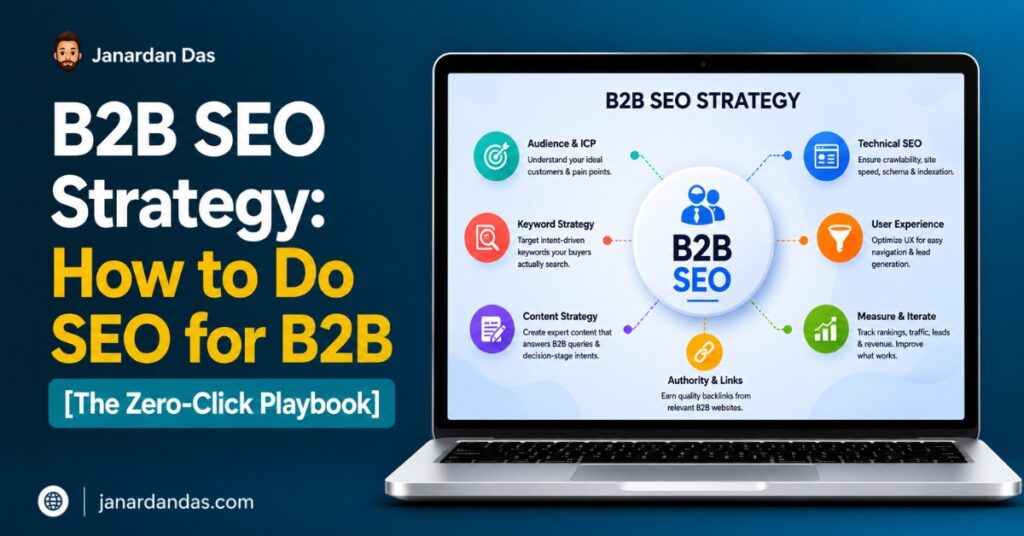
This guide is built around what actually moves the needle in 2026: a B2B SEO strategy that wins zero-click visibility, maps content to buying committees, earns citations in AI-generated answers, and builds the kind of authority that shortens sales cycles. I’ve built this framework across 7 years of B2B SEO work, and it’s the same approach I use today when I take on a new B2B SEO client.
Why B2B SEO Strategy Fails Without a Zero-Click Framework
Zero-click searches are not a future trend. They’re the current reality. SparkToro and Datos data from 2024 showed that over 58% of Google searches in the US ended without a click. For B2B informational queries, the rate is even higher because Google’s AI Overviews now directly answer questions like “what is a SaaS SEO strategy” or “how does enterprise link building work” before the user ever sees a search result.
This doesn’t mean SEO is dead. It means the definition of “winning” has expanded.
What Zero-Click Visibility Actually Means for B2B
Winning zero-click is not about giving up on traffic. It’s about ensuring that when Google or an LLM surfaces an answer to your buyer’s query, your brand is the one being cited. A CFO searching “what should an SEO audit cost for an enterprise site” who sees your brand’s data cited in the AI Overview has now encountered your brand in a credibility context, without ever clicking a result. That brand impression compounds. When they search again, or when a vendor comparison comes up in a Slack thread, your name already has weight.
The B2B companies winning zero-click are doing three things: they structure their content with clear H2/H3 hierarchies and answer-first paragraphs so AI systems can extract clean answers, they publish content dense with named entities (specific tools, specific price ranges, specific frameworks with names), and they maintain topical authority across the full cluster of related queries so Google trusts them as the authoritative source on the topic.
The Buying Committee Problem in B2B SEO
A B2B purchase typically involves 6 to 10 stakeholders, according to Gartner research. Each one has a different job title, a different set of concerns, and different search behavior. Your Head of Marketing searches “B2B SEO strategy examples.” Your CFO searches “SEO ROI for B2B SaaS.” Your procurement lead searches “SEO agency contracts, what to look for.” If your content strategy addresses only one of these people, you have a presence in one part of the buying journey and nothing in the others.
The fix is not to write more content. It’s to map content to committees. Before building your editorial calendar, list every stakeholder who influences or approves the purchase decision your company is trying to win. Then assign search intent to each role. Build content that serves each stakeholder at the stage where they’re actually searching. This is a fundamental shift in how most B2B SEO strategies are architected, and it’s the single biggest reason most B2B companies get traffic without a pipeline.
B2B Keyword Research That Maps to Buying Committees, Not Just Search Volume
Standard keyword research for B2B fails for a predictable reason. Most teams open Ahrefs or Semrush, filter by volume and difficulty, and pick keywords that look achievable. The problem is that the highest-volume B2B keywords are almost never the ones that bring in qualified buyers. “CRM software” has an enormous volume. “CRM software for commercial real estate teams under 50 users” has almost none. But the second query has far higher purchase intent, and a far shorter path to a demo request.
How to Do B2B Keyword Research by Buying Stage
Start by segmenting your keyword research into three stages, not by volume, but by where the searcher sits in the decision process.
Awareness stage: The buyer has a problem but hasn’t framed it as a product category yet. They search things like “why is our content not converting,” “how to improve pipeline from SEO,” or “B2B demand generation vs inbound.” These queries have lower commercial intent but high topical authority value. They bring in the right audience before they’ve started comparing vendors. Target them with educational content that positions your brand as the expert on the underlying problem.
Consideration stage: The buyer knows the category and is evaluating approaches. Queries here include “B2B SEO strategy examples,” “enterprise SEO agency vs in-house team,” or “how long does B2B SEO take to show results.” These are your core content pillars. Each one should be a long-form guide that addresses the decision the buyer is trying to make, not just the question they asked.
Decision stage: The buyer is close to a vendor choice. Queries are specific: “best B2B SEO consultants,” “SEO Consulting & Strategy for SaaS companies,” “[competitor] alternative,” or “B2B SEO agency pricing.” These need dedicated landing pages, not blog posts. The content should be direct, credibility-heavy, and built to convert, with case-style evidence, specific results, and a clear next step.
Using Ahrefs and Semrush for B2B Keyword Discovery
In Ahrefs Keywords Explorer, start with your core category term (“B2B SEO”) and filter by “Questions” under SERP features. This surfaces what your buyers are actually asking, not just what they’re typing. Then use the “Also rank for” report on your top competitors to find keyword clusters you’re missing entirely. In Semrush, the Keyword Gap tool against 3 to 4 competitors reveals keywords where every competitor ranks, but you don’t. Those gaps represent the fastest opportunities.
For B2B specifically, don’t ignore low-volume high-intent phrases. A keyword with 50 monthly searches that maps to the decision stage is worth more than a 2,000-volume keyword that attracts researchers with no buying authority. I’d rather rank for “fractional SEO director for B2B SaaS” at 40 monthly searches than “SEO tips” at 40,000.
Technical SEO for B2B Sites: The Foundation Most Teams Ignore
You cannot content-market your way out of technical SEO problems. I’ve audited B2B sites with excellent editorial teams that were producing great content and ranking for almost none of it because Googlebot couldn’t crawl the pages efficiently, or because the site had so many duplicate variants that PageRank was being diluted across dozens of near-identical URLs. Technical SEO is not glamorous, but it is the ceiling on everything else you do.
If you haven’t run a thorough SEO audit recently, that’s the first step, not keyword research, not content planning.
The B2B Technical SEO Issues That Kill Rankings
Crawl budget waste: Enterprise B2B sites often have thousands of URLs that should never be indexed: internal search results pages, session ID variants, filtered product pages, paginated archives. Every crawl credit Googlebot spends on these is a crawl credit not spent on your actual content. Use Google Search Console’s Coverage report to find what Google has crawled and index-blocked. Then audit your robots.txt and noindex tags to make sure the right pages are excluded.
Slow Core Web Vitals on unglamorous pages: Most B2B teams optimize their homepage and product pages for speed and ignore their blog at scale. But if your 300-page content library is averaging 4+ seconds on Largest Contentful Paint, Google is treating those pages as a poor user experience regardless of how good the content is. Run a site-wide CWV audit using PageSpeed Insights API or Screaming Frog’s CWV integration. Fix the slow pages before you publish more of them.
Schema markup gaps: B2B sites consistently underuse structured data. At minimum, every article should have Article schema, every FAQ section should have FAQPage schema, and your company pages should have Organization and LocalBusiness schema where applicable. The FAQPage schema is particularly important for zero-click visibility because it creates rich results directly in the SERP and increases the chances your answers surface in AI Overviews.
Internal linking architecture: Most B2B sites have a flat internal linking structure where the homepage links to product pages, and blog posts link to nothing. This leaves the site’s most valuable pages underpowered from an internal PageRank perspective. Build a deliberate internal linking system: every pillar page should receive links from all supporting cluster content, and every cluster post should link back to the pillar. Ahrefs Site Audit’s “Link Opportunities” report identifies internal linking gaps across your entire site automatically.
B2B Content SEO That Wins in AI Overviews and LLM Citations
AI Overviews and LLM-generated answers are not replacing organic traffic for every query. But for informational and comparison-stage B2B queries, they’re already capturing significant SERP real estate. The question is not whether to optimize for them. It’s how.
The answer is structural, not stylistic. AI systems don’t prefer content that “sounds authoritative.” They prefer content that is structured so an automated system can extract a clean, self-contained answer and attribute it to a specific source.
The Answer-First Structure for B2B Content
Every H2 section in your B2B content should lead with a direct answer to the implied question. Not a teaser. Not a “great question, let’s explore.” A direct answer in the first sentence, followed by the explanation. If your H2 is “How Long Does B2B SEO Take to Show Results,” the first sentence should be something like: “Most B2B SEO programs start showing meaningful organic traffic increases between 6 and 9 months, but first-page rankings for competitive terms typically take 12 to 18 months depending on domain authority and content volume.” That sentence is extractable. An AI system can pull it, attribute it to your page, and use it to answer the query.
Named Entities and Specificity as LLM Citation Signals
Vague content does not get cited. Specific content does. When you write “keyword research tools can help you find opportunities,” you give an LLM nothing to work with. When you write “Ahrefs Keywords Explorer’s ‘Parent Topic’ feature groups related keywords so you can target an entire cluster with one page rather than creating separate articles for every variation,” you give it a specific, verifiable claim tied to a named tool and a named feature. That gets cited.
For B2B content specifically, build in: named frameworks (give your process a name), specific statistics with sources, tool names, and specific features, and concrete examples drawn from your actual client work (with identifying details removed). Every major claim should have a named entity attached to it.
My AI & LLM SEO service goes deeper on this if you’re trying to build a systematic LLM citation strategy alongside your organic SEO.
Topical Authority Clusters for B2B
A single excellent article does not rank in a competitive B2B niche. A cluster of 15 to 20 interlinked articles that comprehensively covers every angle of a topic does. Google’s systems evaluate topical coverage, not just individual page quality. If your site has one post on “B2B SEO strategy” but your competitor has that post plus posts on B2B keyword research, B2B link building, technical SEO for B2B, B2B content strategy, and B2B SEO metrics, their topic coverage signals deeper expertise. Build clusters before you build individual pieces.
B2B Link Building Strategy That Builds Pipeline Authority
Link building for B2B is not about accumulating the highest possible domain authority score. It’s about earning links from publications your buyers actually read, because those links do two things simultaneously: they improve your search rankings and they put your brand in front of the exact audience you’re trying to reach.
A backlink from a generic SEO blog with DA 70 is worth less to a B2B SaaS company than a backlink from a SaaS-specific publication with DA 45 that their target buyers subscribe to. The second link builds brand recognition in the buying audience. The first one doesn’t.
The B2B Link Building Channels That Actually Work
Original research and data: B2B buyers cite data. If you publish original survey data or a proprietary analysis of your industry, other publications and blogs will link to it because it gives them something to cite. A B2B SaaS company publishing “2026 State of B2B Buyer Research Behavior” gets inbound links from everyone writing about B2B marketing this year. The research doesn’t have to be enormous; a credible survey of 200 to 300 relevant respondents produces citable data.
Podcast and webinar appearances: When you appear on an industry podcast, the episode page almost always links back to your site. These are editorial links from relevant publications, and they build both domain authority and brand recognition simultaneously. Prioritize podcasts where your buyers are the audience, not podcasts where your peers are the audience.
Broken link building at scale: Use Ahrefs Content Explorer to find pages in your industry with significant inbound links that are now returning 404 errors. Those pages had linking value that is now pointing nowhere. Reach out to the sites linking to them and offer your equivalent (or better) content as a replacement. The response rate is higher than cold outreach because you’re solving a problem for them.
SaaS Link Building through tools and calculators: Publishing a free tool (an ROI calculator, a benchmark report, a grading tool) generates passive links because other publishers embed or reference it. For B2B SaaS specifically, this is one of the most efficient link acquisition channels at scale.
How to Measure B2B SEO Strategy ROI
Rankings are a leading indicator. Revenue is the outcome. Most B2B SEO reporting stops at rankings and traffic, which tells you almost nothing about whether the investment is actually working from a business perspective. The goal is pipeline, not pageviews.
The B2B SEO Metrics That Actually Matter
Organic-attributed pipeline: In your CRM (HubSpot, Salesforce, or equivalent), track deals where the first touch or a significant touch was organic search. This requires proper UTM tracking and a multi-touch attribution model. Without it, you’re flying blind on whether SEO is contributing to revenue or just contributing to vanity metrics.
Keyword coverage by buying stage: Track how many keywords you rank in positions 1 to 10 for each stage of the buyer journey, awareness, consideration, and decision. If you have 200 awareness keywords ranking but only 5 decision-stage keywords, your SEO is building audience but not capturing buyers at the point of decision. Rebalance the content strategy accordingly.
AI Overview and LLM citation rate: Set up Google Alerts and use tools like Brand24 or Mention to track when your brand or specific content is cited in AI-generated answers. This is a newer metric, but it matters because brand citations in LLM responses influence buying committees who use AI tools for research, which is most of them.
Branded search volume growth: As your B2B SEO strategy builds authority and visibility, branded search volume should increase. People who encounter your brand through organic content search your name directly later in the buying cycle. Google Search Console shows branded vs. non-branded query splits. If branded search is growing month over month, your content is working even when it’s not producing a direct click to a landing page.
Conclusion
B2B SEO strategy in 2026 is not harder than it used to be. It’s just wider. You have to win traditional blue-link rankings, and you have to win zero-click visibility through AI Overviews and LLM citations. You have to produce content that serves the researcher, the decision-maker, and the approver, not just the person who typed the query. And you have to build the kind of topical authority and link equity that makes your site the default reference point in your category.
The companies getting this right are not necessarily publishing more. They’re publishing more deliberately, with a cleaner architecture, a sharper understanding of who they’re writing for, and a measurement system that connects content to pipeline. If you want help building or auditing this kind of strategy, take a look at my SEO Consulting & Strategy service. That’s where we do the strategic layer before touching a single piece of content.
Frequently Asked Questions
What is B2B SEO strategy?
B2B SEO strategy is the process of optimizing a business-to-business website to attract organic search traffic from buyers, decision-makers, and researchers at companies that could become customers. Unlike B2C SEO, B2B SEO must account for longer buying cycles, multiple stakeholders, low-volume but high-intent keywords, and content that serves different roles within a buying committee rather than a single individual consumer.
How is B2B SEO different from B2C SEO?
B2B SEO targets a narrower, more specialized audience with higher average deal values and longer sales cycles, typically 3 to 18 months. The keywords have lower search volumes but higher commercial intent. The content must address multiple stakeholders in a buying committee, not a single buyer. Conversion goals are typically demo requests, free trials, or contact form submissions rather than direct purchases. Rankings alone don’t indicate success; pipeline attribution does.
How long does B2B SEO take to work?
Most B2B SEO programs start showing measurable organic traffic increases between 6 and 9 months. First-page rankings for competitive terms typically take 12 to 18 months, depending on domain authority, content volume, and link acquisition pace. Decision-stage landing pages can sometimes rank faster if competition is lower and the page is technically sound. Branded search volume growth, which signals that content is influencing brand recall in the buying audience, is often visible within 3 to 6 months.
What keywords should a B2B company target?
B2B companies should target keywords across three buying stages: awareness (problem-aware, non-branded queries), consideration (category and comparison queries), and decision (vendor-specific and intent-heavy queries). Prioritize keyword relevance and buyer intent over search volume. A keyword with 80 monthly searches from CFOs comparing enterprise SEO solutions is more valuable than a 5,000-volume term that attracts students or junior marketers.
How do you do B2B keyword research?
Start in Ahrefs Keywords Explorer or Semrush. Enter your core category terms and filter by “Questions” to surface what your buyers are actually asking. Use the Keyword Gap tool against 3 to 5 competitors to find clusters you’re missing. Segment every keyword you find by buying stage (awareness, consideration, decision) and by stakeholder role (end user, technical evaluator, executive buyer). Build content that addresses each segment, not a one-size-fits-all resource targeting everyone simultaneously.
What type of content works best for B2B SEO?
Long-form educational guides work best for awareness and consideration stage queries. Comparison pages, use-case landing pages, and case study content work for decision-stage queries. Original research (surveys, benchmark reports, proprietary data) earns inbound links and LLM citations at scale. FAQ content structured with FAQPage schema captures rich results and AI Overview placements. The common thread: specific content, answer-first in structure, and built around named entities rather than vague generalizations.
How important is technical SEO for B2B websites?
Technical SEO is the foundation of any B2B SEO strategy. Without clean crawlability, fast Core Web Vitals, proper canonical tags, and structured data, no content investment reaches its potential. Enterprise B2B sites, in particular, accumulate technical debt quickly: duplicate URL variants, orphaned pages, bloated JavaScript, unoptimized images. A thorough technical audit should precede any content or link strategy, not follow it.
What is zero-click SEO and why does it matter for B2B?
Zero-click SEO refers to optimizing for visibility in search results where the user doesn’t click through to a website, including Google’s AI Overviews, featured snippets, People Also Ask boxes, and LLM-generated answers. It matters for B2B because a growing share of informational and comparison-stage queries now surface answers directly in the SERP. B2B brands that appear in these zero-click placements build brand recognition and authority with buying committees even without generating a click, which influences vendor consideration later in the sales cycle.
How should B2B companies measure SEO success?
B2B SEO success should be measured primarily by organic-attributed pipeline and revenue, not just rankings and traffic. Secondary metrics include keyword coverage across buying stages, branded search volume growth, AI Overview citation frequency, and leads or demo requests from organic sources. In your CRM, track first-touch and multi-touch organic attribution on closed deals to connect SEO investment to actual revenue.
Should B2B companies do link building?
Yes, but with a B2B-specific approach. Link building for B2B should prioritize relevance and audience fit over raw domain authority. A link from an industry publication your buyers subscribe to is more valuable than a generic high-DA link from an unrelated niche. Effective B2B link building channels include original research publication, podcast and webinar appearances, broken link building within your vertical, and publishing free tools or calculators that other publishers embed or reference.
What is a topical authority cluster in B2B SEO?
A topical authority cluster is a group of 10 to 20 interlinked content pages that together cover every major angle of a core topic. The cluster has one pillar page (a comprehensive guide on the broad topic) and multiple supporting pages (each addressing a specific sub-topic). When Google’s systems see that your site covers a topic comprehensively, with clear internal linking between the pillar and supporting content, it treats the site as an authoritative source on that topic and ranks the cluster pages more favorably than isolated posts covering the same topics without structural connection.
How does AI Overview optimization differ from standard SEO?
Standard SEO focuses on ranking in positions 1 to 10 in blue-link results. AI Overview optimization focuses on getting your content cited inside Google’s AI-generated summary that appears above traditional results. The key differences: AI Overviews favor content with answer-first paragraph structure, clear entity density (named tools, named statistics, named frameworks), FAQPage schema, and pages that already rank in positions 1 to 10. AI Overview citations don’t always correlate with the highest-ranked page; the most directly answerable content wins, regardless of whether it ranks first.