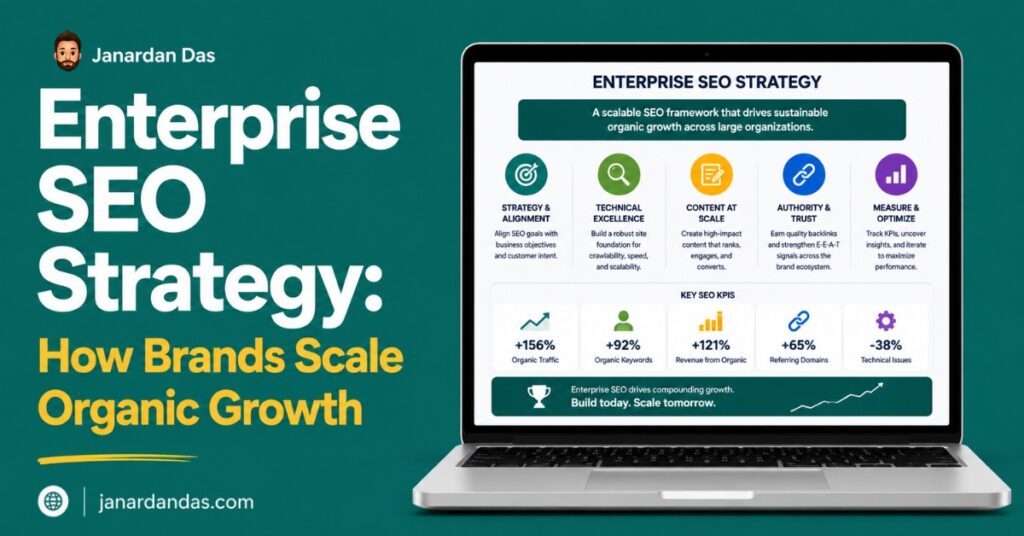

Enterprise SEO is not SEO with more pages. That framing is why so many large brands spend significant budget on organic search and see underwhelming results. The real difference between enterprise SEO and standard SEO is not scale. Its complexity. You’re dealing with multiple stakeholders who all have opinions on canonical tags. You’re managing dev sprint cycles that make a simple title tag change take six weeks. You’re trying to build topical authority across thousands of URLs where duplication, orphaned content, and crawl inefficiency are quietly killing rankings that should already be yours.
I’ve worked on enterprise SEO programs for brands operating in competitive verticals with 50,000-page websites, international subdomain structures, and content teams producing articles that never rank because the underlying technical architecture is broken. In most of those engagements, the biggest wins didn’t come from publishing more content. They came from fixing what was already there: consolidating duplicate URLs, surfacing orphaned pages through internal linking, resolving Core Web Vitals issues that had been deprioritized for two years, and building content clusters that gave Google a coherent topical signal instead of thousands of disconnected pages.
Enterprise SEO at scale means operating across legal approvals, engineering queues, brand guidelines, and multi-market considerations simultaneously. Most SEO consultants are not built for that environment. This guide covers exactly how I approach enterprise SEO strategy: what I look at first, what levers move the needle fastest, and how I build programs that produce compounding organic growth rather than one-time ranking bumps.
Key Takeaways
- Enterprise SEO requires a different operating model, not just more of the same tactics.
- Technical SEO is almost always the highest-leverage starting point on large sites: crawl efficiency, Core Web Vitals, duplicate content, and internal linking architecture.
- Content at enterprise scale requires governance frameworks, not just editorial calendars.
- AI Overview and LLM visibility matter more at the enterprise level because branded queries and category-defining queries both appear in AI-generated answers.
- Link building for enterprise brands is about consolidating existing authority and earning high-relevance editorial links, not volume-based campaigns.
- SEO wins at enterprise scale require cross-functional buy-in. Strategy without execution pathways is not strategy.
Why Enterprise SEO Strategy Requires a Different Operating Model
The SEO playbook for a 50-page website does not translate to a 50,000-page one. Not because the fundamentals change, but because the constraints do. At enterprise scale, the bottleneck is almost never “we don’t know what to do.” It’s “we can’t implement what we know.”
A brand managing a global website with regional subdirectories, multiple CMS platforms, a content team of 20 people, and a single shared dev team has an SEO execution problem, not an SEO knowledge problem. Recommendations sit in a backlog. Title tag updates go through brand review. Redirects require sign-off from legal because the URL contains a trademark. In this environment, the most important skill an enterprise SEO strategist brings is not technical knowledge. It’s knowing how to operate within institutional constraints while still moving fast enough to matter.
The Stakeholder Problem in Enterprise SEO
Enterprise SEO programs fail most often because of misaligned stakeholders, not misaligned strategy. I’ve seen technically flawless SEO audits produce zero implementations because no one built the internal case for prioritizing the recommendations in the engineering backlog. Marketing wants traffic. Engineering wants clean code. Legal wants nothing that could create liability. Finance wants ROI proof before approving budget. The enterprise SEO strategist has to build a case that speaks to all four audiences simultaneously.
When I engage with an enterprise client, one of the first things I establish is not the keyword strategy. It’s the implementation pathway. Who approves changes? How long does a dev cycle take? Who owns the CMS? What’s the fastest way to get a recommendation live? The answers to those questions determine the entire execution sequence. A technically perfect recommendation that requires three months of dev time is worth less in the short term than a directionally good recommendation that can go live next week.
Where Large Sites Lose Organic Ground Without Noticing
Enterprise websites accumulate technical debt silently. A URL parameter gets added to support a new filtering feature, and creates 3,000 near-duplicate pages that start competing with the canonical. A site migration happens and 200 high-authority URLs get accidentally redirected to the homepage instead of their proper equivalents. A new CMS rollout changes the heading structure of 10,000 blog posts simultaneously, stripping H1 tags or replacing them with the site name. Each of these is a ranking event disguised as an infrastructure change.
The brands that catch these changes fast have one thing in common: automated monitoring. Google Search Console alerts, Ahrefs Site Audit on a weekly crawl schedule, and a custom dashboard tracking organic impressions and CTR by page segment (blog, product pages, landing pages) separately. When a page segment drops 15% week over week, you catch it before it compounds. When you’re checking rankings monthly in a spreadsheet, you catch it after the damage is done.
Technical SEO for Enterprise Sites: The Highest-Leverage Starting Point
In 7 years of doing this, I have yet to audit a large enterprise website that didn’t have significant technical SEO problems. Not minor issues. Revenue-impacting problems: pages Google can’t crawl, content that’s indexed but inaccessible to Googlebot due to JavaScript rendering issues, internal linking structures that concentrate PageRank in the wrong places, and crawl budgets wasted on parameterized URLs that should have been excluded years ago.
When I take on an Enterprise SEO Consultant engagement, technical SEO is where I start. Always.
Crawl Budget Management at Scale
Google allocates a crawl budget to each site based on its authority and server performance. For a site with 100,000 URLs, Googlebot cannot crawl everything every day. If your crawl budget is being consumed by parameter variants, paginated pages with thin content, internal search results, and staging URLs that escaped a robots.txt misconfiguration, your actual content pages are being crawled less frequently and ranked on the basis of stale signals.
The fix requires three things: a full crawl using Screaming Frog or Sitebug to map every URL being discovered, a log file analysis using a tool like Botify or JetOctopus to see exactly which URLs Googlebot is visiting and how frequently, and a systematic exclusion of URLs that should never be crawled using robots.txt directives and noindex tags. This process alone has recovered significant rankings for enterprise clients by freeing crawl budget for the pages that actually matter.
JavaScript SEO at Enterprise Scale
Many enterprise sites use React, Angular, or Vue.js frameworks that render content client-side. Googlebot can process JavaScript, but it does so in a second wave, after initial crawling, which means JavaScript-rendered content may be indexed days or weeks after the page is first crawled. For product pages and content that needs to rank fast, this delay matters.
The solution is server-side rendering (SSR) or dynamic rendering for critical pages: category pages, pillar content, product pages, and landing pages where ranking speed has a commercial impact. Blog posts and lower-priority content can tolerate client-side rendering more easily. The implementation decision needs to be made collaboratively with engineering, which is why the stakeholder alignment work happens first.
Internal Linking Architecture for Large Sites
Most enterprise sites have a homepage with strong external link equity and hundreds of deep content pages that receive almost no internal links. This means the pages most likely to rank for competitive terms (deep guides, specific product pages, long-tail content) are starved of PageRank while the homepage accumulates authority it can’t fully use.
A proper internal linking strategy for enterprise sites works backwards from value: identify the highest-priority pages (highest commercial intent, highest conversion rate, highest potential traffic), map every related piece of content that could logically link to them, and systematically build those internal links across the site. For sites with thousands of pages, this is done programmatically: using content similarity tools or a custom Screaming Frog export to identify linking opportunities at scale, then implementing them through CMS bulk updates rather than manual edits.
Enterprise Content SEO: Governance, Clusters, and AI Visibility
Publishing content at enterprise scale without a governance framework produces the exact opposite of topical authority. It produces topical chaos: hundreds of pages on vaguely related topics, written by different teams to different standards, with no coherent internal linking structure, competing for the same keywords against each other. I’ve audited enterprise content libraries where the company had 40 blog posts targeting variations of the same keyword, each ranking on page 4 because none of them was strong enough to dominate, and they were all splitting the same crawl attention and internal link equity.
The Content Audit as the Starting Point for Enterprise Content Strategy
Before adding new content to a large site, audit what’s already there. A content audit maps every indexed URL against its current ranking position, organic traffic (from Google Search Console), word count, internal links received, and last modification date. From that data, you identify four buckets: keep and optimize (ranking, getting traffic, needs updates), consolidate (multiple thin posts on the same topic that should be merged into one authoritative guide), redirect (pages with no traffic and no ranking value that should redirect to stronger equivalents), and delete and noindex (pages that add no value and dilute overall site quality signals).
For most enterprise sites, this audit reveals that 30 to 40% of their indexed content is producing less than 10 organic sessions per month. That content is not helping topical authority. In many cases, it’s hurting it because it signals to Google that a significant portion of the site’s content is low-quality or irrelevant.
Building Topical Authority Clusters at Enterprise Scale
Topical authority at enterprise scale means covering every relevant sub-topic within your core categories at a depth that makes your site the definitive resource. This is not about publishing one piece per keyword. It’s about building interconnected clusters where a pillar page covers the broad topic and supporting pages address every specific question, use case, objection, and sub-topic within it.
For a large brand in a complex category, a single topical cluster might contain 15 to 25 pages. Across 5 to 10 core topic areas, that’s 75 to 250 pages of structured, interlinked content. The enterprise SEO advantage here is real: large brands with the editorial resources to build these clusters comprehensively can establish category ownership that smaller competitors with one or two posts cannot challenge.
AI Overview and LLM Visibility at Enterprise Scale
Enterprise brands have a unique exposure to AI-generated search results that smaller sites don’t face in the same way. When someone searches a brand category term like “best enterprise SEO platforms” or “enterprise link building strategy,” the AI Overview is pulling from multiple sources and synthesizing an answer. If your brand is not in the cited sources, you are invisible to the portion of your audience that stops at the AI Overview and never scrolls down to the blue links.
Optimizing for AI Overview citations at enterprise scale requires an answer-first content structure across the entire content library, not just new posts. This means retrofitting existing high-authority pages with direct answer paragraphs at the top of each section, adding FAQPage schema at scale, and ensuring that entity density (named tools, named frameworks, specific statistics with sources) is present throughout the content rather than confined to a few manually optimized pages.
This is work I cover in detail through my AI & LLM SEO service, specifically for brands that need to build AI visibility alongside traditional organic rankings.
Link Building for Enterprise Brands: Authority Consolidation First
Enterprise brands typically have a counterintuitive link problem. They have significant domain authority from years of existence, press coverage, and natural link acquisition, but that authority is fragmented and often pointed at pages that no longer exist, have been redirected incorrectly, or are not the pages that need it most. Before running any new link acquisition campaign, the highest-leverage link building work at enterprise scale is usually internal: consolidating existing authority.
Link Reclamation and Redirect Auditing
Use Ahrefs Site Explorer to pull every inbound link pointing to your domain. Filter for links pointing to 404 pages and redirect chains. Every 404 with inbound links is a link equity leak. Implement proper 301 redirects from those dead URLs to the most relevant live equivalents, and you recover that authority without acquiring a single new link. For large sites, this exercise can surface hundreds of lost links. I’ve seen reclamation campaigns move domain authority measurably within 60 days simply by cleaning up redirect chains and 404 errors.
Editorial Link Building That Matches Enterprise Standards
Enterprise brands cannot use the same outreach-volume approach that works for smaller sites. Sending 500 cold outreach emails from a brand domain that buyers and journalists recognize creates reputational risk. Enterprise link building is selective, relationship-driven, and focused on publications with genuine audience overlap.
The most effective channels for enterprise link building are original research (surveys, annual reports, proprietary data studies that journalists cite), expert-led contributed content in relevant trade publications, and partnership-driven co-marketing that generates mutual editorial links. For enterprise SaaS or technology brands, the Link Building strategy also includes developer community content that earns links from technical blogs and documentation sites, which carry strong relevance signals for technology-category keywords.
How I Structure an Enterprise SEO Engagement
Enterprise SEO is not a single deliverable. It’s a sustained program. The way I structure engagements reflects that reality: the first 90 days are diagnostic and foundational, the middle period is execution-heavy, and the ongoing relationship is about iteration, monitoring, and adapting to algorithm changes before they compound into ranking losses.
Phase 1: Audit and Prioritization (Days 1 to 60)
I start every enterprise engagement with a comprehensive SEO Audit: technical crawl, content audit, backlink profile analysis, keyword gap assessment, and competitor benchmarking. The output is not a 200-slide deck that gets filed away. It’s a prioritized action list ranked by impact and implementation effort, with a clear rationale for why each item is ranked where it is. The engineering team gets the technical items in a format compatible with their ticketing system. The content team gets the content items with specific briefs. The strategic items go to the leadership stakeholders with a revenue impact framing.
Phase 2: Execution and Monitoring (Months 2 to 6)
This phase is where most enterprise SEO programs succeed or stall. The audit is done. The recommendations exist. The question is whether they get implemented. I stay involved in the execution phase specifically to manage this: attending sprint planning sessions where needed, QA-ing implementations before they go live, and tracking the impact of each change so the team can see the results of their execution effort. That visibility is what keeps momentum alive in a large organization where SEO competes for dev resources with product features.
Phase 3: Compounding Growth (Month 6 onward)
Enterprise SEO results compound when the foundation is right. New content ranks faster because the technical infrastructure is clean. Internal links flow efficiently because the architecture has been rebuilt. New link acquisition builds on an already-strong authority base rather than compensating for technical problems. By month 6 to 12 of a well-executed program, organic traffic growth tends to accelerate rather than plateau, because each new piece of content benefits from the accumulated authority and infrastructure improvements made earlier.
Conclusion
Enterprise SEO strategy is an organizational capability as much as a technical discipline. The brands that scale organic growth consistently are not the ones with the biggest content budgets. They’re the ones with clean technical foundations, structured content governance, cross-functional alignment on implementation, and a measurement system that connects rankings to revenue rather than tracking vanity metrics.
If you’re running SEO at a large organization and feel like you’re producing recommendations that don’t get implemented, or publishing content that doesn’t rank despite significant resources, the problem is almost always structural, not tactical. I work with enterprise brands to identify exactly where that structure is breaking down and build the execution system to fix it. If that sounds like where you are, the Enterprise SEO Consultant page is where to start.
Frequently Asked Questions
What is an enterprise SEO strategy?
Enterprise SEO strategy is the process of planning and executing search engine optimization for large websites, typically those with thousands to hundreds of thousands of pages, multiple teams, complex technical infrastructure, and competitive keywords with significant revenue at stake. It differs from standard SEO primarily in its operational complexity: implementations require cross-departmental coordination, technical changes go through engineering queues, and content governance must work across large editorial teams. The strategic priorities are also different, with crawl efficiency, technical debt, and topical authority clusters taking precedence over individual page optimization.
How is enterprise SEO different from regular SEO?
Regular SEO focuses on optimizing individual pages and small-to-medium websites where one person or a small team can implement recommendations quickly. Enterprise SEO operates at a scale where individual page optimization is impractical: the priorities are systemic, targeting the architecture, crawl efficiency, internal linking structure, and content governance that affects thousands of pages simultaneously. Stakeholder management is a core competency in enterprise SEO in a way it rarely is at smaller scale. Engineering, legal, brand, and finance teams all have input on what gets implemented and when.
What is the first thing to fix in enterprise SEO?
Technical SEO is almost always the highest-leverage starting point. Specifically: crawl budget waste (parameterized URLs, thin paginated pages, and internal search results consuming Googlebot’s attention), Core Web Vitals issues at scale, duplicate content from URL parameters or CMS-generated variants, and internal linking gaps that leave high-priority pages starved of PageRank. Fixing these issues makes every subsequent content and link building investment more effective because Google can now crawl, index, and rank pages it was previously missing or de-prioritizing.
How long does enterprise SEO take to show results?
Meaningful organic traffic increases typically appear between 6 and 9 months into a well-executed enterprise SEO program. However, early technical wins, such as recovering crawl budget, fixing redirect chains, and resolving Core Web Vitals issues, can show ranking improvements within 4 to 8 weeks of implementation. Full compounding growth, where new content ranks faster and existing content continues to climb because of improved authority infrastructure, typically becomes visible at the 9 to 12 month mark.
How do you manage enterprise SEO across multiple teams?
Successful enterprise SEO across multiple teams requires three things: a clear RACI (who is responsible, accountable, consulted, and informed for each type of SEO task), a shared ticketing system that integrates SEO recommendations directly into engineering and content workflows rather than keeping them in separate documents, and a regular cross-functional reporting cadence that shows each team the impact of their contribution. When marketing sees that a technical fix their engineering team shipped improved organic impressions by 20%, they invest more in getting future technical recommendations prioritized.
What does an enterprise SEO audit cover?
A comprehensive enterprise SEO audit covers technical crawl analysis (crawlability, indexation, Core Web Vitals, JavaScript rendering, redirect chains, duplicate content), content audit (ranking position, traffic, word count, and linking data for every indexed URL), backlink profile analysis (authority distribution, link reclamation opportunities, toxic link identification), keyword gap assessment (topics competitors rank for that you don’t), and internal linking architecture review. The output should be a prioritized action plan ranked by impact and implementation effort, not a list of every issue found.
How do you scale content for enterprise SEO without losing quality?
Enterprise content at scale requires a governance framework: defined content briefs, keyword-to-URL mapping to prevent internal keyword cannibalization, editorial standards applied through templates and review checklists, and a content audit cycle that retires or consolidates underperforming content rather than letting the content library grow without pruning. Volume without governance produces topical dilution. The brands that scale content successfully maintain strict standards on what gets published and have a systematic process for updating and consolidating existing content alongside publishing new pieces.
What is keyword cannibalization in enterprise SEO, and how do you fix it?
Keyword cannibalization occurs when multiple pages on the same site target the same or closely related keywords, causing them to compete against each other in search results rather than consolidating authority into a single dominant ranking. On enterprise sites with thousands of pages and multiple content teams, cannibalization is common and often goes undetected for months or years. The fix is a keyword-to-URL mapping document that assigns clear ownership of every target keyword to a single canonical page, followed by merging or redirecting duplicate or near-duplicate content into the canonical URL.
How does site architecture affect enterprise SEO?
Site architecture directly affects how PageRank flows through the site, how efficiently Googlebot crawls all pages, and how clearly Google understands the topical relationships between your content. A flat architecture where most pages are only 2 to 3 clicks from the homepage is generally more effective for large sites than a deeply nested structure where important content is buried 6 or 7 levels deep. Topic clusters, where pillar pages and supporting content are tightly interlinked, signal topical authority more clearly to Google than a flat chronological blog structure.
Should enterprise companies hire an in-house SEO team or an external consultant?
Most enterprise brands benefit from a hybrid model: a small in-house SEO team (1 to 3 people) who own the channel internally and manage implementation coordination, combined with an external specialist or consultant who brings strategic depth, cross-industry pattern recognition, and specific technical expertise that is difficult to maintain in-house. A single in-house SEO manager embedded in a large organization often lacks the external benchmarking and specialized expertise that complex enterprise programs require. The external consultant provides strategic direction and specialist skills; the in-house team provides institutional knowledge and execution continuity.
What KPIs should enterprise SEO programs track?
Enterprise SEO programs should track organic-attributed pipeline and revenue (the primary business metric), organic sessions segmented by page type (blog, product, landing pages), keyword coverage across buying stages (awareness, consideration, decision), branded vs. non-branded organic search volume growth, Core Web Vitals pass rate across the site, indexed page count vs. total URL count (to catch indexation problems), and AI Overview citation frequency for key category queries. Rankings alone are insufficient as a primary KPI because they don’t capture zero-click visibility or actual business impact.
How does international SEO fit into an enterprise SEO strategy?
International SEO adds a layer of complexity to enterprise programs: hreflang implementation across regional variants, subdomain vs. subdirectory structure decisions for international markets, regional keyword research that accounts for language variation and local search intent, and crawl budget management across multiple market-specific URL structures. For enterprise brands in multiple markets, international SEO requires a separate strategic layer on top of the core enterprise program, with market-specific keyword research, localized content governance, and regional link building. Getting hreflang wrong at scale is one of the most common and costly international SEO errors on large sites.