
Key Takeaways
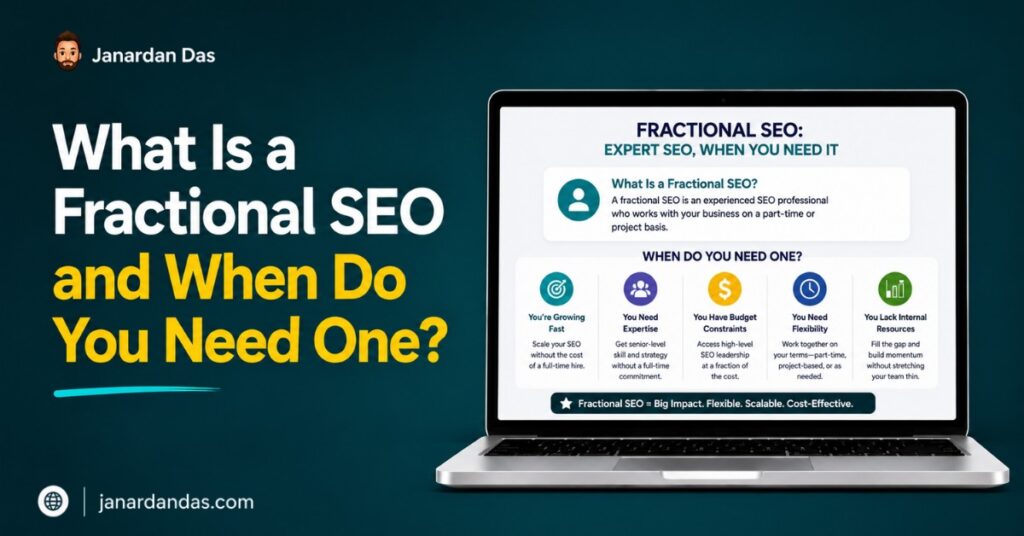
- A fractional SEO is a senior SEO professional who works with your business part-time but owns strategy, not just execution.
- The model sits between a freelancer (task-based) and a full-time hire (fully embedded), and costs significantly less than either a full-time salary or a full-service agency retainer.
- The right time to hire a fractional SEO is when you have organic search as a real growth channel, a budget of at least $3,000 to $6,000 per month, and someone in-house who can implement.
- The wrong time is when you have no content infrastructure, no technical team, and expect the fractional SEO to do everything themselves.
- A good engagement starts with a site audit and 90-day roadmap, then moves into a recurring cadence of strategy, oversight, and execution guidance.
Most businesses that need SEO are not at the stage where hiring a full-time SEO director makes financial sense. A senior SEO lead in a competitive market costs anywhere from $120,000 to $180,000 annually in salary alone, before benefits, equity, or management overhead. For a Series A startup, a bootstrapped ecommerce brand, or a services business with a lean team, that number does not pencil out.
But the alternative, handing SEO off to a generalist marketer who “knows some SEO” or paying an agency $3,000 a month for a deliverables checklist, rarely moves the needle either.
That gap is where the fractional SEO model exists. A fractional SEO gives your business access to senior-level SEO strategy and execution leadership without the cost or commitment of a full-time hire. The model is not new, but the demand for it has grown sharply as more businesses realize that consistent, strategic SEO work requires someone who thinks in systems, not just tasks.
This article breaks down what a fractional SEO actually does, how the engagement model compares to freelancers and agencies, when it makes sense for your business, and what you should expect to get out of it.
What a Fractional SEO Actually Does Beyond the Job Title
A fractional SEO is not a part-time SEO specialist. The distinction matters.
A specialist executes tasks: writes title tags, builds links, and uploads blog posts. A fractional SEO owns the strategy layer: decides which tasks get done, in what order, with what resources, and measures whether they are working. The difference between those two is the difference between someone who follows a playbook and someone who writes one.
Strategy Ownership vs. Task Execution
The core of a fractional SEO’s role is decision-making. They are responsible for figuring out where organic search fits in your overall growth model, what the highest-leverage opportunities are on your specific site, and what roadblocks are holding back performance.
In practice, that means your fractional SEO will do things like: audit your current site against a technical SEO framework, identify keyword clusters where you can realistically compete, define a content strategy tied to your actual buyer journey, set up tracking and reporting infrastructure so decisions are data-driven, and oversee or directly manage the people executing the work.
What they typically do not do is write every blog post, manually build every link, or act as the implementer across every workstream. Some fractional SEOs will take on more execution than others depending on the engagement scope, but the primary value is thinking and decision-making, not hours logged on production tasks.
If you want someone to execute a list of SEO tasks each month, a freelancer or a content agency is a better fit. If you want someone who owns the channel and is accountable for its performance, that is the fractional model.
What a Fractional SEO Engagement Looks Like Week to Week
Here is a realistic picture of what working with a fractional SEO looks like in practice.
Week one of each month typically involves a review of the previous month’s data: organic traffic trends, keyword movement, conversion performance from organic, and any technical crawl issues that surfaced. This shapes the priority list for the coming weeks.
Weeks two and three are where the core work happens. The fractional SEO might be: reviewing content drafts and giving direction before they go live, meeting with your developer to walk through technical recommendations from the last audit, doing keyword research to brief the next three articles, reviewing your link profile and identifying gaps, or adjusting the strategy based on what Google’s algorithm is rewarding right now.
Week four usually involves output: a report, a strategy update, or a brief for the next cycle.
The number of hours varies by engagement. Most fractional SEO arrangements run between 10 and 20 hours per month. Some go higher during intensive phases, like a site migration or a new vertical launch. The key is that the hours are directed at the highest-value activities, not split evenly across low-impact tasks.
Fractional SEO vs. Freelancer vs. Agency: Where the Model Sits
If you have looked into this before, you have probably wondered whether a fractional SEO is just a freelancer with better positioning, or whether it is meaningfully different from an SEO agency retainer. The answer is: the model is genuinely different, and the right choice depends on what your business actually needs right now.
How the Billing and Scope Differ
A freelancer typically works on a project basis or hourly. You hire them to do a specific thing: write ten articles, conduct a technical audit, or build 20 backlinks. Once that work is done, the engagement ends or restarts on a new project. The scope is narrow by design, and the accountability is task-level.
An agency retainer is usually broader. You pay a monthly fee, and the agency delivers a set of services: SEO audits, monthly reporting, content production, link building. The deliverables are defined upfront, and an account manager coordinates the team behind them. You are essentially buying production capacity from a team, not strategic leadership from a senior individual.
A fractional SEO is closer to what you get when you hire a VP of SEO or a Head of SEO, but for a fraction of the time and cost. The engagement is ongoing, the accountability is outcome-level (not task-level), and the person takes ownership of the channel rather than delivering against a predetermined checklist.
Billing for fractional SEO is almost always a monthly retainer. Rates vary depending on the seniority and track record of the practitioner. Entry-level fractional SEOs might charge $2,000 to $3,000 per month. Senior practitioners with deep specialization or a strong track record typically run $5,000 to $10,000 per month. That number is significantly below what you would spend on a full-time SEO lead once you factor in salary, benefits, and the opportunity cost of hiring.
What Each Model Is Actually Optimized For
Here is the honest breakdown:
Freelancers work well when you have a defined, time-boxed task and someone internally who can direct the work and absorb the output. They are execution resources, not strategic ones.
Agencies work well when you need consistent production volume (content, links, technical fixes) and do not want to manage multiple individual contractors. The trade-off is that the strategic thinking is often thin, and the people doing the work are not always senior.
A fractional SEO works well when SEO is a real growth channel for your business, you need senior-level thinking to set direction, and you have some capacity inside the team to implement recommendations. The model breaks down if you have no one who can execute and expect the fractional SEO to do everything alone.
The Right Time to Hire a Fractional SEO
Not every business is ready for this model. Bringing in a fractional SEO before your business has the internal infrastructure to act on recommendations is like hiring a head chef for a kitchen with no equipment. The thinking is there; the execution cannot follow.
Signals Your Business Is Ready
You are a good candidate for a fractional SEO if most of these are true:
Your site has enough existing traffic that there is something to analyze and optimize. A brand-new domain with zero content and no authority is better served by foundational content and technical setup work before strategy ownership becomes the bottleneck.
You have a real content or marketing budget. A fractional SEO can set direction, but direction without resources does not produce results. If you cannot fund content production, link acquisition, or technical development, the fractional SEO strategy will sit unimplemented.
You have someone internally who can handle implementation, even if they are not a specialist. This could be a developer who can push technical changes, a content writer who can execute on briefs, or a marketing manager who can coordinate vendors. The fractional SEO needs an implementation layer to work through.
Your organic search channel has real commercial potential. B2B companies with specific buyer intent keywords, ecommerce brands with product category and comparison searches, SaaS businesses with software and solution keywords, and local service businesses with high-intent local queries: all of these are categories where fractional SEO pays off clearly. Businesses where search intent does not map well to the buying journey are harder cases.
Signals You Are Not Ready Yet
If you are pre-revenue, early-stage, and building your product, a fractional SEO is probably not the right spend right now. Your time and budget are better directed at product-market fit and direct sales.
If you have no one who can implement technical changes, no content infrastructure, and no budget for link building, a fractional SEO will spend most of their time writing recommendations that go nowhere. Before hiring strategically, make sure the execution layer exists.
If you need someone to be fully embedded in your team, attend daily standups, manage a full in-house SEO team, and treat this as a primary focus, you need a full-time hire, not a fractional arrangement.
What a Fractional SEO Engagement Should Deliver
A fractional SEO engagement should be results-oriented from the start. That means clear milestones, measurable targets, and a strategy that is specific to your site rather than a generic plan pulled from a template.
The First 30 to 60 Days
The first phase of any fractional SEO engagement is diagnosis and a roadmap. Before any tactical work begins, a good fractional SEO needs to understand exactly where your site stands and what the highest-leverage opportunities are.
This typically starts with a technical SEO audit. The audit should cover crawl health (indexation issues, crawl budget problems, redirect chains, duplicate content), Core Web Vitals, site architecture, and internal linking. Tools like Screaming Frog and Ahrefs Site Audit flag technical issues systematically; the judgment call is which ones actually matter for your specific site’s performance.
Alongside the technical audit, a fractional SEO should be doing keyword gap analysis: pulling your current rankings against competitors using Ahrefs or Semrush, identifying which high-intent keywords you should be targeting but are not, and mapping those opportunities to your existing content or content gaps. If you want to run a clean diagnostic first, an SEO audit is the natural starting point before any strategic planning begins.
By day 60, you should have a 90-day roadmap with prioritized initiatives, clear ownership for each item, and defined success metrics tied to business outcomes, not just traffic volume.
Ongoing: What Good Looks Like at 90 Days and Beyond
After the initial audit and roadmap phase, a fractional SEO engagement moves into a recurring strategy and oversight cadence.
At 90 days, you should see measurable movement on the technical issues that were flagged. Crawl health should be cleaner. Any quick-win on-page optimizations (title tag rewrites, internal link improvements, structured data additions) should be live. If you have been publishing content during this period, the content should be mapped to keyword targets with clear intent alignment.
At six months, a well-run engagement should show keyword ranking improvements in your priority clusters, a growing share of indexed, properly structured pages, and a link acquisition process that is either in progress or systematically planned.
The honest truth about SEO timelines: meaningful organic traffic growth from a standing start typically takes four to six months minimum. What separates a good fractional SEO from a bad one is not the presence of results in month one; it is whether the strategic decisions made in months one through three hold up and compound over time.
How to Evaluate and Hire the Right Fractional SEO
The fractional SEO market has grown enough that finding candidates is not the hard part. Evaluating whether they are actually the right person for your business is.
What to Look For
Track record over credentials. A fractional SEO should be able to show you specific results from past engagements: organic traffic growth on a named site type, keyword ranking improvements in a relevant niche, or a documented case of solving a specific problem (a site migration, a manual penalty recovery, a technical crawl issue at scale). Ask for examples and ask follow-up questions about the decisions behind them.
Specificity in their initial thinking. Before you hire anyone, give them enough context about your site and your business goals and see how they respond. A strong fractional SEO will ask sharp questions about your current traffic, your competitive landscape, your conversion funnel, and your existing team capacity. A weak one will pitch you a generic services deck.
Communication style. This person is operating as a senior strategic voice for your business. They need to be able to explain complex technical decisions in plain language to non-SEO stakeholders. If their explanation of their own process confuses you, that is a signal.
Relevant vertical experience. SEO for ecommerce looks different from SEO for B2B SaaS, which looks different from SEO for local service businesses. A fractional SEO who has worked primarily in one vertical will have a steeper learning curve in another. It is not disqualifying, but vertical experience accelerates time to impact.
Red Flags to Avoid
Any fractional SEO who promises specific ranking positions or traffic numbers within a defined timeline is either inexperienced or being dishonest. SEO outcomes are directional, not guaranteed, and anyone with real experience knows this.
Watch out for proposals that lead with deliverables (number of articles per month, number of links per month) rather than strategy. Deliverables-first thinking is an agency pattern. A fractional SEO’s value is knowing which deliverables actually matter, not producing a fixed volume of them.
Be skeptical of fractional SEOs who want to do everything themselves without asking about your team’s implementation capacity. That either means they have not thought seriously about how the work gets done, or they are going to bottleneck on execution and blame slow results on your team later.
If you are evaluating someone for link building oversight as part of their scope, look at whether their approach is specific and accountable. Vague talk about “building relationships” and “outreach campaigns” without specifics on target site criteria, outreach process, and quality control is a sign that they do not have a systematic approach. My link building service work starts with a precise target list before any outreach begins, and any serious fractional SEO should think the same way.
Conclusion
The fractional SEO model fills a specific and real gap. For businesses where organic search is a meaningful growth channel but a full-time SEO hire is not yet justified, bringing in a senior fractional SEO gives you strategic direction, a clear roadmap, and accountability for results at a cost that makes sense.
The model only works when both sides hold up their end. The fractional SEO has to own the strategy and communicate it clearly. Your business has to have the infrastructure to act on it. Get both right, and the compounding nature of SEO means the investment pays back disproportionately over time.
If you are weighing whether a fractional SEO arrangement fits your business right now, start by honestly assessing whether you have the implementation capacity to act on strategic guidance. If yes, the next step is finding someone whose track record matches your specific business type and growth stage.
Frequently Asked Questions
What is a fractional SEO?
A fractional SEO is a senior SEO professional who works with a business on a part-time or retainer basis, typically 10 to 20 hours per month, and takes strategic ownership of the organic search channel. Unlike a freelancer who executes specific tasks, a fractional SEO sets direction, builds the roadmap, and is accountable for channel-level outcomes. The model is common in businesses that need senior SEO thinking but cannot justify or afford a full-time hire.
How much does a fractional SEO cost?
Fractional SEO retainers typically range from $2,000 to $10,000 per month, depending on the seniority of the practitioner, the scope of the engagement, and the complexity of the site. Entry-level or generalist fractional SEOs sit at the lower end. Senior specialists with deep vertical experience and a documented track record of results typically charge $5,000 to $10,000 per month. That remains significantly below the all-in cost of a full-time SEO director.
What is the difference between a fractional SEO and an SEO freelancer?
A freelancer executes defined tasks: an audit, a set of articles, and a link building campaign. The engagement is often project-based and task-level in accountability. A fractional SEO owns the strategy layer. They decide which tasks get done, set the roadmap, oversee implementation (whether by you, your team, or vendors), and are accountable for channel performance over time. The distinction is between doing specific work and owning an outcome.
Is a fractional SEO the same as an SEO agency?
No. An agency provides a team-based service model with predefined deliverables (monthly reports, content production, link building packages). A fractional SEO is a single senior individual who acts as strategic leadership for your SEO channel. Agencies optimize for consistent production volume. A fractional SEO optimizes for the right decisions. In many cases, businesses use a fractional SEO to set a strategy and then use lower-cost vendors or in-house staff to execute the production work.
When should I hire a fractional SEO instead of a full-time SEO?
Hire a fractional SEO when: your organic search growth goals are real, but a full-time SEO hire is not yet financially justified, you need senior-level thinking without the overhead of a full-time employee, and you have some internal capacity to implement recommendations. Hire full-time when your business is large enough that SEO requires daily, deeply embedded attention, you need someone managing a full in-house SEO team, or the channel is material enough to your revenue that fractional involvement creates a bottleneck.
What should I expect in the first 90 days of a fractional SEO engagement?
The first 30 to 60 days should focus on a thorough site audit, keyword gap analysis, and a prioritized 90-day roadmap. By day 90, you should have measurable movement on technical issues, quick-win on-page improvements live, and a content and link strategy in active execution. If your fractional SEO is still in “research mode” at 90 days with nothing shipped, that is a red flag.
How many hours per month does a fractional SEO work?
Most fractional SEO engagements run between 10 and 20 hours per month. Some expand to 30+ hours during high-intensity phases like site migrations, major content pushes, or new vertical launches. The value is not in the hours logged but in the quality of the decisions made during those hours. A 10-hour month with sharp strategic calls can outperform a 40-hour month of undirected execution.
Can a fractional SEO work without an in-house team?
It depends on the scope. A fractional SEO can partner with external vendors for content production and link building while providing strategic direction and oversight. What they cannot do is be effective if no implementation layer exists at all. Someone needs to push technical changes, produce or brief content, and manage outreach. If your business has zero capacity to execute, the strategy sits unimplemented regardless of how strong it is.
What results should I expect from a fractional SEO?
Realistic expectations: measurable improvement in keyword rankings within your target clusters within three to six months, improved crawl health and technical SEO scores within 60 to 90 days, and organic traffic growth that trends upward over six to twelve months of consistent execution. SEO is a compounding channel. Month-one results are diagnostic; month-six to twelve results are where the investment becomes visible in revenue.
How do I know if my fractional SEO is doing a good job?
The leading indicators are: Are technical issues being fixed systematically? Are content decisions tied to keyword data and search intent? Are rankings moving in the right direction for target keywords? Are there clear explanations when things are not working, and adjustments being made? The lagging indicator is organic traffic and the conversions that come from it. If your fractional SEO cannot articulate a clear reasoning chain from their decisions to the numbers on your dashboard, something is wrong.
Is fractional SEO worth it for small businesses?
For small businesses where organic search is a genuine acquisition channel (local service businesses, ecommerce stores, B2B service providers), fractional SEO can deliver strong ROI because the cost is a fraction of what an agency or full-time hire would run. The key is that the business has to be able to act on recommendations. A small business owner who can implement changes based on strategic guidance is a great fit. A small business with no bandwidth to execute anything will not get value from the engagement, regardless of how good the strategy is.