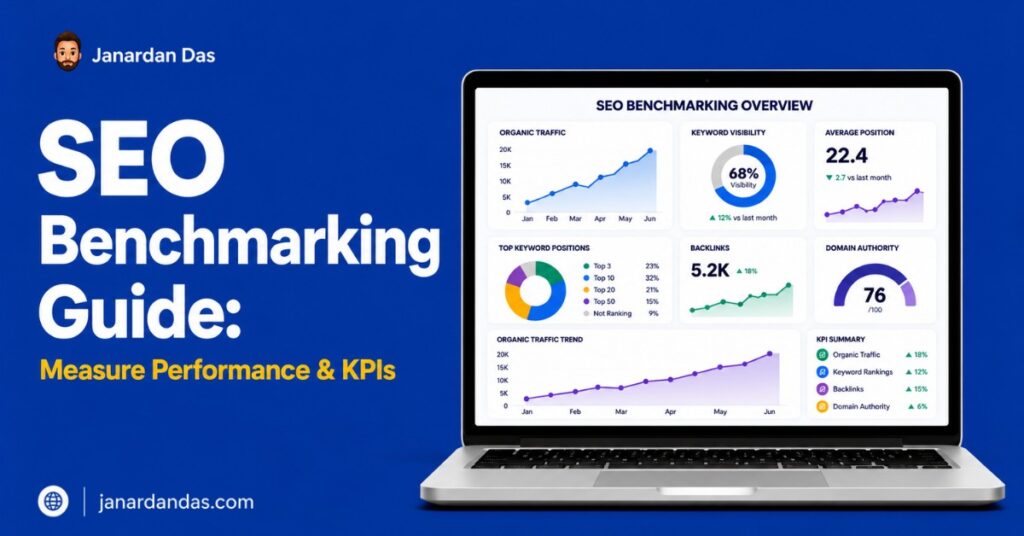

Most SEO benchmarking advice tells you to "track your rankings and organic traffic." That is not benchmarking. That is reporting. There is a meaningful difference, and conflating the two is exactly why most SEO teams spend months working without knowing if anything is actually moving in the right direction.
Real SEO benchmarking answers a specific question: compared to what? Compared to where you were six months ago, compared to your top three competitors, compared to what the data says should be possible given your domain authority and content depth. Without that comparison layer, you are just watching numbers change on a screen and hoping the trend is good. I have run SEO on sites across eCommerce, B2B SaaS, and service businesses, and the pattern I see over and over is the same: teams track everything and benchmark nothing. They have dashboards full of organic sessions, click-through rates, and keyword counts. But when asked, “Is your SEO working?” they cannot give a straight answer because they never defined what “working” looks like against a real baseline.
This guide lays out the exact benchmarking framework I use across projects, the metrics I prioritize and the ones I ignore, and the specific tools and cadences that actually surface useful signals. If you are setting up SEO tracking from scratch or trying to make sense of an existing reporting mess, this is where I would start.
Key Takeaways
- SEO benchmarking compares performance against a defined baseline, not just tracking metrics over time.
- The five benchmarks that matter most are organic click share, keyword coverage vs. competitors, crawl-to-index ratio, topical authority depth, and share of SERP features.
- Use a 90-day rolling window as your primary comparison period. Weekly data is too noisy. Annual is too slow.
- Competitor benchmarking is not optional. Your traffic could drop by 20% and still be a relative win if competitors drop by 40%.
- Set benchmarks before you start any SEO initiative, not after.
What SEO Benchmarking Actually Means (and Why Most Teams Get It Wrong)
SEO benchmarking is the process of measuring your current performance against a defined reference point so you can evaluate whether your strategy is producing results. That reference point can be your own historical data, a competitor’s performance, or an industry standard. What it cannot be is “whatever we tracked last month.”
The mistake I see most often in SEO strategy work is treating benchmarking as a reporting function instead of a strategic one. Reports tell you what happened. Benchmarks tell you whether what happened is good, bad, or neutral relative to where you should be. Those are fundamentally different questions.
Why Vanity Metrics Kill SEO Accountability
If your organic traffic grew 15% this quarter, does that mean your SEO is performing well? Maybe. But if your top competitor grew 40% in the same window, and your industry’s average organic growth rate was 22%, your 15% is underperformance by two different measures. Without those reference points, you would celebrate a number that actually indicates a problem.
This is why I always start any SEO engagement with a benchmark audit before touching a single title tag or building a single link. I need to know what the baseline looks like so that in 90 days, I can say specifically what moved, by how much, and whether it was enough. If you need help setting that baseline properly before starting a new initiative, this is exactly what my SEO consulting and strategy work covers.
The Two Types of Benchmarks You Need
Internal benchmarks compare your current performance to your own historical data. These are useful for tracking momentum and confirming that the changes you made had the effect you expected. The most useful internal benchmark windows are 90 days over 90 days (MoM rolling), and year over year for seasonal sites where monthly comparison is misleading.
Competitive benchmarks compare your performance to the sites ranking above you, beside you, or threatening to displace you. These are the benchmarks most teams skip because they require more setup, but they are the only benchmarks that tell you whether your SEO is actually competitive or just in motion.
You need both. Internal benchmarks tell you if you are improving. Competitive benchmarks tell you if your improvement is enough.
The Five SEO Benchmarks That Actually Signal Progress
Not all metrics are worth benchmarking. Many are either too noisy, too easy to inflate, or too disconnected from business outcomes to be useful as performance signals. Here are the five I track on every project and why each one earns its place.
1. Organic Click Share vs. Competitors
Organic click share measures the percentage of the total available clicks in your target keyword set that your site is capturing, compared to the full set of competing domains. It is more useful than raw traffic because it accounts for changes in search volume. If a keyword loses 30% of its search volume due to a shift in demand, your traffic could fall even if your rankings are steady. Click share surfaces that distinction.
How to track it: Pull your target keyword list into Ahrefs or Semrush. Use the SERP overview for each keyword to estimate total click volume, then compare your site’s estimated clicks against the top three to five competitors. This is not a single-session task. Build it into a spreadsheet you update every 30 days.
The benchmark question: Is your click share growing relative to your competitors, not just in absolute terms? If you are capturing 8% of clicks in your target keyword set and your nearest competitor is at 22%, that gap is your benchmark. Closing it by two to three percentage points per quarter is meaningful progress. Staying flat is a signal that your current strategy is not working.
2. Keyword Coverage Depth vs. Competitors
This benchmark looks at how many keywords in your target topic space you rank for in positions 1 to 10, compared to how many your top competitors rank for. It surfaces gaps in your content coverage that organic traffic data alone will not show.
Use Ahrefs’ Content Gap tool or Semrush’s Keyword Gap feature for this. Enter your domain and two to three competitors, filter to keywords where competitors rank in the top 10 but you do not, and you have your coverage gap. Quantify it. If a competitor ranks for 3,200 keywords in your niche and you rank for 800, your coverage ratio is roughly 25%. That number is your starting benchmark. Growing it to 40% in two quarters is a concrete, measurable target.
What most benchmarking guides skip: keyword coverage depth matters more than total keyword count. It is better to rank in positions 1 to 3 for 500 high-intent keywords than to have 5,000 rankings scattered across positions 20 to 50. When you track this metric, filter to positions 1 to 10 specifically, and weight your analysis toward keywords with transactional or commercial intent.
3. Crawl-to-Index Ratio
This one is underused and underappreciated. Your crawl-to-index ratio is the percentage of pages Google crawls that it then actually indexes. A healthy site should have a ratio above 80%. If Google is crawling 1,000 pages but only indexing 600, something is wrong, and traffic benchmarks alone will not tell you what.
Pull this from Google Search Console. Go to Settings, then Crawl Stats, to see total crawl requests. Cross-reference with the Coverage report to see how many pages are indexed. The gap between those two numbers is your benchmark.
This metric matters especially if you are working on a large-scale site with hundreds or thousands of pages. A declining crawl-to-index ratio is often an early signal of crawl budget issues, duplicate content problems, or indexation directives that are unintentionally blocking good pages. I always track this in a technical SEO audit before anything else, because no amount of content or links will fix a site that Google is not fully indexing.
4. Topical Authority Depth by Cluster
Topical authority is Google’s assessment of how comprehensively your site covers a given subject area. Benchmarking it requires measuring coverage within a defined topic cluster, not across your site as a whole.
The practical way to benchmark topical authority: define your primary topic clusters (for example, “link building“, “technical SEO“, “eCommerce SEO“). For each cluster, identify the 20 to 30 most important keywords. Then check how many of those keywords your site ranks for in positions 1 to 20, compared to your top competitor for that cluster. The competitor with the deepest coverage across that keyword set tends to own the most traffic and the most featured snippets.
If you rank for 6 out of 25 core keywords in a cluster while your competitor ranks for 19 out of 25, you have a coverage deficit in that cluster that content creation or link building alone can address. This benchmark should be revisited every 60 days, because it tracks slowly. Topical authority builds over months, not weeks.
5. Share of SERP Features
The final benchmark I track is what percentage of available SERP features your site is capturing across its target keyword set. This includes featured snippets, People Also Ask appearances, image pack results, video results, and site links.
Why it matters: Google has significantly expanded rich results over the past two years. In many niches, the difference between a site ranking position 1 with no SERP features and a site ranking position 3 with a featured snippet is that the position 3 site gets more clicks. Tracking raw rankings without tracking SERP feature capture gives you an incomplete picture.
Use Semrush’s Position Tracking tool, which shows SERP feature columns alongside rank data. Set a baseline for how many SERP features you currently appear in across your tracked keywords, then compare that against the sites most frequently appearing in those features. If your top competitor holds featured snippets for 40 of your 150 tracked keywords and you hold four, that gap is your benchmark.
How to Set Up a Competitive SEO Benchmarking System
Knowing which metrics to track is half the job. The other half is building a system that makes benchmarking repeatable without consuming 10 hours a month maintaining spreadsheets.
Step 1: Define Your Competitive Set
Most teams benchmark against the wrong competitors. Your SEO competitors are not the same as your business competitors. Your SEO competitors are the domains ranking in positions 1 to 5 for your highest-priority keywords, regardless of what they sell or who they serve.
Pull your top 10 to 15 target keywords into Ahrefs and note which domains appear most frequently in positions 1 to 5. The domains that appear across more than 30% of that keyword set are your primary SEO competitors. Benchmark against these domains specifically. For most niches, three to five competitors are enough.
Step 2: Establish Baselines Before Any Work Starts
This is the step most people skip and then regret. Before you launch a new content strategy, start a link building campaign, or push a technical fix live, document the current state of every benchmark metric you plan to track. Date it. Store it somewhere you will not lose it.
Without a pre-intervention baseline, you cannot attribute improvements to anything specific. You are just watching numbers change and guessing at causes. I set baselines at the start of every project and review them at the 30, 60, and 90-day marks. That review structure is what lets me tell a client exactly what moved and what did, not give them a vague story about “SEO taking time.”
Step 3: Use a 90-Day Rolling Comparison Window
Weekly SEO data is too noisy to benchmark meaningfully. A single Google algorithm update, a holiday weekend, or a temporary crawl spike can make week-over-week comparisons actively misleading. Monthly comparisons are better but still susceptible to seasonal bias.
The 90-day rolling window smooths most of that noise without losing enough recency to be useful. I compare the current 90 days to the previous 90 days for internal benchmarks, and to the same 90-day period in the prior year for any site with seasonal traffic patterns. Year-over-year (YoY) comparison is especially critical for eCommerce SEO, where Q4 traffic will always look like an anomaly compared to Q1 without a proper seasonal baseline.
Step 4: Build a Single Source of Truth Dashboard
Do not benchmark across five separate tools. The data will not reconcile, and you will spend more time explaining discrepancies than making decisions. Pick one primary reporting layer and pull everything into it.
My standard setup: Google Search Console as the source of truth for impressions, clicks, and crawl data. Ahrefs for keyword rankings and competitive gap analysis. A single Google Sheet that aggregates the five benchmark metrics above, updated monthly with color-coded delta columns so changes are visible at a glance.
If you want more automation, Looker Studio (formerly Google Data Studio) connects to Google Search Console natively and to tools like Semrush and Ahrefs via third-party connectors. But do not let the dashboard become the project. The goal is a clear signal, not a beautiful interface.
Common SEO Benchmarking Mistakes I See in Real Projects
Every mistake here is one I have either made myself or found when taking over an existing SEO program from another team.
Benchmarking Traffic Without Controlling for Seasonality
A SaaS company I reviewed a while back was tracking organic traffic month-over-month and reporting steady growth. When I pulled their year-over-year data alongside a competitor comparison, it became clear that most of the growth was seasonal, driven by increased search demand in their category, not by anything the SEO team had done. Their share of total available clicks had actually declined slightly while their absolute traffic grew. They were winning in a rising tide and attributing it to strategy.
Fix: always pull YoY comparisons for any metric affected by seasonality. If your category search volume grew 25% and your organic traffic grew 20%, that is not SEO progress.
Using Domain Authority as a Performance Benchmark
Domain Authority (Moz) and Domain Rating (Ahrefs) are third-party metrics with real utility for assessing a site’s backlink strength relative to others. They are not performance benchmarks. They do not correlate directly with traffic or rankings in a tight enough way to measure against them month-to-month. I have seen sites with DR 30 outrank sites with DR 65 on commercial keywords because of better content depth and topical authority.
Use DA and DR for competitive analysis (understanding who you are up against and roughly how strong their link profiles are). Do not use them as the primary lens for benchmarking your own SEO progress.
Tracking Rankings Without Tracking Click-Through Rate
A keyword ranking in position 1 can have a wildly different CTR depending on what SERP features appear above it. If Google added a featured snippet, a People Also Ask block, and three ads above your organic result, your position 1 result may be getting 6% CTR instead of the expected 28% to 35%. Rankings and clicks need to be tracked together.
Google Search Console gives you actual CTR data by keyword and page. Pull it. Compare your average CTR by position against the industry benchmarks published by studies from Advanced Web Ranking and Semrush. If your position 1 page is getting 12% CTR when the benchmark for position 1 is around 25% to 30%, you likely have a title tag or meta description problem, or you are being displaced by SERP features.
Setting Benchmarks After Results Are Already In
This is the equivalent of drawing a target around an arrow after it lands. If you wait until your organic traffic has grown 30% and then declare that was the goal all along, your benchmarks are meaningless. They have to be defined before the intervention, with enough specificity to be falsifiable. “We will grow organic sessions by 20% in 90 days” is a benchmark. “We are doing well in organic” is not.
My Personal Benchmarking Workflow, Step by Step
Here is exactly what I do at the start of a new SEO project, in the order I do it.
Week 1: Pull all five benchmark metrics for the client’s domain and three to five competitors. Document them in a dated baseline spreadsheet. Note any anomalies (algorithm update impact, recent site migrations, seasonality factors) that might distort the baseline.
Week 2: Define target benchmarks for each metric at the 30, 60, and 90-day marks. These targets are not guesses. They are calculated based on the gap between current performance and competitor performance, weighted by how many resources are going into each area. If I am investing heavily in content for a cluster where the coverage gap is large, I expect keyword coverage depth to move faster than it would if I were doing minimal content work.
Month 1 review: Check internal benchmarks only. It is too early for meaningful competitive movement. Look for early signals: crawl-to-index ratio improving, new content getting indexed, CTR changes on pages where I updated title tags.
Month 2 review: Start comparing competitive benchmarks. Are the competitor gaps narrowing? Are any competitors accelerating faster than expected, which might indicate they have launched a major initiative?
Month 3 review: Full benchmark review across all five metrics. Compare to the baselines, to the stated targets, and to competitor trajectories. This is the review that tells you whether the strategy is working or needs to change.
Conclusion
SEO benchmarking only works if you treat it as a strategic function, not a reporting task. The five metrics I covered here (organic click share, keyword coverage depth, crawl-to-index ratio, topical authority depth, and SERP feature share) give you enough signal to know whether your SEO is actually competitive, not just whether it is moving.
The starting point is always the same: establish your baseline before you start, pick three to five real SEO competitors, and commit to a 90-day comparison window. Everything else follows from there.
If you are not sure what your current benchmarks look like or how they compare to the sites outranking you, an SEO audit is the fastest way to get that picture clearly.
Frequently Asked Questions
What is SEO benchmarking?
SEO benchmarking is the process of measuring your site’s search performance against a defined reference point, such as your own historical data, competitor performance, or industry standards. It answers the question “is this good or bad relative to a real comparison?” rather than just showing what your metrics are doing in isolation.
How often should I benchmark my SEO performance?
A 90-day rolling comparison is the most useful cadence for most sites. Weekly data is too noisy to benchmark meaningfully, and annual comparisons are too slow for actionable decisions. Review internal benchmarks monthly and competitive benchmarks quarterly, with a full benchmark review at the end of every 90 days.
What tools do I need for SEO benchmarking?
The minimum setup is Google Search Console (free, for actual impressions, clicks, CTR, and crawl data) plus one third-party rank tracker. Ahrefs and Semrush are the two tools I rely on most for competitive benchmarking, keyword gap analysis, and backlink comparison. You do not need both. Pick one and use it consistently.
What is a good organic click-through rate benchmark for position 1?
Studies from Advanced Web Ranking and Semrush consistently show that position 1 in organic search captures between 25% and 35% CTR on average for non-branded, non-featured-snippet results. However, this varies significantly by query type. Navigational queries have higher CTR at position 1. Informational queries with featured snippets or People Also Ask boxes have lower CTR because those features absorb clicks before users reach organic results.
How do I benchmark SEO performance for a new website?
For a new site, you do not have your own historical baseline to compare against yet. Start by benchmarking against competitors in your target keyword set from day one. Track your keyword coverage ratio relative to theirs, your crawl-to-index ratio, and your CTR by position as soon as you start getting impressions in Google Search Console. Your first meaningful internal benchmark comparison will be available around the 90-day mark once you have enough data history.
What is the difference between SEO benchmarking and SEO reporting?
SEO reporting describes what happened: sessions went up, rankings improved, and new pages were indexed. SEO benchmarking evaluates whether what happened is good, bad, or neutral compared to a reference point. Reporting is backward-looking. Benchmarking is analytical. Both are necessary, but confusing them leads to teams that produce reports without knowing if they are winning or losing.
Should I benchmark against all competitors or just the top one?
Benchmark against your top three to five SEO competitors, not just the single leader. The top-ranked site often has domain authority or brand equity that makes it an unrealistic short-term target. Benchmarking against a broader set gives you a clearer picture of where you sit in the competitive landscape and surfaces opportunities to gain ground on sites within realistic reach.
How do I know if my SEO benchmarks are realistic?
A realistic benchmark is based on the size of the gap between your current performance and competitor performance, weighted by the resources you are committing to closing it. If a competitor ranks for 3,000 keywords in your niche and you rank for 500, expecting to close that gap to 1,500 in 90 days is unrealistic unless you are publishing an enormous volume of content. A 10% to 20% improvement in coverage depth per quarter is a more defensible target for most teams.
What happens if an algorithm update disrupts my benchmarks?
Note the update date in your benchmark data and adjust your comparison windows accordingly. If a core algorithm update dropped your traffic in the middle of a 90-day window, comparing the full 90 days before versus after is going to be noisy. Instead, compare the 30 days immediately after the update against the same 30-day period the prior year, and note explicitly that the baseline was affected by an external factor. SEO benchmarks need context to be interpreted correctly.
Is Domain Authority a good SEO benchmark metric?
Domain Authority (Moz) and Domain Rating (Ahrefs) are useful for assessing the relative strength of your backlink profile compared to competitors. They are not reliable as primary performance benchmarks because they do not track closely enough to actual search performance outcomes like traffic, rankings, or click share. Use them as context metrics in competitive analysis, not as the primary measure of whether your SEO is working.
How do I benchmark topical authority?
Define your core topic clusters, identify the 20 to 30 most important keywords in each cluster, and measure what percentage of those keywords your site ranks for in positions 1 to 20, compared to your top competitor for that cluster. Track this number per cluster, per quarter. A cluster where you rank for 30% of core keywords and a competitor ranks for 70% is a benchmark gap that content and internal linking strategy can close over two to four quarters.